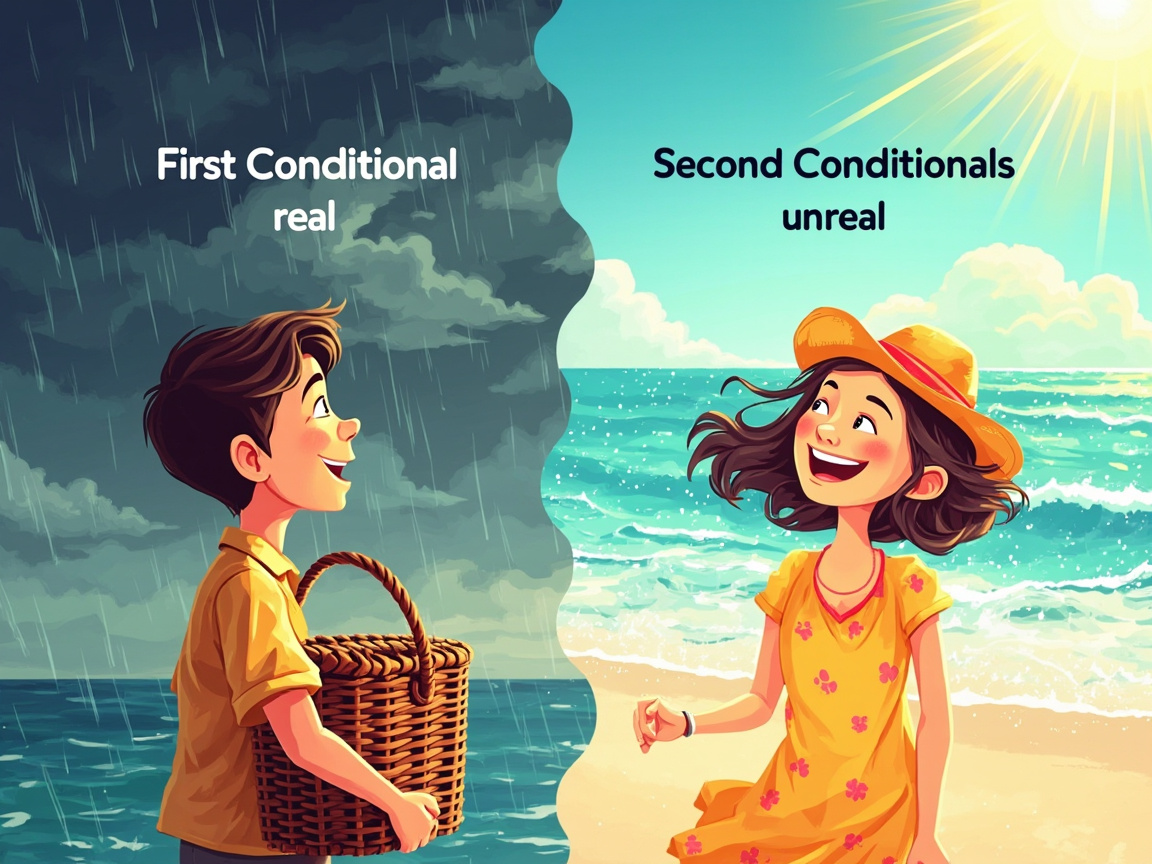
First and Second Conditional
If it rains vs If it rained — real and unreal futures explained.
Explanation
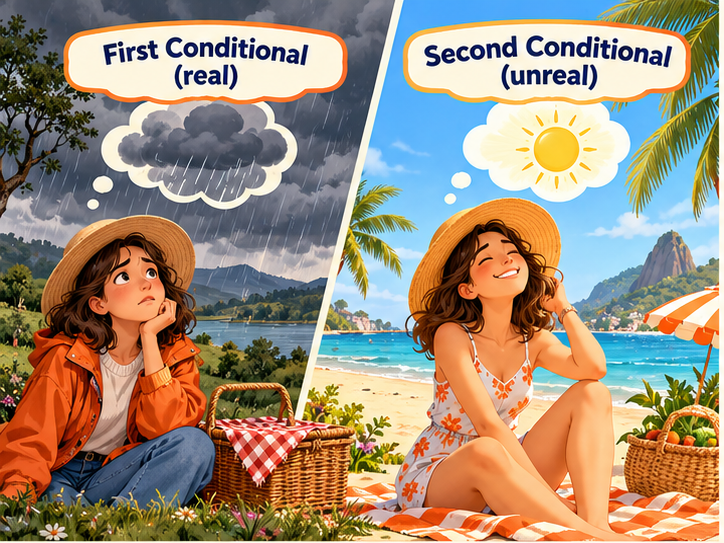
English has two common conditional structures for talking about the present or future: the First Conditional and the Second Conditional.
First Conditional = real or possible situations. We use if + present simple in the if-clause, and will + base verb in the main clause.
Form: If + present simple, … will + base verb.
- If it rains tomorrow, we will stay at home.
- If she studies hard, she will pass the exam.
Second Conditional = unreal, imaginary, or unlikely situations, often in the present or future. We use if + past simple, and would + base verb in the main clause.
Form: If + past simple, … would + base verb.
- If it rained tomorrow, we would stay at home.
- If she studied harder, she would pass the exam.
Quick tip: if is not a tense — it only joins the two clauses. The verb form after if tells you which conditional you have.
Examples
First Conditional — real or possible:
- If I finish work early, I will call you.
- If the weather is nice, we will go to the beach.
- If you don't hurry, you will miss the bus.
- If she doesn't feel better tomorrow, she will see a doctor.
Second Conditional — unreal or unlikely:
- If I won the lottery, I would buy a house by the sea.
- If he had more free time, he would learn to cook.
- If we lived in Paris, we would walk to work.
- If I were you, I would talk to the manager.
Notice: in the Second Conditional we often use were instead of was with I/he/she/it after if — this is common in formal and written English.
Common mistakes
1. Using will in the if-clause.
❌ If it will rain tomorrow, we will stay home.
✅ If it rains tomorrow, we will stay home.
2. Using the past simple after would in the Second Conditional.
❌ If I had more time, I would went to the gym.
✅ If I had more time, I would go to the gym.
3. Mixing the two conditionals in one sentence.
❌ If it rains, we would stay home.
✅ If it rains, we will stay home. (real) / If it rained, we would stay home. (unreal)
4. Using will or would at the start of the sentence.
❌ Will if you study more, you will pass?
✅ If you study more, will you pass? / If you study more, you will pass.
In real life
A short dialog between two friends, Tom and Sara, planning the weekend.
Tom: What are your plans for Saturday? Would you like to go hiking?
Sara: I'd love to, but only if the weather is good. If it rains, I will stay home and read.
Tom: That's a good idea. And if the sun shines, we will walk to the lake.
Sara: Perfect. If I were free next weekend, I would travel to the mountains, but I have to work.
Tom: No problem. If we get tired, we will stop for a coffee.
Sara: Deal! If you bring snacks, I will bring drinks.
Quiz
-
1Which tense follows 'if' in the First Conditional?
In the First Conditional, the if-clause uses the present simple (e.g., 'if it rains').
-
2In the sentence 'If I had more free time, I would learn to cook', what kind of situation is described?
The Second Conditional (if + past simple, would + base verb) is used for imaginary or unlikely situations.
-
3Which sentence is correct?
After 'if' we use the present simple, not 'will', in the First Conditional.
-
4What does the Second Conditional usually express?
The Second Conditional describes unreal, imaginary, or unlikely situations in the present or future.
-
5In the dialog, Sara says: 'If I were free next weekend, I would travel to the mountains.' Why does she use 'were' instead of 'was'?
In the Second Conditional, formal and written English often use 'were' for I/he/she/it after 'if'.