
Reported Speech: Questions and Commands
Turn direct questions and imperatives into smooth, natural reported forms.
Explanation
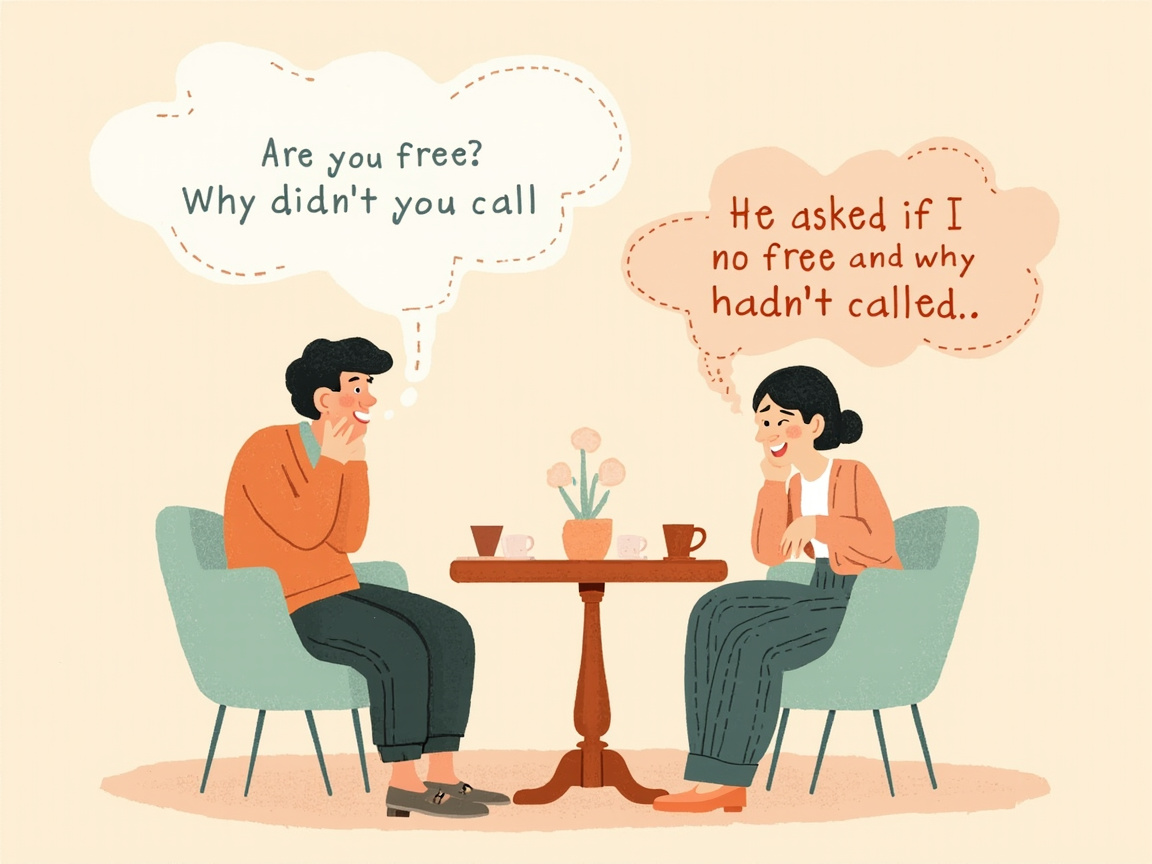
When we report questions and commands, the original words are transformed so they fit inside a normal sentence. The result is a statement, not a question or an order, so we usually need to change word order, pronouns, and tense.
Reporting questions. Yes/no questions are introduced with if or whether. Wh- questions keep their wh- word, but the verb moves into statement position. Tenses typically backshift: present simple becomes past simple, will becomes would, and can becomes could. Because the whole thing is now a statement, the question mark is dropped.
Reporting commands. We use a reporting verb such as tell, ask, order, warn, or advise, followed by the person addressed and to + base verb. Negative commands insert not before to: "not to + verb".
Examples
Here are some everyday transformations.
- Direct: "Are you coming?" → Reported: She asked if I was coming.
- Direct: "Where do you live?" → Reported: He asked me where I lived.
- Direct: "Can you help me?" → Reported: She asked whether I could help her.
- Direct: "Why did you leave early?" → Reported: My friend asked why I had left early.
- Direct: "Close the door!" → Reported: He told me to close the door.
- Direct: "Please sit down." → Reported: The host asked us to sit down.
- Direct: "Don't touch that!" → Reported: The teacher told them not to touch that.
Common mistakes
- ❌ She asked me where do I live. ✅ She asked me where I lived. (In reported questions, the word order stays like a statement.)
- ❌ He told to me to wait. ✅ He told me to wait. (Told is followed directly by the object.)
- ❌ He asked did I like coffee. ✅ He asked if I liked coffee. (Use if or whether for yes/no questions.)
- ❌ "Don't run!" He told not to run. ✅ He told them not to run. (Always include the person addressed.)
- ❌ "What time is it?" She asked what time was it. ✅ She asked what time it was. (Statement word order again.)
In real life
Anna and Ben talk about a job interview.
Anna: How was the interview?
Ben: Quite intense. The manager asked me why I had left my last job. Then she asked if I could start next month and whether I was willing to travel.
Anna: What did you say?
Ben: I told her I could start in two weeks. She also told me not to give up my hobbies, which was kind. Finally, she ordered me to call HR by Friday.
Quiz
-
1According to the article, which words are used to report a yes/no question?
The article explains that yes/no questions are reported with 'if' or 'whether'.
-
2Which reporting verb is most commonly used with commands in the article?
The article shows 'told' as a typical reporting verb for commands, followed by a person and 'to + base verb'.
-
3What happens to the wh- word in a reported question such as 'Where do you live?'
The article explains that wh- words are kept but the verb order changes to match a normal statement.
-
4How would you report the command 'Don't be late!'?
The article shows that negative commands use 'told + person + not to + verb'.
-
5What typically happens to the question mark when a direct question is reported?
The article notes that reported questions are statements, so the question mark is dropped.