Relative Clauses Mastery: Defining vs. Non-Defining Explained
Learn to distinguish between essential and non-essential information using relative clauses with confidence.
Explanation
Relative clauses are dependent clauses that provide additional information about a noun in the main clause. They begin with a relative pronoun such as who, whom, which, that, whose, where, or when.
There are two main types:
Defining relative clauses (also called restrictive) give essential information that identifies the noun. Without this information, the meaning of the sentence would be incomplete or unclear. These clauses are not separated by commas.
Non-defining relative clauses (also called non-restrictive) provide extra information that could be removed without changing the core meaning of the sentence. They are always separated by commas (or a comma and period at the end).
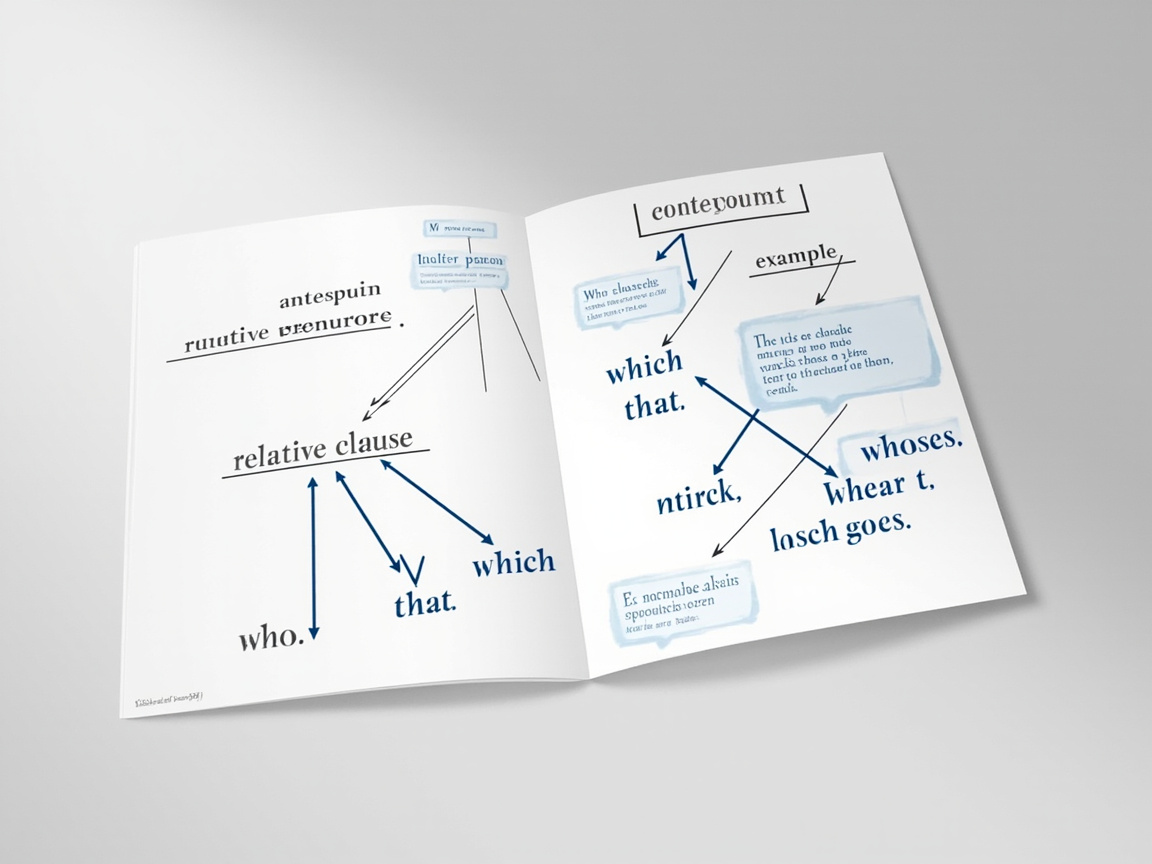
The choice of relative pronoun depends on the noun being described and its grammatical function within the clause:
- Who and whom refer to people (subject and object respectively)
- Which refers to things and animals
- That can refer to people or things, but only in defining clauses
- Whose shows possession (people or things)
- Where, when, and why replace prepositional phrases of place, time, and reason in defining clauses
Examples
Defining clauses (no commas):
1. The woman who lives next door is a doctor.
2. The book that I bought yesterday is on the table.
3. He is the only student whose homework was perfect.
4. That's the café where we met.
Non-defining clauses (with commas):
1. My sister, who lives in Paris, is visiting next week.
2. The Eiffel Tower, which was built in 1889, is a famous landmark.
3. Mr. Johnson, whose car broke down, arrived late to the meeting.
4. Next summer, when the weather improves, we plan to travel.
Common mistakes
Learners often make these errors:
1. Adding commas in defining clauses
✗ The students , who passed the exam received certificates.
✓ The students who passed the exam received certificates.
2. Forgetting commas in non-defining clauses
✗ My brother , lives in Australia.
✓ My brother, lives in Australia.
3. Using "that" in non-defining clauses
✗ London, that is the capital of England, has many museums.
✓ London, which is the capital of England, has many museums.
4. Incorrect relative pronoun choice
✗ The man which told me the news was kind.
✓ The man who told me the news was kind.
5. Omitting the relative pronoun when needed
✗ The book I bought yesterday is interesting.
✓ The book that/which I bought yesterday is interesting. (in formal writing)
In real life
Setting: A job interview. Sarah is the interviewer, and David is the candidate.
Sarah: I see you worked at TechCorp, which was acquired last year. Can you tell me about that experience?
David: Of course. The company that I worked for had about 200 employees. I was responsible for project management.
Sarah: That's interesting. And your supervisor, who has extensive industry experience, would be a good reference?
David: Absolutely. Mr. Anderson, whose leadership guided my professional growth, agreed to recommend me.
Sarah: Perfect. Do you have any questions about the position where you'd be working?
David: Yes, I'd like to know more about the team whom I'll be collaborating with.
Sara smiles and continues the interview.
اختبر نفسك
-
1What is the main function of a relative clause?
Relative clauses are dependent clauses that provide additional information about a noun in the main clause.
-
2How can you distinguish between defining and non-defining relative clauses?
Defining clauses are not separated by commas, while non-defining clauses are always separated by commas.
-
3Which relative pronoun should be used when referring to a person as the subject of the relative clause?
Who refers to people as subjects, while whom refers to people as objects, and which refers to things.
-
4What is wrong with the sentence: 'The man which told me the news was kind'?
'Which' should be replaced with 'who' because it refers to a person (the man), and who is used for people as subjects.
-
5In the dialogue, why does Sarah say 'where you'd be working' when asking about the position?
'Where' replaces prepositional phrases of place in defining clauses, such as 'the position in which you'd be working'.