مفردات لا بدّ منها
| الكلمة | العربية | Deutsch | Español | Français | Italiano |
|---|---|---|---|---|---|
| بوق نحاسي صغير | Kornett | corneta | cornet | corno | |
| سكتة دماغية | Schlaganfall | derrame cerebral | AVC | ictus | |
| مسابقة | Wettbewerb | concurso | concours | concorso | |
| طريقة وضع الشفاه | Mundstückansatz | embocadura | embouchure | imboccatura | |
| الاعتدال | Mäßigung | templanza | tempérance | temperanza | |
| كوخ ريفي | Häuschen | casa de campo | chaumière | casetta | |
| عنيد | stur | terco | têtu | testardo | |
| صادق | aufrichtig | genuino | sincère | autentico | |
| كفء | kompetent | competente | compétent | competente | |
| مؤلم | schmerzend | doloroso | douloureux | dolorante |
القصة
The call came on a grey Tuesday morning. Eleanor was at her desk in Manchester when her phone buzzed with a number she had not seen in three years. Her mother's voice was steady but fragile. "Nana's had a stroke, love. She's stable, but Granddad collapsed at the practice room. He's awake, but he's not himself."
Eleanor had not visited her grandparents in Newark since the argument at her grandmother's seventieth birthday. Words had been spoken that could not be taken back. She had been twenty-three, stubborn, and convinced she was right. Now she was twenty-six, and the distance she had created seemed suddenly insignificant.
She drove south that afternoon, rehearsing apologies she had never imagined making. The cottage on the edge of the village looked smaller than she remembered. Her grandmother opened the door, thinner and greyer, but with the same sharp eyes. "Upstairs," she said simply. "He's been asking for you."
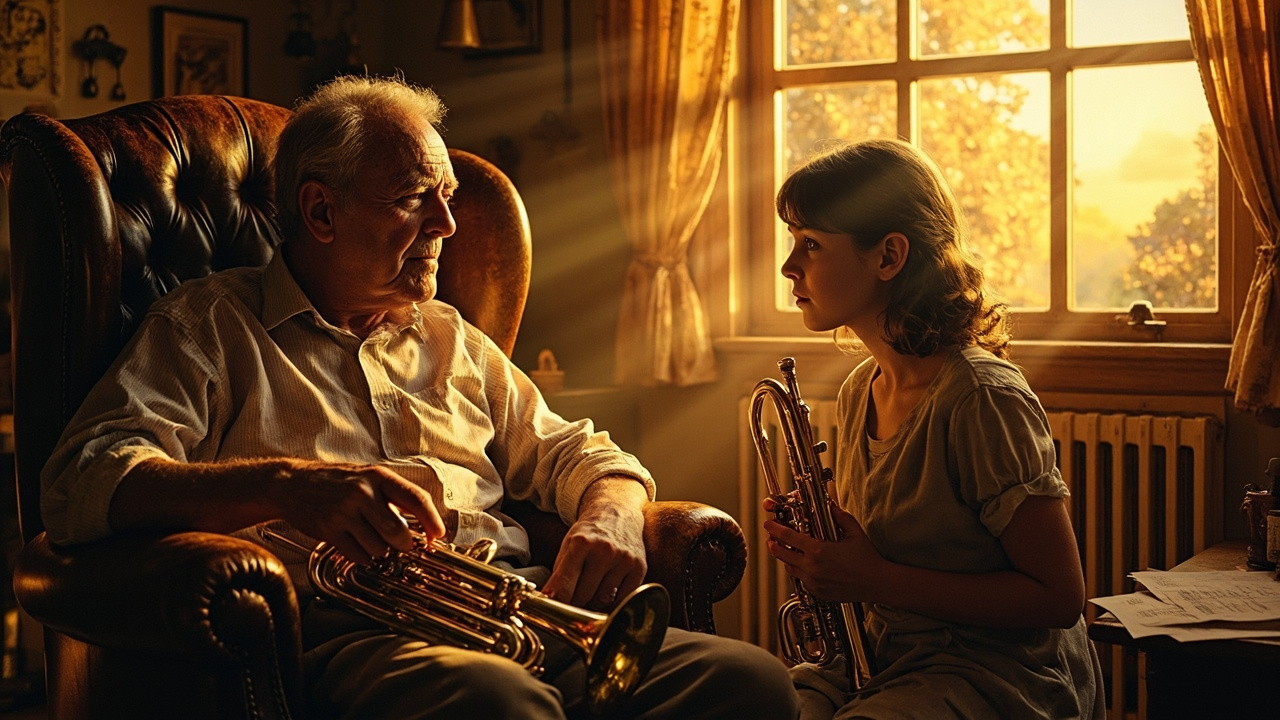
Her grandfather sat in the armchair by the window, his silver cornet resting across his lap. The right side of his face had softened, and his speech came slowly now, carefully. But when he saw Eleanor, he smiled—a genuine smile that made her chest ache.
"They found it early," her grandmother explained later. "The doctors say he'll recover most of his movement, but not in time for the contest. He's missed only one in forty years, Eleanor. He can't bear the thought of letting the band down."
The Nottinghamshire Annual Brass Band Contest was in eight days. Her grandfather's band, the Newark Temperance, had won their section for the past three years. And now their musical director was unable to play.
Eleanor had not touched a brass instrument since school. She had been forced to learn the cornet at eleven, had hated every squeaky note, and had quit at thirteen the moment she was allowed. Her grandfather had been disappointed but had not argued. That had been the beginning of the distance, though neither of them had recognised it then.
"I'll do it," she said, surprising herself. Her grandmother's eyebrows rose. Her grandfather looked at her for a long moment, then nodded slowly.
What followed were the most exhausting eight days of Eleanor's life. Her grandfather taught her from his chair, correcting her embouchure, adjusting her hand position, playing the melody on an old cassette recorder so she could hear every nuance. He was patient in a way she had never witnessed before, perhaps because he had no choice but to be.
"Music is not about perfection," he told her on the fourth evening. "It is about feeling. You must listen to the story the composer is telling." He gestured for her to play the piece again. "Now, this passage. It should sound like longing. Like someone waiting for someone who has gone away."
She understood then what he had been trying to teach her all those years ago, what she had been too young and too angry to hear. Music was his language of love. He had not pushed her because he had wanted her to find her own way to it.
By the seventh day, she could play the contest piece without error. It was not beautiful, not yet, but it was competent. More importantly, she and her grandfather had rebuilt something that neither of them had realised they had lost.
The day of the contest dawned clear and bright. Eleanor stood in the back row of the Newark Temperance, her grandfather's cornet in her hands, and played every note with everything she had. The band did not win that year. They came second, losing to a section from Derby by half a point.
But as they filed out of the concert hall, her grandfather reached out and squeezed her hand. It was the most he could manage, and it was enough. They had played together. And tomorrow, they would begin again.