مفردات لا بدّ منها
| الكلمة | العربية | Deutsch | Français | Русский |
|---|---|---|---|---|
| التطريز والخفق | steppen | piqûre de matelasage | стежка | |
| خياطة | Näherin | couturière | швея | |
| شفرة مورس | Morsecode | code Morse | азбука Морзе | |
| رسولة | Kurier | messager | курьер | |
| احتلال | Besatzung | occupation | оккупация | |
| مقاومة | Widerstand | résistance | сопротивление | |
| إصبع خياطة | Fingerhut | dé à coudre | наперсток | |
| سداسي الأضلاع | Sechseck | hexagone | шестиугольник | |
| إرث | Erbe | héritage | наследство | |
| إحداثيات | Koordinaten | coordonnées | координаты |
القصة
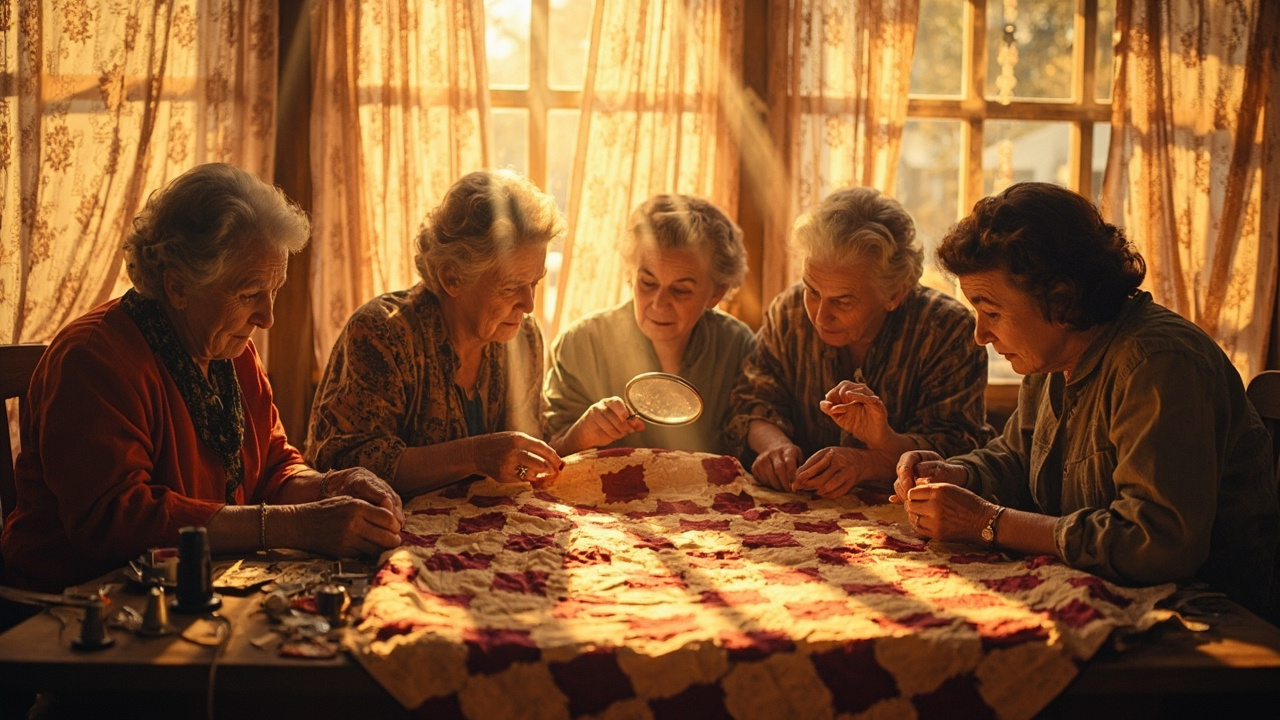
Eleanor had inherited many things from her grandmother when she passed: a cottage by the river, a collection of silver thimbles, and a stack of unfinished quilts wrapped in faded cotton sheets. Among the elderly women who gathered every Thursday afternoon in the community hall, Eleanor was the newest member, still learning the delicate art of threading a needle with the precision the others possessed.
"Your grandmother made this one," said Margaret, running her weathered fingers across a hexagon pattern of deep burgundy and cream. "She was the finest seamstress in the village. We used to call her our queen bee."
Dorothy, who rarely spoke but observed everything, leant forward to examine the quilt more closely. "There's something odd about this stitch pattern here. It's different from the rest."
The women gathered around as Dorothy pointed to a sequence of tiny stitches along the border, so fine they were barely visible. Margaret squinted through her spectacles. "It's Morse code," she breathed. "I'd recognise it anywhere. My father taught it to me during the war."
A shiver passed through the room, though the afternoon sun streamed warmly through the windows. The women had all grown up during the Second World War, children of a generation who had lived with secrets and silences, with ration books and coded whispers.
Over the following weeks, the quilting circle became something else entirely. They examined every quilt in Eleanor's inheritance with magnifying glasses and growing excitement. Pattern after pattern revealed hidden messages: stitches marking coordinates, fabric colours indicating safe houses, and seemingly random arrangements of stars that actually spelled out names.
"They were couriers," Eleanor realised one evening, her voice trembling as the full picture emerged. "Our grandmothers. They carried messages across enemy lines, right under the occupation's nose, hidden in their quilting."
Dorothy produced a letter she had found pressed between the layers of one particularly old quilt, its paper so thin it seemed almost transparent. The handwriting belonged to Eleanor's grandmother.
"If you are reading this, the work is finished. We completed what we started, but some secrets must wait for safer times. The river crossing at Hollis Bridge: seven souls saved. The blacksmith's cellar: twelve more. Remember us kindly, girls. We did what we could with what we had."
Margaret wiped her eyes with the back of her hand. "They never told us. All those years, meeting here, sewing together, and they never said a word."
Eleanor folded the letter carefully and placed it back among the quilts. "Perhaps they didn't need to. Perhaps they trusted that someday, we would understand."
The Thursday meetings continued, but they were different now. The women worked with new purpose, adding their own stitches to patterns that told stories of courage and quiet resistance. And though the war had ended decades ago, the secret language of thread and fabric lived on, passed down through generations of women who had always known that some messages needed to be sewn, not spoken.