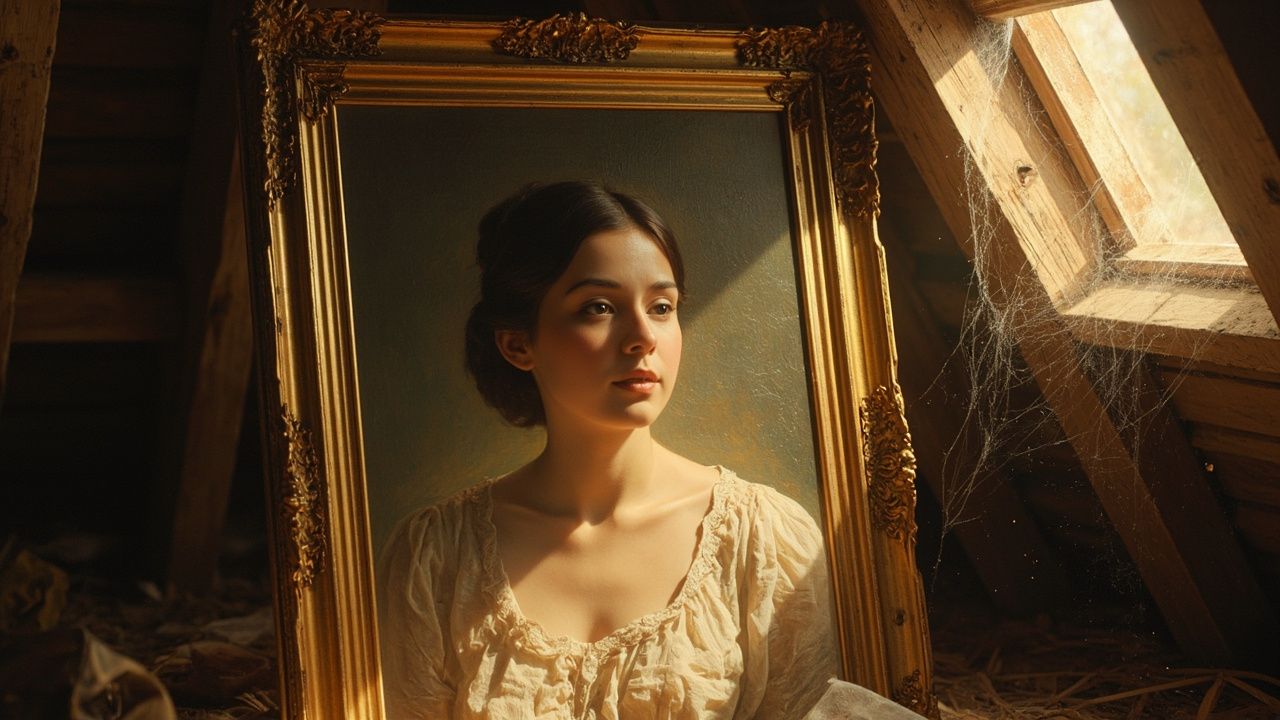
كان المنزل قد يخص جدتنا منذ أن يتذكر أي شخص. عندما توفيت إلينور في الثالثة والتسعين من عمرها، اجتمع أقاربها لتفريغ العقار قبل بيعه. كان عملاً مرهقاً، يفصلون بين ذكريات متراكمة عبر عقود، يقررون ما يجب الاحتفاظ به وما يجب التخلص منه.
كانت عمتي هي من وجدت اللوحة. فقد تسلقت إلى العلية المتربة، حيث لم يذهب أحد منذ سنوات، وخرجت تحمل شيئاً كبيراً ملفوفاً في قماش بالي. تجمعنا حول طاولة المطبخ وهي تفكّه بعناية.
كانت الصورة رائعة. لوحة زيتية لامرأة شابة، ربما في العشرينات من عمرها، رسمت بمهارة فائقة. كان لديها شعر داكن مرفوع بأناقة فوق وجهها، وترتدي قميصاً أبيض بسيطاً. كان تعبيرها متأملاً، Almost melancholic، كما لو كانت غارقة في ذكرى خاصة.
"يا إلهي،" همست أمي. "إنها تبدو تماماً مثل..."
كنا جميعاً نعرف ما كانت ستقوله. كان التشابه مع جدتنا مذهلاً. نفس العيون الداكنة، نفس خط الفك الحازم، نفس العبوس الطفيف بين الحاجبين. ومع ذلك، لم تذكر جدتنا هذه اللوحة أبداً، ولم hint أبداً لأي شخص في العائلة قد يكون قد كلف بعمل كهذا.
"ربما هي قريبة،" اقترح عمّي. "شخص من الأجيال السابقة."
بحثنا خلال صناديق الصور والوثائق، لكننا لم نجد تفسيراً. كانت هناك صور لجدتنا وهي شابة، دائماً مبتسمة، دائماً مرحة، لكن لا شيء عن هذه الشخصية الجادة والفنية. أخيراً، في قاع صندوق قديم، اكتشفنا حزمة من الرسائل مربوطة بشريط باهت.
العناوين كانت لشخص يدعى روز. كان الخط أنيقاً، Almost theatrical. بينما كنت أقرأها بصوت عالٍ للعائلة، emerged قصة رائعة.
يبدو أن روز قد غادرت إنجلترا في ثلاثينيات القرن العشرين لدراسة الفن في فيينا. هناك التقت امرأة شابة أخرى تدعى آيفي، وأصبحتا لا يفترقان. لم يكونا مجرد صديقتين، كما sugerowane في الرسائل، بل شيئاً أعمق، شيئاً لم تكنSociety تلك الحقبة ستقبله بسهولة.
"عندما стала Situation السياسية خطيرة،" read one letter، "عرفت أنني يجب أن أهرب. لكنني عرفت أيضاً أنني لا أستطيع أبداً أن أترككِ خلفك. سنجد طريقة، حبيبتي. سنجد دائماً طريقة."
كان آخر خطاب مؤرخ عام 1939. تحدث عن portrait تم رسمه كهدية، طريقة لحمل بعضنا البعض عبر أي مسافة قد تفصلنا. أعرب الكاتب عن أمله في Reunite قريباً.
لم تكن هناك مراسلات لاحقة.
"روز،" قالت أمي ببطء. "هذا كان اسم جدتنا."
فجأة أصبح كل شيء منطقياً. جدتنا، المرأة التي عرفناها كأرملة لطيفة لكنها متحفظة، كانت قد lived حياة مختلفة تماماً قبل أن تتزوج من جدنا. كانت شابة وشجاعة ومحبوبة. كانت قد سافرت إلى أوروبا ودرست الفن. كانت قد عرفت شخصاً يدعى آيفي، شخصاً يبدو تماماً مثلها.
وبطريقة ما، لأسباب tidak erklären الرسائل، انفصلا. عادت روز إلى إنجلترا، وتزوجت، وأنشأت عائلة، ولم تتحدث أبداً عن تلك الفترة مرة أخرى. remained اللوحة مخفية في العلية، تنتظر reveal أسرارها.
لم نكتشف أبداً ما حدث لآيفي، أو لماذا عادت روز وحدها. ربما كانت الحرب قد فرقتهما. ربما كانت هناك أشياء مؤلمة جداً للتذكر. لكن عندما أنظر الآن إلى اللوحة المعلقة في ممري، أشعر بالارتباط بجزء من حياة جدتي لم أكن أعرف بوجوده.
كانت قد أبقت Self الحقيقية الخاصة بها مخفية لمدة ثمانين عاماً. لكن لم تستطع إخفائها إلى الأبد.
Das Haus hatte ihrer Großmutter gehört, solange sich jeder erinnern konnte. Als Eleanor im Alter von dreiundneunzig Jahren starb, versammelte sich ihre Familie, um das Anwesen vor dem Verkauf zu räumen. Es war eine ermüdende Arbeit, angesammelte Erinnerungen aus Jahrzehnten zu sortieren und zu entscheiden, was behalten und was weggeworfen werden sollte.
Meine Tante war es, die das Gemälde fand. Sie war auf den staubigen Dachboden gestiegen, wo sich seit Jahren niemand mehr hingewagt hatte, und kam mit einem großen, in ein von Motten zerfressenes Tuch eingewickelten Gegenstand wieder herunter. Wir versammelten uns um den Küchentisch, während sie es vorsichtig auswickelte.
Das Porträt war großartig. Ein Ölgemälde einer jungen Frau, vielleicht in ihren Zwanzigern, mit außerordentlicher Kunstfertigkeit dargestellt. Sie hatte dunkles Haar, elegant über ihrem Gesicht hochgesteckt, und trug eine einfache weiße Bluse. Ihr Ausdruck war nachdenklich, fast melancholisch, als wäre sie in irgendeiner privaten Erinnerung versunken.
"Meine Güte," flüsterte meine Mutter. "Sie sieht genauso aus wie..."
Wir wussten alle, was sie sagen wollte. Die Ähnlichkeit mit unserer Großmutter war verblüffend. Dieselben dunklen Augen, dieselbe entschlossene Kieferlinie, dieselbe leichte Stirnfalte zwischen den Augenbrauen. Und doch hatte unsere Großmutter dieses Porträt nie erwähnt, nie auf irgendjemanden in der Familie hingewiesen, der ein solches Werk in Auftrag gegeben haben könnte.
"Vielleicht ist es eine Verwandte," schlug mein Onkel vor. "Jemand aus früheren Generationen."
Wir durchsuchten Kartons mit Fotos und Dokumenten, fanden jedoch keine Erklärung. Es gab Bilder unserer Großmutter als junge Frau, immer lächelnd, immer fröhlich, aber nichts von dieser ernsten, künstlerischen Figur. Schließlich entdeckten wir am Boden einer alten Truhe ein Bündel Briefe, die mit verblasstem Band zusammengebunden waren.
Die Briefe waren an jemanden namens Rose adressiert. Die Handschrift war elegant, fast theatralisch. Als ich sie der Familie vorlas, enthüllte sich eine bemerkenswerte Geschichte.
Rose, wie sich herausstellte, hatte England in den 1930er Jahren verlassen, um Kunst in Wien zu studieren. Dort lernte sie eine andere junge Frau namens Ivy kennen, und die beiden wurden unzertrennlich. Sie waren nicht nur Freundinnen, wie die Briefe nahelegten, sondern etwas Tieferes, etwas, das die Gesellschaft dieser Ära nicht leicht akzeptiert hätte.
"Als die politische Situation gefährlich wurde," hieß es in einem Brief, "wußte ich, dass ich fliehen musste. Aber ich wusste auch, dass ich dich niemals zurücklassen könnte. Wir würden einen Weg finden, meine Liebste. Wir würden immer einen Weg finden."
Der letzte Brief war auf 1939 datiert. Darin war von einem Porträt die Rede, das als Geschenk gemalt worden war, als eine Art, einander über welche Entfernung auch immer hinweg zu tragen. Der Verfasser drückte die Hoffnung aus, dass sie sich bald wiedersehen würden.
Es gab keine weitere Korrespondenz.
"Rose," sagte meine Mutter langsam. "Das war der Name unserer Großmutter."
Plötzlich ergab alles einen Sinn. Unsere Großmutter, die Frau, die wir als freundliche, aber zurückhaltende Witwe gekannt hatten, hatte ein völlig anderes Leben geführt, bevor sie unseren Großvater heiratete. Sie war jung und mutig und verliebt gewesen. Sie hatte Europa bereist und Kunst studiert. Sie hatte jemanden namens Ivy gekannt, jemanden, der genau wie sie aussah.
Und irgendwie, aus Gründen, die die Briefe nicht erklärten, waren sie getrennt worden. Rose war nach England zurückgekehrt, hatte geheiratet, eine Familie gegründet und nie wieder von dieser Zeit gesprochen. Das Porträt war im Dachboden verborgen geblieben und wartete darauf, seine Geheimnisse zu enthüllen.
Wir haben nie herausgefunden, was aus Ivy geworden ist oder warum Rose allein zurückkam. Vielleicht hatte der Krieg sie getrennt. Vielleicht gab es Dinge, die zu schmerzhaft waren, um sich zu erinnern. Aber wenn ich jetzt das Porträt ansehe, das in meinem Flur hängt, fühle ich mich mit einem Teil von meiner Großmutters Leben verbunden, von dem ich nie wusste, dass er existierte.
Sie hatte ihr wahres Ich achtzig Jahre lang verborgen gehalten. Aber sie konnte es nicht für immer verstecken.
La maison appartenait à leur grand-mère depuis aussi longtemps que l'on puisse se souvenir. Lorsque Éleanor s'est éteinte à quatre-vingt-treize ans, sa famille s'est réunie pour vider la propriété avant la vente. C'était un travail épuisant, triant des décennies de souvenirs accumulés, décider quoi garder et quoi jeter.
C'était ma tante qui a trouvé le tableau. Elle était montée au grenier poussiéreux, où personne ne s'était aventuré depuis des années, et en était ressortie serrant un grand objet enveloppé dans un chiffon mangé par les mites. Nous nous sommes rassemblés autour de la table de cuisine pendant qu'elle le déballait soigneusement.
Le portrait était magnifique. Une peinture à l'huile d'une jeune femme, peut-être dans la vingtaine, rendue avec une habileté extraordinaire. Elle avait les cheveux sombres relevés élégamment au-dessus de son visage, et portait un simple corsage blanc. Son expression était pensive, presque mélancolique, comme si elle était perdue dans quelque souvenir privé.
"Mon Dieu," a murmuré ma mère. "Elle ressemble exactement à..."
Nous savions tous ce qu'elle allait dire. La ressemblance avec notre grand-mère était frappante. Les mêmes yeux sombres, la même mâchoire déterminée, le même léger froncement de sourcils entre les sourcils. Pourtant, notre grand-mère n'avait jamais mentionné ce portrait, n'avait jamais laissé entendre l'existence de quiconque dans la famille pouvant avoir commandé une telle œuvre.
"Peut-être est-ce une parente," a suggéré mon oncle. "Quelqu'un des générations précédentes."
Nous avons fouillé dans des boîtes de photographies et de documents, mais n'avons trouvé aucune explication. Il y avait des photos de notre grand-mère jeune femme, toujours souriante, toujours joyeuse, mais rien de cette figure sérieuse et artistique. Finalement, au fond d'une vieille malle, nous avons découvert un paquet de lettres liées d'un ruban fané.
Les lettres étaient adressées à quelqu'un nommé Rose. L'écriture était élégante, presque théâtrale. Pendant que je les lisais à voix haute à la famille, une histoire remarquable a émergé.
Rose, semble-t-il, avait quitté l'Angleterre dans les années 1930 pour étudier l'art à Vienne. Là, elle avait rencontré une autre jeune femme nommée Ivy, et les deux étaient devenues inséparables. Elles n'étaient pas simplement des amies, comme le suggéraient les lettres, mais quelque chose de plus profond, quelque chose que la société de cette époque n'aurait pas facilement accepté.
"Quand la situation politique est devenue dangereuse," lisait-on dans une lettre, "j'ai su que je devais fuir. Mais je savais aussi que je ne pourrais jamais te laisser derrière moi. Nous trouverions un moyen, ma chère. Nous trouverions toujours un moyen."
La dernière lettre était datée de 1939. Elle parlait d'un portrait qui avait été peint comme un cadeau, une façon de s'emporter l'une l'autre à travers quelque distance qui pourrait les séparer. L'auteur exprimait l'espoir qu'elles seraient bientôt réunies.
Il n'y avait plus de correspondance.
"Rose," a dit ma mère lentement. "C'était le nom de notre grand-mère."
Soudain, tout a pris sens. Notre grand-mère, la femme que nous avions connue comme une veuve gentille mais réservés, avait vécu une vie entièrement différente avant d'épouser notre grand-père. Elle avait été jeune et brave et amoureuse. Elle avait voyagé en Europe et étudié l'art. Elle avait connu quelqu'un nommé Ivy, quelqu'un qui lui ressemblait exactement.
Et somehow, pour des raisons que les lettres n'expliquaient pas, elles avaient été séparées. Rose était retournée en Angleterre, s'était mariée, avait élevé une famille, et n'avait plus jamais parlé de cette période. Le portrait était resté caché dans le grenier, attendant de révéler ses secrets.
Nous n'avons jamais découvert ce qui était arrivé à Ivy, ni pourquoi Rose était revenue seule. Peut-être que la guerre les avait séparées. Peut-être qu'il y avait des choses trop douloureuses à se rappeler. Mais en regardant le portrait maintenant, accroché dans mon couloir, je me sens connectée à une partie de la vie de ma grand-mère dont je ne savais pas l'existence.
Elle avait gardé son vrai moi caché pendant quatre-vingts ans. Mais elle ne pouvait pas le cacher pour toujours.
Дом принадлежал их бабушке с незапамятных времён. Когда Элеанор скончалась в девяносто три года, её семья собралась, чтобы разобрать имущество перед продажей. Это была изнурительная работа — сортировать накопленные за десятилетия воспоминания, решать, что оставить, а что выбросить.
Моя тётя нашла картину. Она забралась на пыльный чердак, куда годами никто не заходил, и вышла оттуда, сжимая большой предмет, завёрнутый в истлевшую ткань. Мы собрались вокруг кухонного стола, пока она аккуратно его распаковывала.
Портрет был великолепен. Масляная живопись молодой женщины, возможно, лет двадцати с небольшим, исполненная с необыкновенным мастерством. У неё были тёмные волосы, изящно собранные над лицом, и она носила простую белую блузку. Её выражение было задумчивым, почти меланхоличным, словно она погрузилась в какое-то личное воспоминание.
«Боже мой,» — прошептала моя мать. «Она выглядит точно как...»
Мы все понимали, что она хотела сказать. Сходство с нашей бабушкой было поразительным. Такие же тёмные глаза, такой же решительный подбородок, такой же лёгкий хмурый взгляд между бровей. И всё же наша бабушка никогда не упоминала этот портрет, никогда не намекала ни на кого из семьи, кто мог бы заказать такое произведение.
«Возможно, это родственница,» — предположил мой дядя. «Кто-то из более ранних поколений.»
Мы перерыли коробки с фотографиями и документами, но не нашли объяснения. Были фотографии нашей бабушки в молодости, всегда улыбающейся, всегда жизнерадостной, но ничего об этой серьёзной, художественной фигуре. Наконец, на дне старого сундука мы обнаружили связку писем, перевязанных выцветшей лентой.
Письма были адресованы кому-то по имени Роуз. Почерк был изящным, почти театральным. Когда я прочитал их вслух для семьи, раскрылась удивительная история.
Оказалось, что Роуз уехала из Англии в 1930-х годах, чтобы изучать искусство в Вене. Там она встретила другую молодую женщину по имени Айви, и они стали неразлучны. Они были не просто подругами, как следовало из писем, а чем-то более глубоким, чем общество той эпохи не могло легко принять.
«Когда политическая ситуация стала опасной,» — говорилось в одном письме, — «я поняла, что должна бежать. Но я также знала, что никогда не смогу оставить тебя позади. Мы найдём способ, моя дорогая. Мы всегда найдём способ.»
Последнее письмо было датировано 1939 годом. В нём говорилось о портрете, который был написан в подарок, как способ нести друг друга через любые расстояния, которые могли их разлучить. Автор выражала надежду на скорое воссоединение.
Дальнейшей переписки не было.
«Роуз,» — медленно произнесла моя мать. «Так звали нашу бабушку.»
Внезапно всё встало на свои места. Наша бабушка, женщина, которую мы знали как добрую, но замкнутую вдову, прожила совершенно другую жизнь до того, как вышла замуж за нашего деда. Она была молодой, смелой и влюблённой. Она путешествовала по Европе и изучала искусство. Она знала кого-то по имени Айви, кого-то, кто выглядел точно как она.
И каким-то образом, по причинам, которых письма не объясняли, их разлучили. Роуз вернулась в Англию, вышла замуж, создала семью и никогда больше не вспоминала об этом периоде. Портрет оставался спрятанным на чердаке, ожидая, когда раскроет свои секреты.
Мы так и не узнали, что случилось с Айви или почему Роуз вернулась одна. Возможно, война разлучила их. Возможно, были вещи слишком болезненные, чтобы о них помнить. Но когда я смотрю сейчас на портрет, висящий в моём коридоре, я чувствую связь с частью жизни моей бабушки, о существовании которой я даже не подозревал.
Она скрывала свою истинную сущность восемьдесят лет. Но она не могла скрывать это вечно.