مفردات لا بدّ منها
| الكلمة | العربية | Deutsch | Français | Русский |
|---|---|---|---|---|
| قارب كاياك | Kajak | kayak | байдарка | |
| متعرج | gewunden | sinueux | извилистый | |
| غير مربوط | losgebunden | détaché | отвязанный | |
| حصى شاطئي | Kies | gravier | галька | |
| طمي | Schlick | limon | ил | |
| نظام بيئي | Ökosystem | écosystème | экосистема | |
| المياه الجوفية | Grundwasserspiegel | nappe phréatique | уровень грунтовых вод | |
| عرق معدني | Mineralader | veine minérale | минеральный пласт | |
| مؤقت | behelfsmäßig | de fortune | временный | |
| تحدي | trotzig | défiant | вызывающий |
القصة
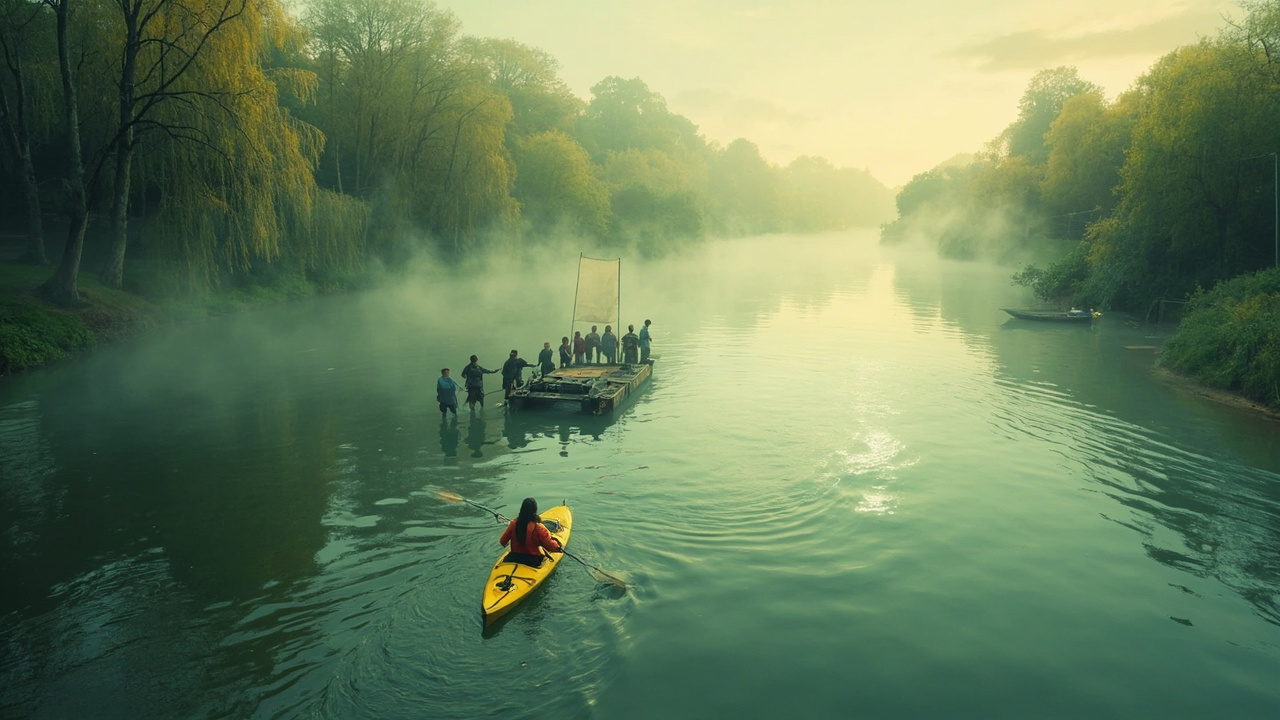
The morning mist clung to the water like a damp shroud as Clara pushed her kayak away from the muddy bank. She had been planning this journey for months — four days alone on the Blackwater River, navigating its meandering course through the remoter reaches of the county where mobile signal was merely a rumour and the only map was the one she'd been handed by a grizzled man in the village pub. "Keep going until the river tells you to stop," he'd said, which she'd taken for the cantankerous advice of someone who'd had one pint too many.
By the second day, the river had grown narrower and the overhanging willows had drawn their branches across the water like interlacing fingers, forcing her to duck beneath them. The silence was immense. No traffic, no aircraft, no distant lawnmowers — only the rhythmic dip of her paddle and the occasional cry of a kingfisher, electric blue against the grey-green reeds. She felt, for the first time in years, genuinely untethered from the modern world, and the sensation was intoxicating.
It was on the morning of the third day that she rounded a bend and found them: a dozen people standing thigh-deep in the river, their arms linked, their faces turned upstream with the grim determination of those who had chosen their battlefield. A makeshift raft moored to the bank bore a banner fashioned from bedsheets, the hand-painted letters reading NO NEW PIPELINE in defiant scarlet. Clara brought her kayak to a halt, caught between curiosity and the instinct to paddle on and pretend she'd seen nothing.
"You'd better pull over," called a woman wading towards the shallows. She was perhaps sixty, with steel-grey hair scraped back from a weathered face and wellies sunk deep in the silt. "You're right in the path of the survey boat."
Clara complied, dragging her kayak onto a small shingle beach. "What's going on here?"
"What's going on," the woman said, and her voice carried the weight of someone who had rehearsed this speech a hundred times, "is that the Northbrook Energy Consortium intends to bore a pipeline directly beneath this river. They claim it won't affect the ecosystem. They claim many things. But they are lying."
Her name was Joan Marsh. She had lived in the village of Thornwick, four miles downstream, for her entire life, and it was Joan who, over a thermos of tea passed hand to hand among the protesters, first mentioned the old village of Harrowgate.
"It stood on the banks here," Joan said, gesturing to the tree line where the willows thickened into an almost impenetrable wall. "Hundreds of people. A church, a school, three pubs. Drowned in 1952 when the reservoir was built. Or so the official story goes."
"Or so the official story goes?" Clara repeated.
Joan's eyes narrowed. "The reservoir was the excuse. What they really wanted was the water table beneath the valley. Something else was happening here, something the county records have been very careful not to mention. And now, would you believe it, they've found a mineral seam running directly beneath where Harrowgate once stood. Convenient, wouldn't you say?"
That evening, with the protest camp settling into its quiet rhythms, Clara paddled alone upstream to where Joan had indicated. The river here widened into something almost like a lake, its surface dark and still under the dying light. And there, just beneath the surface — or so it seemed — she could make out the ghostly outlines of stone walls, the suggestion of doorways, the dark arch of what might once have been a bridge. It was not imagination. The water was extraordinarily clear, and there they were: the remains of a village preserved in an eerie underwater tableau, perfectly still as though its inhabitants had simply walked away and left their homes to the river's slow embrace.
Clara sat motionless in her kayak, her paddle dripping, and felt the strange double weight of the place — the ecological protest above and the drowned village below, two chapters of dispossession separated by seven decades but bound together by the same old impulse: to take what lies beneath the surface and never mind who gets drowned in the process.
She paddled back to the camp in the gathering dark. Joan was sitting by the fire, feeding a stick into the flames, and when Clara sat down beside her she said nothing, only passed her a cup of tea. They sat together in comfortable silence, listening to the river whisper against its banks.
"Will you stay?" Joan asked eventually.
Clara looked at the fire, at the dark water beyond, at the faces of the sleeping protesters. She thought of Harrowgate, of its vanished streets and the lives that had once filled them. She thought of what it meant to refuse to look away.
"I'll stay," she said. And she did.