مفردات لا بدّ منها
| الكلمة | العربية | Deutsch | Français | Русский |
|---|---|---|---|---|
| ترميم | Restaurierung | restauration | реставрация | |
| مشرف | Vorarbeiter | chef d'équipe | прораб | |
| بروسينيوم | Bühnenproscenium | proscenium | просцениум | |
| أكانثوس | Akanthus | acanthe | акакант | |
| ضريح | Mausoleum | mausolée | мавзолей | |
| تناقض | Abweichung | divergence | расхождение | |
| حفظ وترميم | Konservierung | conservation | консервация | |
| مكافحة الرق | Abschaffer | abolitionniste | аболиционист |
القصة
I
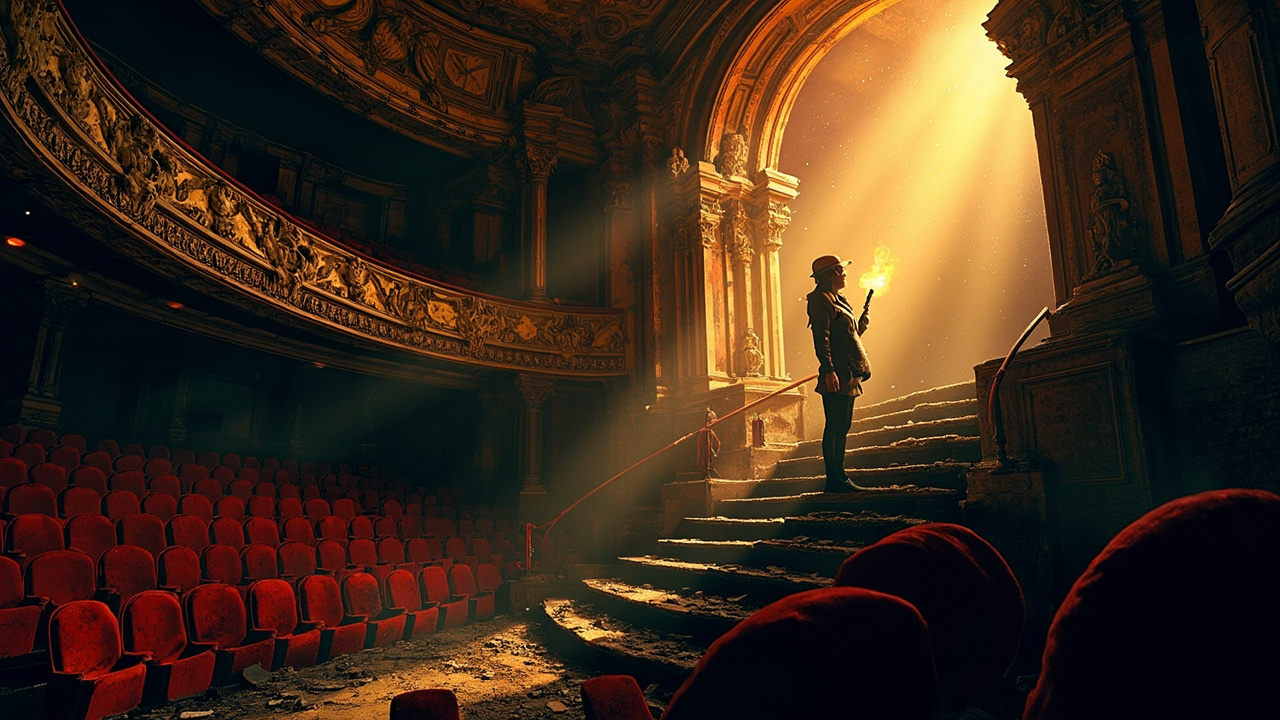
The foreman had warned her about the smell. Damp rot and decades of neglect, he said, the mingled odours of a building abandoned to time. Sarah had nodded, unsurprised; she had spent her career breathing life back into such places. But as she descended the main staircase of the Aldwych Theatre—though Aldwych was no longer its name, that name had been erased long ago—she found something else beneath the expected mustiness. A faint sweetness, like old paper and candle wax, as though the building retained a memory of gaslight and rouge.
She paused on the landing, her torch casting long shadows across the faded grandeur of the old proscenium arch. The plasterwork was exquisite, albeit crumbling: acanthus leaves and putti vied for space with Victorian scrollwork, all rendered in the theatrical style of 1887, the year the theatre had first opened its doors. It had been a palace of dreams once. Now it was a mausoleum, purchased by the Heritage Trust for a pittance, awaiting resurrection at her hands.
The restoration brief was straightforward enough: return the building to its former glory, preserve the ornate facade, make it safe for public access once more. A routine commission, or so she had assumed until the survey team reported their initial findings.
II
The anomaly lay beneath the stage, in what the original plans designated simply as 'cellarage'. Sarah had paid little attention at first; old theatres were riddled with such spaces, their histories layered like geological strata. But the measurements did not accord with the drawings. The cellar, according to the architect's notes, should have extended thirty feet from the stage wall. The survey team had recorded nearly fifty.
She found the discrepancy herself on a grey November morning, kneeling in the dust of the understage area, running her hands along the rear wall. There—a seam in the brickwork where none should exist. A doorway, deliberately concealed, its frame painted the same drab grey as the surrounding stone.
Marcus from the conservation team was the first to voice what they were all thinking. 'A hidden room,' he said, his voice hushed with scholarly excitement. 'Or a hidden passage. These old theatres were full of them, you know. For the machinery, the quick changes. But this feels different.'
He was right. The door was too solid, too deliberately sealed. Someone had wanted it to disappear.
III
The passage beyond was narrow, its walls lined with the same ancient brick as the theatre's foundations. But here the mortar was different—coarser, older, the work of different hands entirely. This tunnel predated the building above it by at least a century.
Sarah switched on her torch and pressed forward, feeling the weight of the earth above her, the sheer tonnage of accumulated London history pressing down. The passage turned twice, then descended steeply, the floor worn smooth by countless passages. Someone had walked this route many, many times.
The chamber at its end was small, perhaps ten feet square, its vaulted ceiling supported by salvaged timber. A wooden bench lined one wall, its surface worn pale by use. On the table beside it sat a rusted tin of lamp oil and a box of long-dead matches. But it was the far wall that arrested her attention.
Chalk marks covered the stone, dozens of them, faded but legible. Numbers, coordinates, compass bearings. And at the centre of the pattern, a single word, written in a careful, deliberate hand: LIBERTY.
IV
The research took weeks. Marcus buried himself in archives; the Trust's historians unearthed correspondence, shipping manifests, parish records. Slowly, the picture emerged.
The theatre had been built in 1887, yes. But the tunnels beneath it were far older—remnants of an earlier structure, a great house that had stood on this spot during the previous century. Its owners had been abolitionists, Quakers who had used their wealth and position to aid those fleeing bondage in the American South.
When the theatre was constructed, the abolitionists' descendants had preserved the tunnels, converting the hidden chambers into a waystation on what they called the Liberty Line—a network of safe houses that guided escaped enslaved people from the American South to freedom in Britain. The theatre above served as perfect cover: a bustling enterprise with arriving companies, departing tours, a constant traffic of visitors and trunks. Who would think to look beneath the spectacle?
The chalk marks were coordinates, she realised. Directions to the next safe house, the next ship, the next step on the journey north.
V
She stood alone in the chamber on the day before the official announcement. The restoration was complete now, the theatre above gleaming with fresh paint and restored gilding. But here, beneath the stage, nothing had changed except the dust—she had insisted on that. The bench remained where it had always stood. The lamp oil tin was empty but present. And on the wall, the word LIBERTY glowed faintly in the torchlight, a promise made in another century, kept by the very stones.
She thought of the people who had waited here in the darkness, their hearts hammering against their ribs, their futures balanced on a whispered word. They had been hunted, desperate, far from home. But they had also been brave—brave enough to walk into the unknown, to trust strangers with their lives, to believe in a word written in chalk on an underground wall.
The theatre would open next month. Sarah intended that every visitor should know what lay beneath. Not a footnote, not a curiosity, but the heart of the place—the secret purpose for which this building had truly been built.
Some performances never appear in any programme. Some legacies are written not in programmes but in the courage of those who came seeking freedom, and those who dared to offer it.