The Conservatoire's Ghost
The practice rooms on the fourth floor had been Ellie's sanctuary since her first year, but that November evening she had ventured where no student in their right mind would go: the disused east wing. The corridor smelt of dust and decades of neglect, and the torch on her phone cast trembling shadows across water-stained wallpaper.
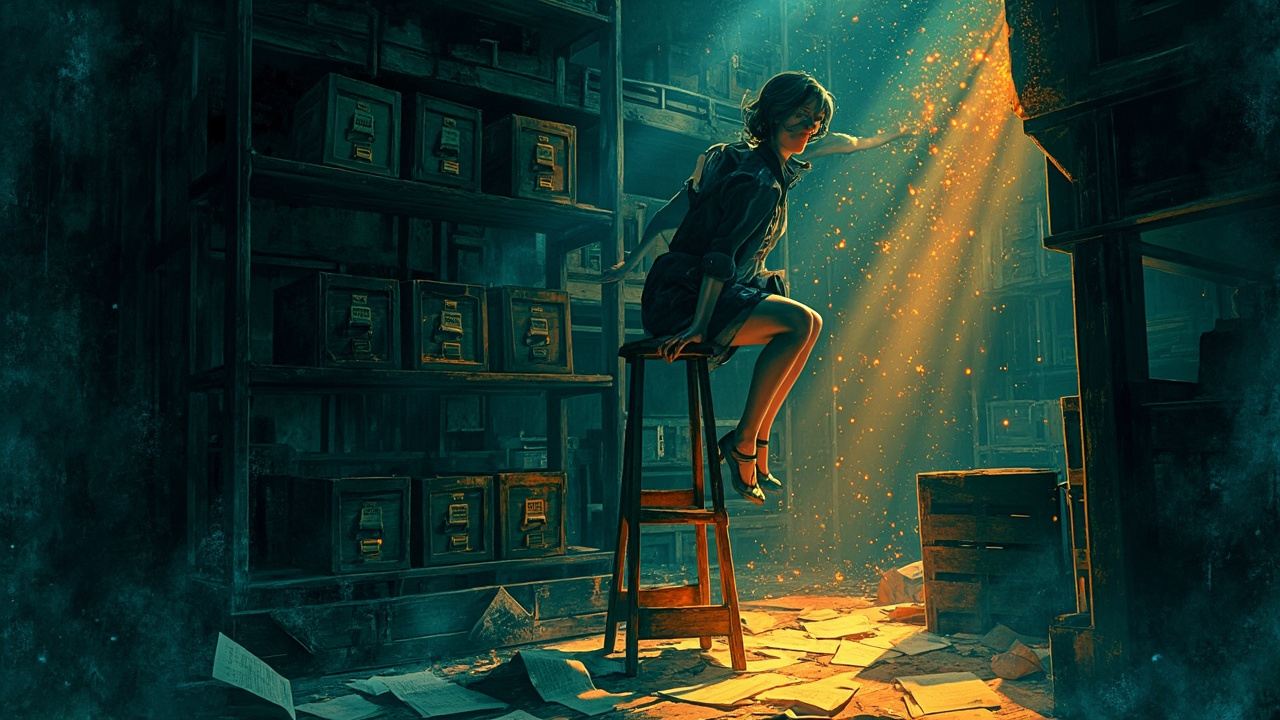
She had been looking for an empty room—any room—desperate to escape the suffocating atmosphere of the shared studios. Instead, she had stumbled upon a door that should not, by rights, have opened. And beyond it, a small room packed floor to ceiling with filing cabinets and wooden crates.
What drew her attention was not the chaos but the glint of something metallic on the top shelf: an old brass plate, tarnished green with age. She dragged a wobbly stool across and stood upon it, her fingers brushing the engraving. Julian Thorne. Composition, 2003.
Ellie had heard the name whispered in the corridors, dismissed by professors as the subject of idle gossip. A prodigy, they said. A tragedy, they murmured, before changing the subject as though the very syllables burned their tongues.
She opened the cabinet.
Inside, bound in leather and tied with ribbon that crumbled at her touch, lay dozens of manuscript scores. Hundreds, perhaps. Handwritten. Every page covered in a cramped, urgent script that spoke of someone who had written as though the words might vanish before they were finished. She lifted the first score with the reverence one might afford a holy relic.
The music was unlike anything she had encountered. It began with a dissonance that made her teeth ache, then resolved into a melody so achingly beautiful that tears pricked her eyes. She did not need to hear it performed to know that she was holding something extraordinary in her hands.
She took the score to the piano in the corner and began to play.
II
The college archivist, Dr Pemberton, nearly dropped her tea when Ellie appeared at her office door the following morning. The woman was ancient, her grey hair pinned in a bun that suggested the 1970s, and she regarded Ellie with the wariness of someone who had long ago learned to distrust students bearing requests.
"Julian Thorne," Ellie said. "I found his work in the east wing. Who was he?"
Dr Pemberton was silent for a long moment. "You shouldn't have been in there, Miss Marsh."
"And yet I was. What happened to him?"
The archivist sighed and gestured to a chair. "Sit down. It's a long story, and one that this institution would rather forget."
Julian Thorne had arrived at the Conservatoire in 1999, barely seventeen years old, with a scholarship that turned heads and a talent that silenced critics. He composed like a man possessed, filling notebooks with symphonies and sonatas that seemed to reach beyond the realm of human experience. He was, by all accounts, difficult—arrogant, solitary, prone to vanishing for days on end—but his music was transcendent.
"He was on the verge of something," Dr Pemberton said. "A cycle of works that everyone believed would redefine modern classical music. His professors spoke of him in hushed, reverent tones. Then, in March 2003, he was found dead in his studio."
"Dead?"
"The official report said suicide. A tragedy of a young mind overwhelmed by its own brilliance." The archivist paused. "But I never believed it."
"Why not?"
"Because his compositions—his true, unfinished masterwork—was missing. Stolen, we assumed. And his final letter, which I read before the police sealed his effects, made no mention of despair. Only of urgency. He wrote of people who wanted to silence him, who feared what he had created."
Ellie thought of the scores she had found. "Someone hid them."
"Someone did. Perhaps to protect them. Perhaps to protect themselves."
III
The weeks that followed were a fever dream of discovery. Ellie spent every spare hour in that forgotten room, cataloguing Julian's manuscripts. She came to know him through his music—the fierce intelligence, the aching vulnerability, the wild flights of imagination that made conventional composition seem pale by comparison.
And she came to believe, with growing certainty, that he had been murdered.
His scores spoke of a man who sensed his own danger. One piece, titled simply
The Reckoning, depicted in musical terms a chase, a betrayal, and a final, devastating confrontation. The final movement, incomplete, ended on a sustained chord of such profound sorrow that Ellie had to set down her bow and weep.
She began performing his work in secret. First for herself, in empty rooms at midnight. Then, tentatively, for a trusted few: her composition professor, a sympathetic cellist, a music critic who owed her a favour. Each performance confirmed what she already knew. Julian Thorne had been a genius, and his genius had been deliberately extinguished.
The question that haunted her was why.
The answer came, as answers often do, by accident. A conversation overheard in the faculty common room. A name mentioned in passing: a renowned conductor, now in his seventies, who had been a visiting professor in 2003. A man whose own career had been built upon a foundation of alleged plagiarism, long suspected but never proven.
Ellie cross-referenced the dates. The conductor had been present the semester Julian died. He had since built an empire on a body of work that, to Ellie's newly trained ear, bore striking similarities to the style she had discovered in the east wing.
She did not go to the police. She lacked the evidence, and institutions protect their own. Instead, she did what Julian himself would have done: she let the music speak.
IV
The premiere of Julian Thorne's
Requiem for an Unnamed Season took place in the Conservatoire's grand concert hall on a bitter December evening. Ellie had spent three months orchestrating the score for a full ensemble, completing the passages Julian had left unfinished, honouring the spirit of his vision.
The hall was packed. Music students, professors, critics, a few members of the public who had heard whispers of something remarkable. And in the third row, seated between two lawyers, the ageing conductor who had once stood accused of stealing a dead man's dreams.
Ellie walked onto the stage, her violin tucked beneath her chin. She did not look at him. She did not need to.
The orchestra began.
The music rose like a tide, carrying with it twenty years of silence, of injustice, of a voice that had been ruthlessly silenced. It was beautiful and terrible and utterly, irrevocably true. When the final chord faded, the silence that followed was not empty but full—full of everything Julian had wanted to say, finally given the chance to be heard.
Ellie lowered her bow. She was weeping openly now, as was half the audience. And in the third row, the old man sat motionless, his face ashen, as the truth of what he had stolen—and what had just been reclaimed—washed over him like a wave.
Later, as the hall emptied and Ellie stood alone on the stage, she could almost feel a presence beside her. Not a ghost, not quite. Something warmer. The sense of a debt finally paid, of a gift restored to those for whom it was always intended.
She smiled and pressed her fingers to the strings one last time.
"I hope you heard it," she whispered to the empty hall. "I hope you finally heard it."