مفردات لا بدّ منها
| الكلمة | العربية | Deutsch | Français | Русский |
|---|---|---|---|---|
| ضباب | Nebel | brume | туман | |
| وادٍ ضيق | Enges Tal | vallée étroite | узкая долина | |
| سرخس | Farnkraut | fougère | папоротник | |
| سُلَّم عبور | Zaunleiter | échalier | перелаз | |
| حجر مكعب | Kleinquadrat | pavé | булыжник | |
| قرّاص | Brennnessel | ortie | крапива | |
| كبسولة زمنية | Zeitkapsel | capsule temporelle | капсула времени | |
| خام | Erz | minerai | руда | |
| مُسرَّح | entlassen | licencié | уволенный | |
| ينبش | ausgraben | exhumer | эксгумировать |
القصة
The morning Dr Eleanor Marsh arrived in theorkshire Dales, a fine mist clung to the valley like a secret unwilling to be told. She had spent fifteen years at the British Library cataloguing historical maps, yet nothing had prepared her for what she held in her hands: a faded Ordnance Survey surveyor's field book from 1892, its ink bleached but legible, marking a footpath that simply did not exist on any modern map.
The path was labelled in careful copperplate handwriting: "To Hagg Foot Mine & Thornsett Colony." Eleanor traced the route with her fingertip, her historian's instinct tingling. Thornsett had been abandoned in 1913, following a catastrophic flooding that claimed eleven lives. The mine had sealed itself beneath the earth decades ago, and the settlement had been erased so thoroughly that even local memory had grown hazy on the matter. Yet here, preserved in nineteenth-century ink, lay the key to a place the twentieth century had chosen to forget.
She followed the old Roman road north from Hawes, then branched onto a track that descended into a narrow gill. Bracken clutched at her walking boots, and the sky had turned the colour of old pewter. Twice she consulted her GPS, which showed nothing but open moorland. The path, it seemed, existed only on paper—or rather, on paper that predated the surveys she had devoted her career to understanding.
By late afternoon, she found it. Or rather, she found the remnants of it: a stone stile half-swallowed by turf, and beyond, a lane of sett cottages huddled against the hillside as though seeking shelter from the wind. The roofs had long since collapsed, and the walls were thick with moss and ivy, but the layout was unmistakable. Here had been a community—flourishing, then suddenly stilled.
Eleanor wandered through the ruins, her camera clicking softly. She discovered a smial of a schoolhouse, its slate blackboard still bearing the ghost of chalk figures. She found a pub sign rotting in the nettles: The Spinning Jenny. And at the far end of the settlement, half-hidden by a tumble of granite boulders, she uncovered the mine entrance—sealed, as she had expected, but with iron rivets still gleaming faintly where the last workers had bolted the barrier shut.
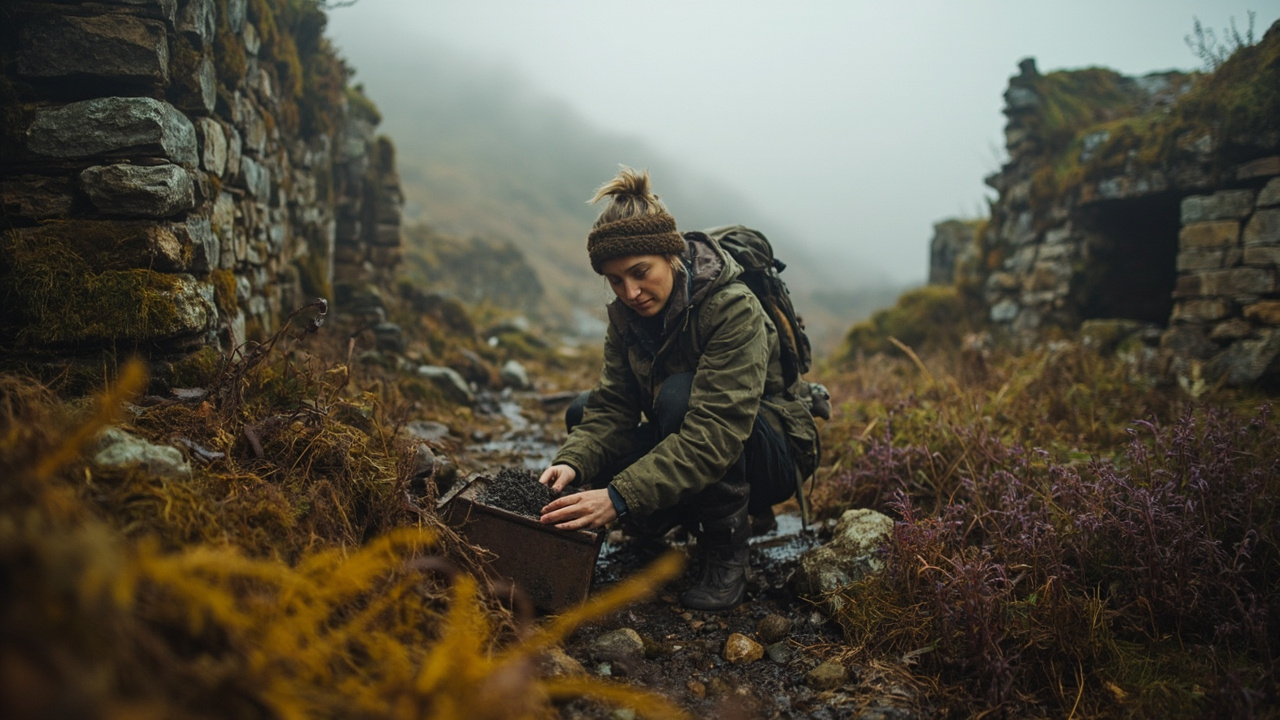
It was behind the schoolhouse that she found the first anomaly. The ground there had settled unevenly, forming a depression roughly two metres square. In the photograph she had studied at the library, this same patch of earth had been a vegetable garden. But something beneath had shifted, collapsed, or been disturbed deliberately. She knelt and brushed away decades of accumulated soil, revealing the corner of a cast-iron box, no larger than a loaf of bread.
Her heart hammered against her ribs. She had read enough archives to recognise a time capsule when she saw one. Miners' communities had frequently buried them during periods of uncertainty, stowing away documents, coins, and personal effects to be unearthed by future generations—or, more often, forgotten entirely when the future failed to arrive as expected.
She worked for an hour with her hand trowel, exhuming the box inch by inch. The iron was rusted but intact, and when she prised open the lid, she found exactly what she had hoped: a leather satchel containing a bundle of letters, a photograph of miners posed formally before the pithead, and a leather-bound ledger entitled Thornsett Mineral Survey, 1912. Her hands trembled as she opened it. The survey documented seams of iron ore far richer than anyone had suspected, with estimated reserves that would have sustained the community for generations.
But it was the final entry that made her breath catch. Dated September 1913, the handwriting was frantic compared to the meticulous entries above: "Company suppressed findings. Forewarned men will be made redundant. Collapse arranged at Shaft 3 to justify closure. God forgive us."
Eleanor sat back on her heels, the ledger heavy in her lap. The flooding that had killed eleven men and doomed Thornsett had not been an accident. It had been arranged—coldly, deliberately—to bury not only the workers but also the truth of what lay beneath their feet. The ore had been too valuable to share with a community of independent miners; it had been easier to destroy them.
She photographed every page, every scrap of evidence, then carefully repacked the satchel. This story belonged to more than just academic journals. It belonged to the eleven families who had never known why their men had died, and to the historians who would ensure it could never happen again.
The mist had lifted by the time she descended from the hill. Below, the modern road wound toward Hawes, its tarmac smooth and certain. But Eleanor knew now that beneath it lay another map entirely—one written in silence, in suffering, and in the stubborn refusal of old paper to let the truth be forgotten.