مفردات لا بدّ منها
| الكلمة | العربية | Deutsch | Français | Русский |
|---|---|---|---|---|
| فهرسة | katalogisieren | catalogue | каталогизировать | |
| مطلية | lackiert | verni | покрытый лаком | |
| إهمال | Vernachlässigung | négligence | пренебрежение | |
| تعليق توضيحي | Anmerkung | annotation | аннотация | |
| قطعة أثرية | Artefakt | artefact | артефакт | |
| فورتي | laut | forte | форте | |
| متعاون | Mitarbeiter | collaborateur | соавтор | |
| محو | Tilgung | effacement | стирание | |
| لا يُقدَّر بثمن | unbezahlbar | inestimable | неоценимый | |
| مخطوطة | Handschrift | manuscrit | рукопись |
القصة
The piano had been awaiting repair for three months when Eleanor finally found time to catalogue it properly. The Broadwood grand, dated 1897, stood in the east wing of Harton Hall's music school, its lacquered surface dulled by decades of neglect. She had been tasked with inventorying the instrument collection before the building's renovation—a tedious assignment that most of her fellow students had managed to avoid.
It was while running her hands along the interior lid that her fingers encountered the不对劲—something lodged behind the cast-iron frame. A folder, wedged into the hollow space with deliberate care, as though someone had wanted it hidden but not destroyed.
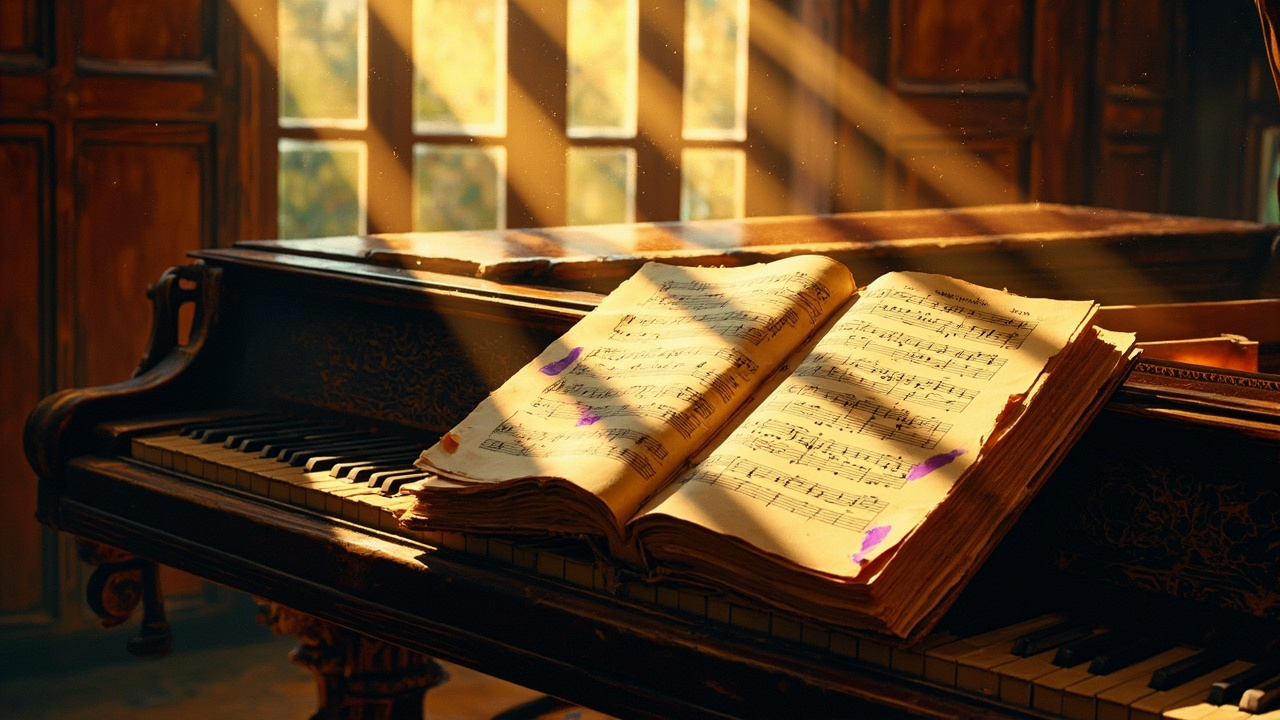
Eleanor extracted the document with the reverence one reserves for artefacts of archaeological significance. It was a score: Elgar's Enigma Variations, she realised, though not quite as she knew it. The printed notes were present, certainly, but every available margin overflowed with annotations in faded violet ink. Whoever had owned this copy had not simply studied the music; they had interrogated it, argued with it, improved upon it.
The Hand Behind the Notes
The annotations were precise and copious. Passages marked with a simple 'no' were crossed out entirely, replaced with alternatives that sang with greater clarity. Dynamic markings had been adjusted—fortes softened, pianissimos intensified—each alteration annotated with a brief justification. Occasionally, whole bars had been inserted in a different hand, their placement indicated by brackets and caret marks in the original printing.
'These aren't a student's notes,' Eleanor murmured to herself, spreading the pages across the dusty music stand. 'These are a collaborator's notes.'
Her heart quickened. She had written her undergraduate dissertation on the role of women in British musical history—a topic she had chosen precisely because it remained so thoroughly unwritten. The contributions of female composers, amanuenses, and teachers had been systematically erased from the canon, their work absorbed into that of their male contemporaries without acknowledgement. Now, holding this annotated score, she sensed she had stumbled upon evidence of precisely such an erasure.
She turned to the title page. In the same violet ink, beneath Elgar's name, someone had written: With grateful recognition of M.E.'s contribution to the whole. The initials did not belong to Elgar. His handwriting, which Eleanor knew from other documents in the collection, was altogether different—rounder, more confident. No, these annotations belonged to someone else entirely.
Violet
The university's archives proved less forthcoming than Eleanor had hoped. The music school's records from the 1890s were fragmentary at best, and the administrative correspondence of the period was maddeningly vague about students' actual contributions to compositional work. She spent four days chasing references through half-remembered donation lists and incomplete course records before finding what she sought: a single letter, preserved in a collection of Elgar's correspondence that had been miscatalogued decades ago.
The letter was addressed to a Miss Violet Marchmont, and it confirmed what Eleanor had suspected. Elgar thanked Violet for her 'invaluable observations' on the Enigma Variations, particularly her work on the ninth variation, which had originally been titled 'Nimrod' but had undergone significant revision following her suggestions. 'Your ear for orchestral colour exceeds my own,' Elgar had written, 'and I shall endeavour to incorporate your insights, though I fear the published score cannot bear two names.'
It couldn't bear two names. Eleanor set down the letter, feeling the weight of those words. Violet Marchmont had contributed something essential to one of the most celebrated works in the British classical repertoire, and history had chosen to forget her entirely.
She searched further. Violet Marchmont had been a gifted pianist and occasional composer, a student at the Royal Academy of Music before taking private lessons with Elgar. She had died in 1938, unmarried, in near-complete obscurity. Her own compositions—a piano sonata, several songs, a small catalogue of chamber works—had never been performed publicly. They had simply vanished, as so many women's works had done.
Resurrection
The score Eleanor had discovered was not merely annotated. Nestled between the pages of Elgar's variations, she found a second, slimmer document: a set of song texts in Violet's own hand, with musical settings that bore her initials. They had been written, she calculated, sometime in the early 1900s, and they were exquisite—technically assured, emotionally resonant, bearing the unmistakable stamp of a distinctive musical voice.
Eleanor contacted her professor, then the university's archivist, then the director of the Royal Academy of Music's special collections. She wrote letters, made telephone calls, submitted proposals. Six months later, she stood in a recording studio in Bloomsbury, watching as a soprano and pianist brought Violet Marchmont's songs to life for the first time in over a century.
The music filled the room—achingly beautiful, long silenced, finally heard. As the final notes faded, Eleanor thought of all the scores still hidden in old pianos, all the manuscripts tucked into forgotten corners, all the voices that history had chosen not to hear. She reached into her bag and withdrew the annotated copy of Elgar, violet ink still visible on every page.
'Thank you, Violet,' she whispered to no one in particular. 'I found you.'