مفردات لا بدّ منها
| الكلمة | العربية | Deutsch | Français | Русский |
|---|---|---|---|---|
| جداول صغيرة | Rinnsale | ruisseaux | ручейки | |
| تحدٍّ | Trotz | défi | вызов | |
| سوء تصرف | Ungehörigkeit | impropriété | неприличие | |
| قبو | Gewölbe | cave | хранилище | |
| مطوي | verzogen | voilé | покоробленный | |
| واجهة | Fassade | façade | фасад | |
| نباتي | botanisch | botanique | ботанический | |
| مراسلات | Korrespondenz | correspondance | переписка |
القصة
It was on a grey Tuesday in March, when the rain traced silver rivulets down the Georgian windows of Broughton Road, that Eleanor Ashworth stumbled upon the portrait.
She had ducked into the Oxfam shop merely to escape the weather, half-heartedly browsing the usual jumble of chipped china and worn paperbacks. But there, resting against a shelf of moth-eaten jumpers, a gilded frame caught her eye. She lifted it carefully, tilting it toward the pale northern light. The face within stopped her cold.
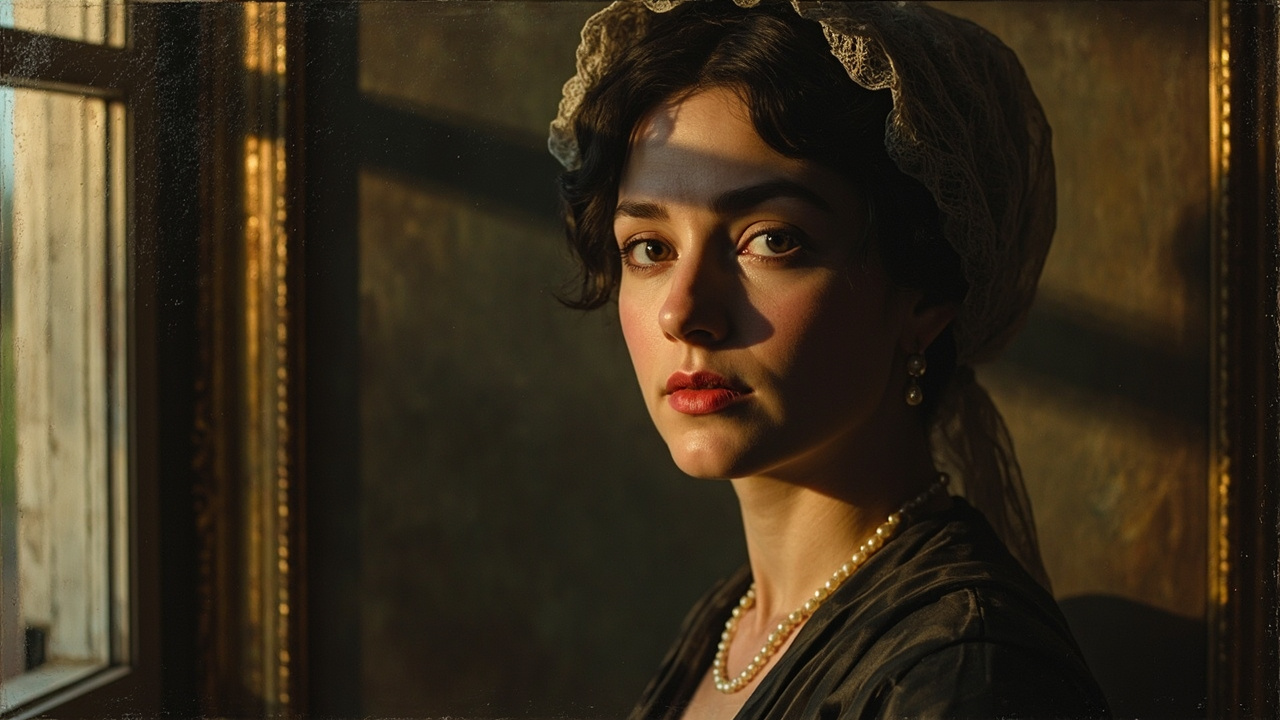
A woman, perhaps thirty, gazed back at her with an expression of quiet defiance. She wore dark silk and a single strand of pearls, her dark hair pinned beneath a lace cap. The brushwork was confident, assured — unmistakably the hand of a skilled portraitist. Yet the canvas was cracked, the varnish clouded, and someone had written in faded India ink along the stretcher bar: Lady Arabella Cromarty, née Dunmore. 1821. See her true self.
Eleanor, a senior lecturer in art history at the University of Edinburgh, turned the frame over. The backboard was warped with age. She paid the volunteer four pounds and carried the portrait home through the rain, her curiosity already beginning to outpace her scepticism.
The Investigation Begins
That evening, Eleanor placed the portrait on her desk beneath a lamp and reached for her laptop. Lady Arabella Cromarty. The name stirred nothing in the standard biographies. The Cromarty family were minor Scottish aristocrats, and a thorough search of the Scots Peerage and the National Records of Scotland yielded next to nothing — no marriage settlement, no estate inventories, no mention whatsoever of an Arabella.
Intrigued, Eleanor turned her attention to the phrase on the stretcher bar. See her true self. She prised the backboard free with a letter opener and found, wedged behind the canvas, a folded sheet of yellowed paper.
The document was a letter, written in a graceful, old-fashioned hand. It was addressed to no one and dated 15 June 1821 — the same year as the portrait. Its author, a solicitor named James Calder of Musselburgh, described with evident discomfort the circumstances of his client's dismissal. Lady Arabella Cromarty had been "removed from the family records by order of the Earl, her husband, following an act of gross impropriety that the household was forbidden to discuss." The letter concluded with a postscript: "All correspondence pertaining to the Lady has been placed in the Dunmore family vault at Canna House, Fife, as the Earl will not permit such papers to be destroyed, yet wishes them hidden from public view."
The Vault at Canna House
It took Eleanor three weeks and a number of politely persistent telephone calls before the current Lady Cromarty — a Cambridge-educated widow named Isobel — agreed to meet her at the family's Fife estate.
Canna House sat on a limestone bluff overlooking the Firth of Forth, its grey stone façade softened by centuries of climbing ivy. Isobel Cromarty proved a woman of sharp intelligence and, as Eleanor would discover, a longstanding private unease about the family's selective memory.
"The vault is sealed," Isobel said, leading Eleanor through a stone corridor beneath the east wing. "But I've always had the key. No one ever asked me what it contained."
The vault was small and smelled of damp earth and old leather. Shelves lined three walls, laden with document boxes and bundles of correspondence tied with rotting ribbon. Eleanor's hands trembled slightly as she opened the first box.
Inside lay dozens of letters in Arabella's own hand, a miniature portrait painted by a different artist — this one far more intimate, showing Arabella laughing in a garden — and a slim journal. Together they told a story that the Earl of Cromarty had spent two centuries trying to bury.
Arabella Dunmore had been a naturalist and botanical illustrator of considerable talent. Her watercolours of Fife flora had circulated privately among scholars in London and Edinburgh. But she had also harboured radical sympathies — she had correspondied with Chartist agitators, housed a wanted pamphlet printer in the estate grounds, and, most damningly in her husband's eyes, had published under a pseudonym an anonymous pamphlet arguing that Scottish women of property should be entitled to vote in county elections.
The Reckoning
The Earl, a man for whom reputation was everything, had acted with decisive cruelty. He had her paintings burned, her correspondence seized, her name expunged from household accounts and family genealogies. She was packed off to a remote estate in Perthshire, where she died in 1847, a recluse.
Eleanor sat on the vault floor, the journal open on her lap, and felt the full weight of institutional erasure settle upon her. It was a story she had seen before — the brilliant wife, the controlling husband, the convenient silence of history — yet each repetition struck her as freshly outrageous.
Isobel stood beside her, reading over her shoulder. "She was my husband's great-great-aunt," she said quietly. "No one in my family ever mentioned her. Not once."
The following autumn, Eleanor published a long article in the Edinburgh Review reconstructing Arabella's life and work, illustrated with the surviving miniature and a careful analysis of the portrait's brushwork. She donated the portrait itself to the Scottish National Portrait Gallery, where it now hangs — restored, labelled, and unapologetically present — in the eighteenth-century galleries.
On the brass plate beneath the frame, a single line reads: Lady Arabella Cromarty, naturalist and polemicist, erased and rediscovered. Visitors often pause before it. Some, Eleanor has noticed, stand there for a very long time.