مفردات لا بدّ منها
| الكلمة | العربية | Deutsch | Français | Русский |
|---|---|---|---|---|
| متخصص في البستنة | Gärtner | horticulteur | садовод | |
| تحت الأرض | unterirdisch | souterrain | подземный | |
| بيت زجاجي | Gewächshaus | serre | теплица | |
| طيني خصب | lehmig | limoneux | глинистый | |
| مداخن | Rauchfänge | conduits de fumée | дымоходы | |
| الركبة | First | faîtage | конёк | |
| طاولات عرض | Pflanzbänke | étagères de culture | полки для растений | |
| انخفاض | Mulde | dépression | углубление | |
| أوساخ | Schmutz | saleté | грязь | |
| آثار باهتة | Spuren | traces effacées | следы |
القصة
Dr Eleanor Ashworth had spent twenty years breathing life into dead gardens. She read the landscape the way others read faces — noting the slight depression where a ha-ha once ran, the suspicious symmetry of trees planted in regimented rows, the stubborn patch of lawn that refused to level itself no matter how often the turf was relaid. So when the builders on the Edgerton development in Kensington scraped away the topsoil and revealed a faint rectangular depression no larger than a garden shed, Eleanor knew the old surveyor's plans were keeping secrets.
She had been hired, as she so often was, to render an opinion before the diggers moved in. The Edgerton site — once the grounds of a demolished townhouse — was to yield luxury apartments, and Eleanor's task was to assess and document whatever remained of the historic gardens before the contractors erased them for good. She sat cross-legged on the cold March earth, poring over a photographic reproduction of the 1885 Ordnance Survey, when she saw it: the survey showed a structure flush with the old boundary wall, perfectly accounted for. But the depression in front of her sat two metres further east, off every map she could lay her hands on.
"Air-raid shelter," said the foreman, when she flagged it. "We've found a few of those. Shall I have the lads clear it?"
Eleanor shook her head slowly. "That wall is Victorian brick. These flues here —" she gestured to the chimney stacks emerging from the earth a short distance away — "those are cast iron. They predate the First World War by decades."
She requested a ground-penetrating radar survey. The results confirmed her instinct: beneath the compacted soil lay a substantial structure, its plan unmistakably horticultural. A greenhouse, sealed and subterranean, its glass ceiling intact but buried under a century's accumulation of earth. The archaeologists were summoned, the developers reluctantly agreed, and three weeks later Eleanor stood at the head of a trench, watching the last of the rubble shift away to reveal a wall of thick green glass, opaque with decades of grime.
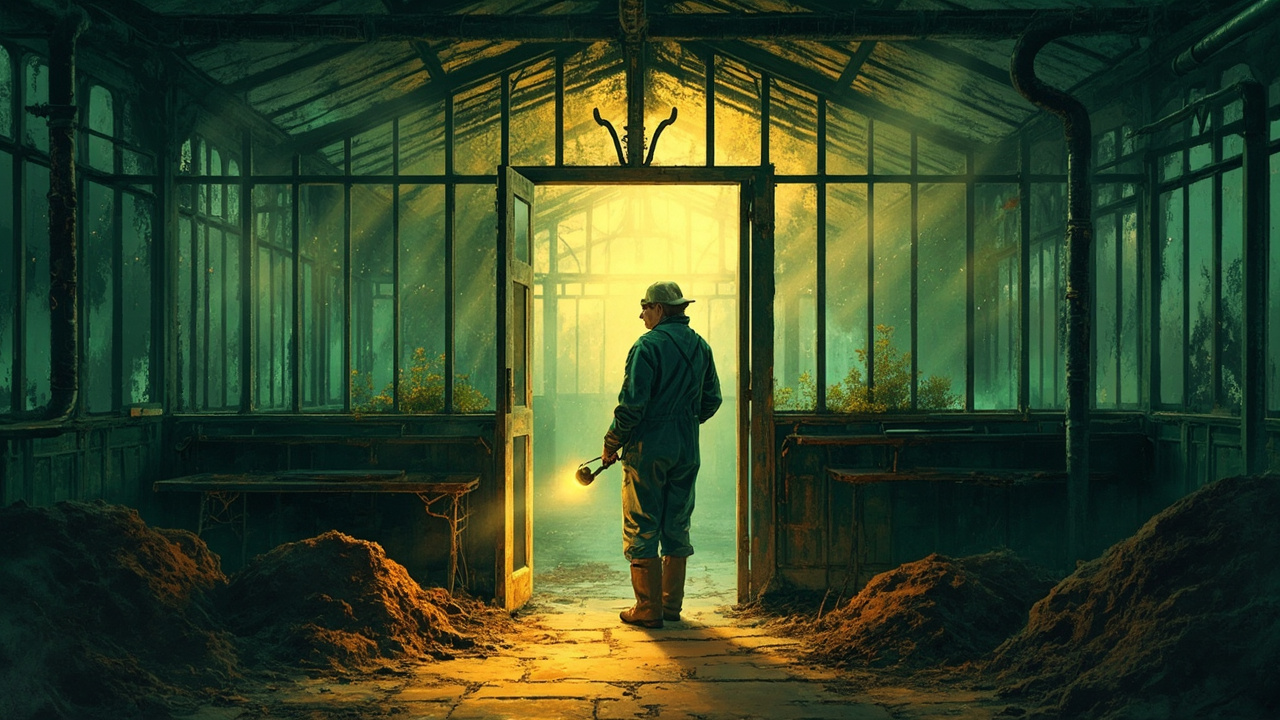
The door was a narrow thing, half-glazed, set into a frame of pitted iron. The lock had long since corroded to nothing. Eleanor pushed it open and stepped inside.
The air inside was cool and dry, surprisingly mild given the season. Morning light — what filtered through the grimy ceiling — fell in long, pale slats across a floor of worn flagstones. The staging tables were empty, their pots removed or smashed long ago, but the iron framework remained, and the heating pipes beneath still snaked along the base of the walls. It was, unmistakably, a Victorian growing house, built to exacting specifications and abandoned with peculiar thoroughness.
Eleanor walked the length of the space, her torch beam catching the intricate ironwork of the ridge and the ghost-marks where staging had been fixed to the walls. At the far end she found what she had instinctively known was there: a smaller chamber, partitioned off by a second glass door, this one sealed with a layer of what appeared to be waxed canvas behind the pane. A horticulturalist's inner sanctum. A place for something precious, or something secret.
She broke the waxed seal with a crowbar from the site toolkit. The door swung inward with a long, slow creak, and the smell that greeted her was extraordinary — rich, loamy, alive. In the centre of the chamber, on a shelf of old brick, sat a single clay pot, and in that pot, impossibly, a plant.
Eleanor knelt. The leaves were unlike anything in her considerable experience: deeply lobed, a dark and velvety green so deep it bordered on black, their edges fringed with a fine silver down that caught the torchlight and shimmered. The plant was small, perhaps thirty centimetres tall, but its structure was complex, almost architectural, and its roots had pushed through the base of the pot and into the ancient brickwork below as though seeking deeper purchase.
She sat back on her heels and stared at it for a long moment. Her mind ran, involuntarily, through every horticultural catalogue, every botanical archive, every monogrammed monograph she had ever committed to memory. Nothing matched. And then, with a cold certainty that began in her stomach and spread outward through her limbs, she knew why.
This plant was extinct. Had been extinct for over a century. It was a hybrid — a cross between a rare native fern and a tropical climbing species, achieved through a process of controlled pollination that had been documented only once, in a paper published in the Journal of the Royal Horticultural Society in 1883. The author was one Josiah Ashworth, head gardener to a minor branch of the royal household. The paper had described a single successful specimen. Within two years, the specimen had vanished — not published about, not propagated, not mentioned again. Extinct before it was ever properly catalogued.
And here it was. Alive, in a sealed room, in a garden that no longer existed on a street that had been built over it.
Eleanor reached for the tin box she had noticed beneath the staging, half-hidden by a collapsed pot. Its lid was rusted shut but yielded to a firm thumb. Inside, wrapped in oilcloth, she found a bundle of letters — a dozen or more — in a hand that was cramped, precise, and unmistakably working-class Victorian. The paper was thick, the ink dark brown, the language formal to the point of ceremony.
The first was dated July 1886. It was addressed to a solicitor in Lincoln's Inn Fields and began, without preamble: Sir, I write to you in some haste and with a heavy heart, having received this morning what I can only describe as a command to deliver my specimen to Windsor for the Queen's personal collection.
Eleanor read on. Josiah Ashworth had been caught between duty and obsession. He had created the hybrid through years of patient, painstaking work, cross-pollinating by hand in the small hours when the greenhouses were dark and silent. It was, he believed, the finest thing he would ever make — a living work of art that transcended the merely botanical. When the royal household learned of it, they wanted it. They wanted it badly. And Ashworth, with the quiet defiance of a man who knew the value of what he held, refused to give it up.
The correspondence traced the pressure that followed: polite letters becoming pointed requests, pointed requests hardening into veiled threats. There were references to his position, to the vulnerability that attaches to servants who displease their masters, to a pension upon which his widow's comfort might depend. Ashworth replied to each with the same immovable courtesy. The plant could not be moved. It was too delicate. It required conditions only he could provide. He would keep it, and tend it, until such time as he was no longer able.
The final letter was dated October 1887. It was short. The greenhouse, it announced, had been sealed on the authority of the estate manager, following the discovery of a contagious disease among the ornamental stock. All personnel had been reassigned. The structure was to be buried in situ. Ashworth was given two weeks' notice.
He died that December, aged sixty-two. The cause was listed as influenza, though a postscript in a different hand — perhaps that of his solicitor — noted that he had been in good health until the final fortnight and that his friends found his death "somewhat convenient for those who wished the matter forgotten."
Eleanor set the letters down on the cold flagstones and looked again at the plant. It had survived. Against every reasonable expectation, in the dark, sealed away from light and air and human attention, it had survived. It had been watered, once, by the condensation that gathered on the glass and dripped through the seals. It had been warmed, faintly, by the residual heat of the pipes still buried beneath the floor. And it had endured, decade after decade, a small green act of defiance that no one was left to witness.
It took Eleanor three months to document everything properly. The plant was carefully extracted and entrusted to the living collections team at Kew, where it was identified conclusively as the Ashworth hybrid and propagated successfully for the first time in recorded history. The letters were authenticated, cross-referenced, and filed with the National Archives. And then, with the quiet satisfaction of a woman who had done a thorough and important piece of work, Eleanor sat down and wrote her paper.
It appeared in the spring edition of the Journal of Horticultural History under the title "The Ashworth Affair: A Scandal Buried in Kensington." The horticultural press received it with the gratifying mixture of outrage and delight that greets any revelation of institutional dishonesty. The Royal Horticultural Society, implicated in the original cover-up, issued a terse non-denial. Several eminent botanists wrote in to disagree about the hybrid's parentage. Eleanor gave three radio interviews and one television appearance, during which she maintained a composure that her colleagues found almost superhuman.
But her private triumph was quieter than any of that. She stood one evening in the greenhouse — now cleared, stabilised, and opened to controlled public visits — and looked up at the green light falling through the restored glass. The old ferns had been replanted along the staging. The heating system had been brought back to life, gently, unobtrusively. And in the inner chamber, behind its glass partition, the original pot still sat on its shelf of old brick, empty now of its plant but not of its meaning.
Eleanor had carried the propagated specimens away with her — three healthy young plants in terracotta pots, each one a living copy of a document that had waited a hundred and thirty years for its author to be read. She kept the largest on the windowsill of her Islington flat, where it caught the morning light and grew steadily, leaf by dark leaf, as though it had all the time in the world.
Perhaps, she thought, it did.