مفردات لا بدّ منها
| الكلمة | العربية | Deutsch | Français | Русский |
|---|---|---|---|---|
| شبح | Geist | fantôme | призрак | |
| لوحة مفاتيح الهاتف | Vermittlungsschrank | standard téléphonique | телефонная станция | |
| مختوم/مغلق | versiegelt | scellé | опечатанный | |
| مدفأة | Heizkörper | radiateur | радиатор | |
| شرفة | Balkon | balcon | балкон | |
| يوميات/دفتر مذكرات | Tagebuch | carnet/journal | дневник | |
| رجل أعمال كبير | Magnat | magnat | магнат | |
| مهرّب | geschmuggelt | de contrebande | контрабандный | |
| استقصائي | investigativ | investigatif | расследовательский |
القصة
Margaret had worked the night shift at the Grand Hotel for eleven years, long enough to know which floorboards creaked and which radiators groaned through the small hours. She had seen guests stumble in at three in the morning, reeking of champagne and sea air, and she had watched couples slip away at dawn, their luggage hastily packed. But she had never experienced anything like the telephone call that came through at 2:47 on a bitter November morning.
"Front desk," she answered, as she always did. The line crackled with static, and then a woman's voice came through—soft, measured, and unmistakably upper class.
"Is anyone there? I need assistance. Please, I've been locked in."
Margaret glanced at the switchboard. Room 714. She knew that room well—or rather, she knew its history. For the past thirty-two years, Room 714 had remained sealed. No guest had ever occupied it since the night Eleanor Ashworth had fallen from its balcony in the autumn of 1992. The police had ruled it suicide. The hotel had simply locked the door and thrown away the key.
"I'm sorry, madam," Margaret said carefully, "but that room has been closed for decades. There must be some mistake."
The line went dead.
She ought to have dismissed it as a prank, some bored guest with too much time on their hands. But the voice had carried a quality of desperation that lodged in her chest and refused to leave. Margaret spent the remainder of her shift staring at the ancient switchboard, willing it to ring again. It did not.
II
The following evening, she arrived early for her shift and made her way to the manager's office. David Pemberton was a younger man, barely forty, who had inherited the Grand Hotel from his father along with the building's considerable debts and its even more considerable ghosts.
"Room 714," Margaret began, before he could offer her a cup of his terrible instant coffee. "I received a call from it last night."
Pemberton's expression flickered with something she couldn't quite identify. "That's not possible. The room has been sealed since before I was born."
"I'm telling you what happened, Mr Pemberton. A woman called, saying she was locked in."
He leant back in his chair, suddenly looking older than his years. "Eleanor Ashworth," he said quietly. "You'd do well to forget about her, Margaret. Some doors are closed for a reason."
But Margaret had never been particularly good at forgetting. That night, armed with the master key she'd been given when she first started, she made her way to the fourth floor.
III
The door to 714 was exactly as she'd imagined—imposing, scrolled with brass, and secured with a lock that hadn't been opened in a generation. She turned the key. It resisted at first, then gave way with a sound like a sigh.
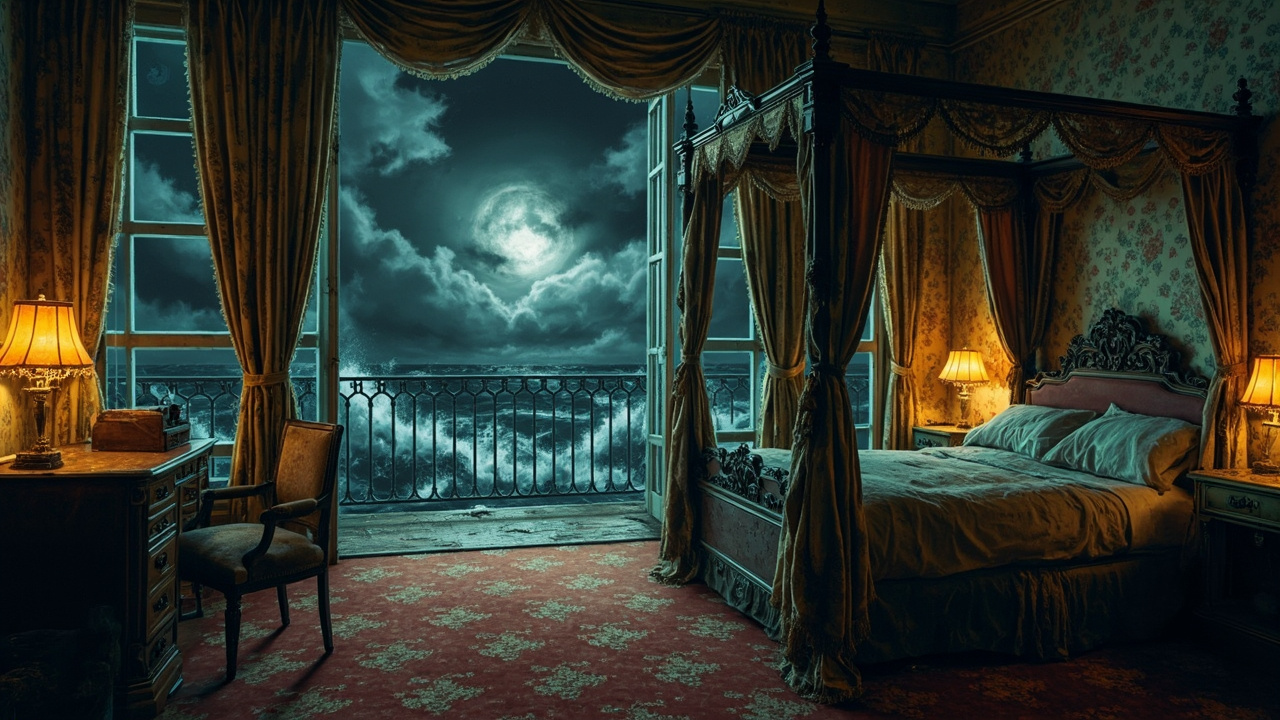
The room had been left exactly as it was on that October night in 1992. A four-poster bed with faded damask curtains. A writing desk by the window. And beyond the glass doors, a balcony overlooking the sea, where Eleanor Ashworth had allegedly ended her own life.
Margaret stepped inside, her torch cutting through decades of undisturbed dust. On the writing desk, she found a leather-bound diary, its pages yellowed but intact. She opened it carefully and began to read.
Eleanor had been a journalist—investigative, tenacious, fearless. The final entries spoke of a story she was pursuing, something involving a shipping magnate and a cargo of smuggled art. She had grown increasingly frightened. He knows I'm close, she had written three days before her death. Richard has been making threats. I don't think I should stay here, but I can't leave without proof.
Richard. Margaret turned the pages until she found a photograph tucked inside the back cover—a handsome man in a tailored suit, smiling at the camera with the easy confidence of someone who had never been held accountable for anything.
She recognised him immediately. Richard Cavendish, now Lord Cavendish, industrialist and philanthropist, whose portrait hung in the lobby of the very hotel where Eleanor had died.
IV
Margaret took the diary to the police. Within a fortnight, they had reopened the investigation. The balcony railing, they discovered, had been tampered with—new bolts fitted to existing wood, designed to give way under minimal pressure. Eleanor Ashworth had not taken her own life. She had been murdered by a man who had过大 much to lose.
Lord Cavendish was arrested on a Tuesday morning in March. He maintained his innocence until the very end, but the jury deliberated for less than three hours before returning a verdict of guilty. He died in prison four years later, a broken shadow of the man he had been.
The night shift continued at the Grand Hotel. Margaret returned to her post, to the creaking floorboards and the groaning radiators, to the guests who stumbled in at three in the morning and the couples who slipped away at dawn. But something had changed. The telephone at the switchboard no longer rang at 2:47. The line was silent at last.
Sometimes, though, in the quiet moments between guests, Margaret would look up at Room 714 and swear she could see a light burning in the window—warm, steady, and finally at peace. Eleanor Ashworth, it seemed, had only ever wanted one thing: the truth. And now, thirty-two years on, she had it.