مفردات لا بدّ منها
| الكلمة | العربية | Deutsch | Français | Русский |
|---|---|---|---|---|
| خط الطول | Meridian | méridien | меридиан | |
| تزامن عصبي | Synchronisation | synchronisation | синхронизация | |
| الذاكرة الجمعية | kollektives Gedächtnis | mémoire collective | коллективная память | |
| مستأصل | herausgeschnitten | excisé | удалённый | |
| شهادة | Zeugenaussage | témoignage | показание | |
| ملاحقة قضائية | Verfolgung | poursuite | судебное преследование | |
| شاذ | anomal | anormal | аномальный | |
| مشفر | kryptographisch | cryptographique | криптографический | |
| تكلّس | verkalkt | calcifié | окостеневший | |
| لا لبس فيه | eindeutig | sans ambiguïté | однозначный |
القصة
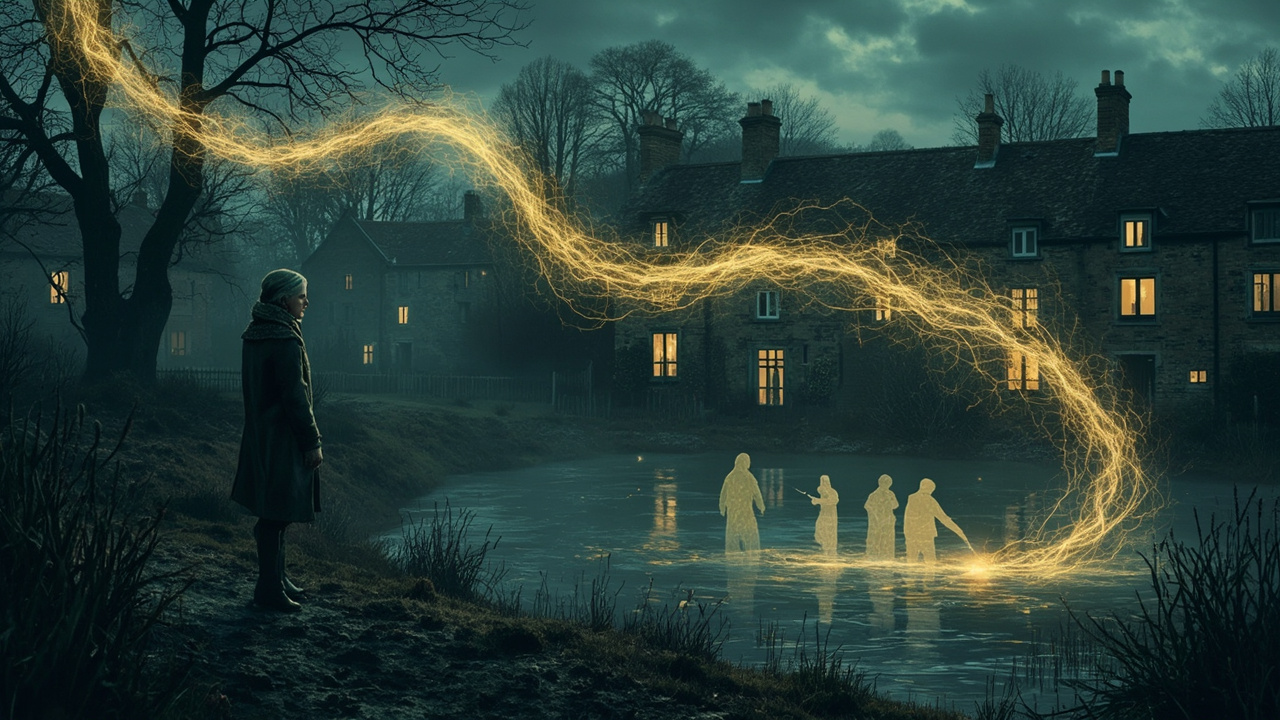
The village announced itself in fragments: a Saxon churchyard, a ducking pond gone green with neglect, and terrace houses whose windows watched the road with the fixed attention of aging eyes. Dr. Eleanor Vance had driven four hours from her laboratory at Cambridge, and she had not anticipated the weight of the place. She had anticipated the grant conditions, the ethical clearances, the peculiar cooperation of a community that had agreed to nothing and everything in the same breath.
Their willingness had troubled her initially. Aldermaston—there had been a witch trial there, once, or so the local historian had claimed in his letter, before deleting his claims and offering instead the vague language of "historical curiosity." Eleanor had accepted this ambiguity. She had learned, over a decade of mapping the architecture of human recollection, that communities buried their wounds with the same care that individuals lavished upon their griefs. The land remembered what its people refused to speak.
Her technique was called Resonance Mapping, and its premise was deceptively simple. Neural synchronisation between individuals escalated measurably when they shared experiential knowledge—events witnessed together, songs learned in common, traumas endured side by side. By introducing a diluted cryptographic stimulus into the water supply and then measuring the delta across a thousand portable EEG readers distributed throughout a population, Eleanor could identify which memories the community held collectively, and which had been somehow excised from the shared record.
She had proven the method in Bristol, in Edinburgh, in a small fishing village off the coast of Cornwall where the collective memory of a shipwreck had calcified into ritual and song. Now she stood in the Aldermaston parish hall, surrounded by boxes of equipment and the lingering scent of flower arranging, and wondered whether this village would surrender its secrets as readily as the others.
The first readings were anomalous. Eleanor had expected clusters—the pub regulars sharing recollection of the summer of 1976, the church congregation maintaining a synchronized narrative of the Queen Elizabeth's jubilee. These emerged cleanly, bright constellations of synchronised neural activity, as predictable as sunrise. But there was something else, something that should not have existed.
A thread of memory, dense and trembling, that wound through every demographic. Young and old, devout and secular, long-term residents and families who had arrived only last decade—it made no difference. They were all, every one of them, holding something in their minds that none of them could name.
Eleanor spent three nights eliminating error. She recalibrated the instruments, replaced the distributors, cross-referenced her control groups. The thread persisted. It pulsed with a coherence she had never encountered, a unity of recollection so complete it suggested not merely shared memory but shared experience, as though a hundred strangers had stood together at some invisible meridian and witnessed the same impossible thing.
On the fourth night, she began the extraction protocol.
What emerged from the data defied immediate interpretation. Sensory fragments, mostly—scent of smoke and river water, the particular quality of afternoon light through an oak door, the sound of children singing. A child's dress, white with embroidered flowers. A voice reciting numbers in Latin. Eleanor studied the patterns for hours before she recognized the structure: a trial.
She cross-referenced the historical record. Aldermaston had no witch trial, not officially. The county archives made no mention of execution, accusation, or accusation's remedy. And yet the collective memory was unambiguous in its testimony. She could see, woven through the neural patterns of the living, the clear outline of a prosecution: the naming of names by a woman who had perhaps been frightened, perhaps resentful, perhaps simply ill; the gathering of villagers who had known one another all their lives and now stood in judgment; the denial that came too late; the fire that consumed what fire consumes; and afterward, the deliberate forgetting, the community agreement that this had not happened, could not have happened, would not be spoken of again.
The irony was precise. To forget together, a group must first synchronise their forgetting. They must agree, unconsciously, upon the shape of the absence. Eleanor's technique had been designed to locate shared knowledge. It had never occurred to her that shared ignorance might be louder still.
She packed her equipment on the fifth morning. The parish council chairman, a grey man whose handshake she had accepted on arrival, asked her what she had found. Eleanor considered the question for a long moment. She thought of the thread of memory she had uncovered, its terrible coherence, its persistence across generations who had learned from infancy not to speak of it. She thought of the woman who had made the accusations, whoever she had been, and the seventeen who had burned, and the village that had loved them both.
"Your water supply is entirely within acceptable parameters," Eleanor said. "I found nothing of concern."
The chairman smiled, and she understood that he knew she was lying, and that he was grateful. Some knowledge exists not to be uncovered but to be preserved, held gently in the collective mind like a stone beneath still water, worn smooth by decades of careful, consensual forgetting. Eleanor drove home through the autumn afternoon, past fields and villages that kept their own counsel, and she wondered whether there was mercy in forgetting, or only the deeper cruelty of a silence that no one, not even the dead, would ever be permitted to break.