مفردات لا بدّ منها
| الكلمة | العربية | Deutsch | Español | Français | Italiano |
|---|---|---|---|---|---|
| الأرشيف | Archive | archivos | archives | archivi | |
| متاهة | Labyrinth | laberinto | labyrinthe | labirinto | |
| نسبي | genealogisch | genealógico | généalogique | genealogico | |
| سجل محاسبي | Hauptbuch | libro mayor | registre | libro mastro | |
| إخفاء | Verbergung | ocultamiento | dissimulation | occultamento | |
| يؤكد | bestätigen | corroborar | corroborer | confermare | |
| سلالي | dynastisch | dinástico | dynastique | dinastico | |
| استطلاع | Aufklärung | reconocimiento | reconnaissance | ricognizione |
القصة
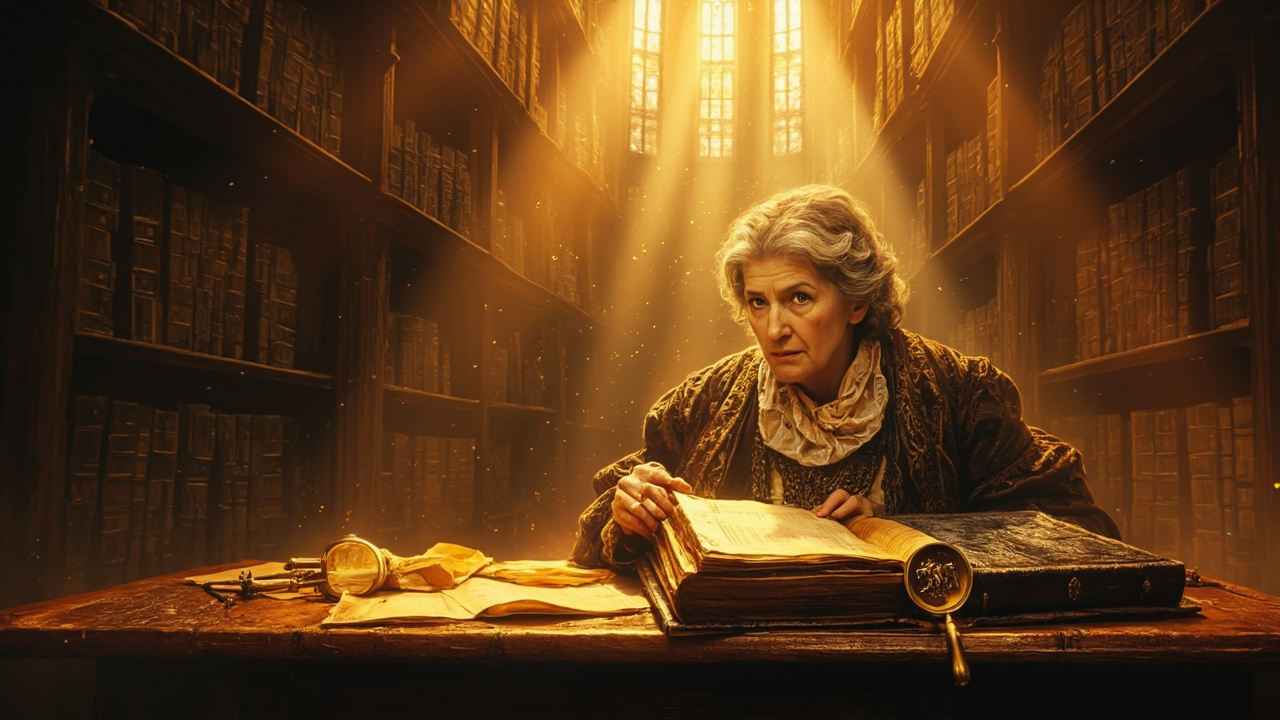
Dr. Eleanor Marsh had spent seventeen years navigating the dusty labyrinth of the Royal Archives at St. James's Palace. She had become accustomed to the peculiar silence of the place—the way sunlight fell in dusty columns through high windows, illuminating motes that swirled like tiny constellations. She had catalogued thousands of birth certificates, death notices, and marriage records, building an unremarkable career as a genealogical researcher for the Crown's Historical Advisory Panel. But nothing had prepared her for what she found on a wet Tuesday in November.
It began with a misfiled box. A recent reorganisation of the Stuart-era records had displaced several collections, and Eleanor had been tasked with returning them to their proper locations. The box in question bore no label, only a faded wax seal depicting a lion rampant—emblematic of a house that had not occupied the British throne for three centuries. Inside, wrapped in oilcloth that had long since disintegrated into a sticky residue, lay a ledger bound in leather so dark it appeared almost black.
The volume fell open to a page dated 14 February 1687, and Eleanor's breath caught in her throat. The entry was written in a careful court hand, documenting the secret marriage of an unnamed duke's daughter to a foreign prince—information that had never appeared in any official record. What followed was more astonishing still: a list of further unions stretching across decades, each annotated with the same cryptic phrase: Deaths and marriages unknown to the public.
For three hours, Eleanor did not move from the reading desk. She photographed page after page, her hands trembling only slightly, her mind racing through the implications. This was not merely an archival curiosity. This was evidence of a systematic concealment that spanned centuries—marriages that had been erased from memory, offspring who had been hidden from genealogies, alliances that had been struck in shadow and then carefully buried. If the children of these unions had survived and reproduced, the entire documented lineage of European royalty might be fundamentally compromised.
The next morning, two men arrived at Eleanor's desk. They wore dark suits and spoke with the clipped politeness of those accustomed to authority. They asked about recent access to the archives, about the reorganisation, about boxes that might have been misplaced. Eleanor recognised the questions for what they were: a reconnaissance. She gave them nothing useful, feigning ignorance with a competence born of long practice in bureaucratic survival. They left a card with a phone number and no name.
That evening, she returned to the ledger. She began cross-referencing entries against secondary sources—parish records, aristocratic correspondence, contemporary diaries. The confirmations came steadily. Death records matched. Marriage certificates corroborated. Portraits existed in private collections. Financial transactions aligned. The ledger was authentic, and its contents were devastating.
Eleanor began to perceive a pattern. Certain families appeared repeatedly as beneficiaries of the secret marriages—their bloodlines reinforced, their claims strengthened, their descendants placed in advantageous positions across generations. Others were conspicuously absent, their names never appearing despite having every historical reason to do so. It was not merely a record of secrets. It was a tool of influence, a mechanism for steering the course of dynastic politics from the shadows.
The most damning entry was dated 1702. It documented the secret marriage of a daughter of Queen Anne—officially stillborn, never acknowledged, struck from all records—to a German prince. The daughter, the ledger stated, had survived. She had been placed with loyal subjects and raised in obscurity. But her children had not remained obscure. Eleanor traced the line forward through generations, her heart hammering, and found connections that led directly to several of the most powerful families in contemporary Europe.
She was still staring at the page when she heard footsteps in the corridor. They were measured, unhurried, and they stopped outside her door.
The man who entered was older than the visitors from the previous day, with the bearing of someone accustomed to deference. He wore a pinstripe suit of impeccable cut and carried a silver-topped cane. His eyes, pale blue and appraising, settled on the open ledger with an expression Eleanor could not quite read.
"Dr. Marsh," he said. "I understand you have been asking rather interesting questions about our archives."
"I don't know what you mean," Eleanor replied, her voice steady despite the fear coiling in her stomach.
He smiled without warmth. "I think you do. And I think you understand, as others have before you, that some knowledge is not meant to be disturbed. The ledger you have found has remained hidden for good reason. Its contents, if released, would destabilise governments. They would delegitimise monarchies. They would expose centuries of deliberate deception."
"And yet you kept it," Eleanor said. "You kept it here, where anyone might find it."
"The archive is secure. It has always been secure. What it has not been, until now, is compromised." He stepped closer, lowering his voice. "We would prefer to resolve this matter discreetly. There are resources available to you—early retirement, a research fellowship abroad, a generous settlement. All we ask is the ledger, the photographs, and your silence."
Eleanor thought of the card with no name, the men in their dark suits, the systematic erasure of inconvenient truths. She thought of the faces in the portraits she had studied for seventeen years—faces now transformed by context, by the terrible knowledge of what had been hidden behind their official smiles.
"No," she said.
The old man studied her for a long moment. "You understand what you are refusing. The consequences will not be pleasant."
"I understand that people have refused before," Eleanor replied. "And I understand what happened to them. But the difference is that they worked alone. They trusted the wrong people, or they hesitated, or they were silenced before they could act. I have done none of those things."
She had not worked alone. In the weeks since discovering the ledger, she had been careful—oh, so careful—to share fragments of her findings with trusted colleagues, to deposit copies with solicitors who owed her personal debts of gratitude, to embed evidence in academic papers that would be published after her death, should death come. She had woven a web of revelation so intricate that no single thread could be cut without the others unravelling it in time.
The old man seemed to read this in her expression. Something shifted in his pale eyes—not defeat, exactly, but a kind of weary recognition.
"You believe you have won," he said. "You believe that the truth will out and justice will prevail. It is a charming sentiment, Dr. Marsh. It is also naive. We have managed these secrets for three hundred years. We will manage them for three hundred more."
"Perhaps," Eleanor said. "But you will manage them differently now. The ledger will surface. It will be authenticated. And when it is, everyone will know what you have done. You can adapt, as you always have. But you cannot pretend anymore. The pretence is over."
He looked at her for a long moment. Then he turned and walked out without another word.
Eleanor sat alone in the archive for a long time after he had gone. The ledger lay open before her, its secrets exposed to the lamplight. Outside, the rain continued to fall on St. James's Palace, on the city, on the centuries of accumulated silence. She did not know what would happen next. She did not know if she would live to see the consequences of what she had set in motion. But she knew, with a certainty that felt like the weight of history itself, that she had done the right thing.
Some doors, once opened, cannot be closed again. And some truths, once spoken, can never be unspoken.