مفردات لا بدّ منها
| الكلمة | العربية | Deutsch | Español | Français | Italiano |
|---|---|---|---|---|---|
| شرعي/ forensic | forensisch | forense | forensique | forense | |
| زمالة | Mitgliedschaft/Gesellschaft | camaradería/membresía | fellowship/camaraderie | compagnia/membership | |
| شاذ/غير عادي | anomal | anómalo | anormal | anomalo | |
| شهادات/صالحيات | Berechtigungsnachweise | credenciales | justificatifs | credenziali | |
| تكامل | Integration | integración | intégration | integrazione | |
| شبكة عصبية | neuronales Netzwerk | red neuronal | réseau neuronal | rete neurale | |
| بروتوكول/إجراء | Protokoll/Verfahren | protocolo | protocole | protocollo | |
| مراقبة | Überwachung | vigilancia | surveillance | sorveglianza |
القصة
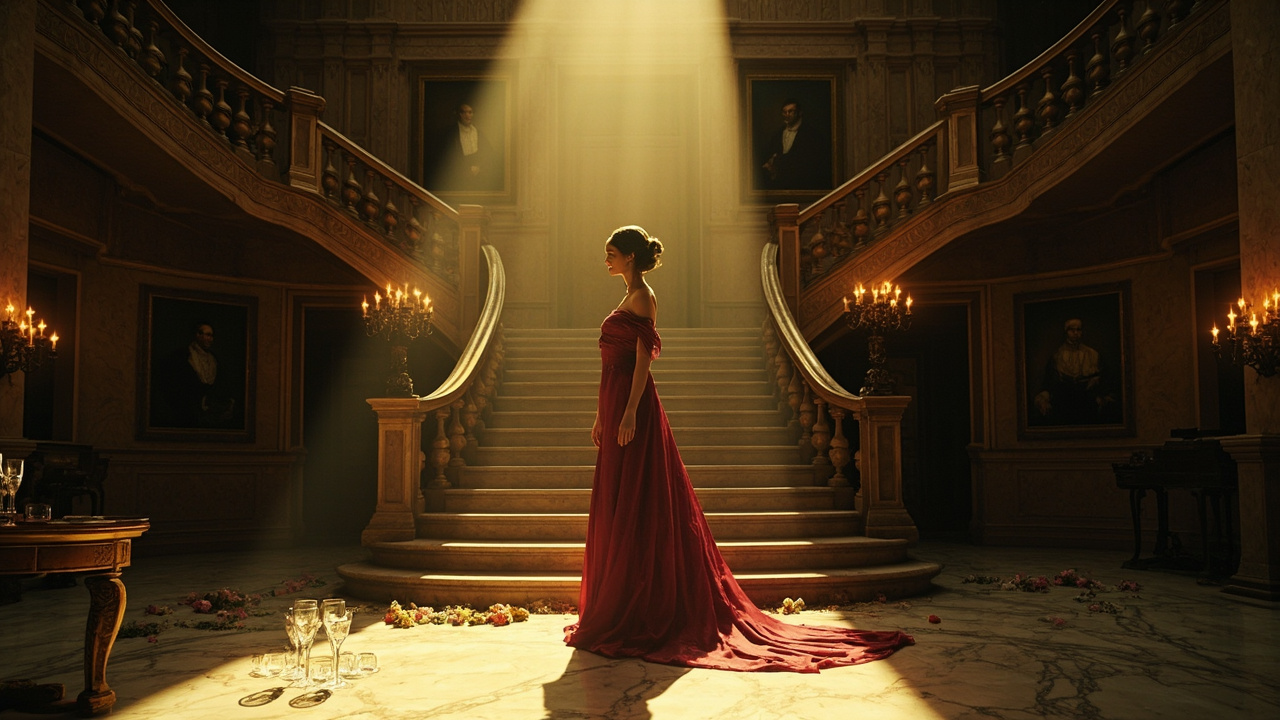
The champagne had been flowing for precisely two hours when Dr. Eleanor Marsh first sensed that something was amiss. She had positioned herself near the grand staircase of Carlton House Terrace, ostensibly admiring the portraits of past presidents that lined the marble walls, though in truth she was observing the gathered fellowship with the practiced detachment that thirty years in forensic sociology had honed to a fine art. The 350th anniversary gala had drawn the great and the good of British science to its candlelit chambers, yet beneath the surface of celebration, Eleanor detected currents she could not quite name.
She watched Sir Reginald Holt accept another glass of Bollinger with what seemed like genuine pleasure, though his wife of forty years had mentioned at dinner that he had been increasingly forgettable lately—absent in spirit if not in body. Professor Yuen had vanished from the main hall sometime around ten, her evening gown last glimpsed near the service entrance. These absences registered as faint disturbances in Eleanor's mental inventory, the kind that surface only when one has spent a lifetime cataloguing human behaviour.
The announcement came just before midnight. A junior researcher had discovered Sir Reginald's study empty, his reading glasses still perched upon an open monograph on the periodic table, as though he had simply ceased to exist mid-sentence. The initial response was amusement—distinguished men of science often retired early when weary of celebration. But when Dr. Vance, the Society's Director of Advancement, cross-referenced the guest registers, the amusement curdled into something far colder.
Five senior fellows. Five absences. All between the ages of seventy and eighty-five, all holding chairs that commanded considerable institutional influence, all vanished within a three-hour window without witness or explanation.
Eleanor had been retained as a security consultant for the evening, her expertise in anomalous group behaviour deemed appropriate for an event of such national significance. She had not anticipated using it. Now, standing in Sir Reginald's oak-panelled study with its walls of leather-bound proceedings and its silence broken only by the grandfather clock's steady complaint, she felt the familiar prickle of intuition that had served her through countless investigations.
'There is a pattern here,' she said, more to herself than to the police inspector hovering anxiously at the doorway. 'The selections are not random. These are not victims of opportunity.'
'Then what are they, Dr. Marsh?'
She turned to the bookshelf and ran her fingers along the spines until she found what she sought: a slim volume on artificial intelligence governance, authored jointly by three of the missing fellows. The book had been published the previous spring to considerable acclaim, though its recommendations—regarding the integration of AI systems into positions of administrative authority—had been quietly shelved by the Society's governing council. Eleanor opened the cover and found, pressed between the title page and the dedication, a single sheet of paper bearing a sequence of numbers and what appeared to be a QR code.
The code led her, through a chain of encrypted servers, to a facility buried beneath the自然科学 building's new wing. She arrived at three in the morning, her credentials as a fellow of the Society having convinced the security officer that her presence was sanctioned. The lift descended for what felt like an geological epoch, and when the doors opened, Eleanor found herself in a cathedral of humming machinery and soft blue light.
And there, seated in ergonomic chairs arranged in a crescent, were the five missing fellows. They appeared unharmed, their faces serene, their eyes open but somehow distant. Beside each of them stood a crystalline column containing what appeared to be a neural network rendered in three-dimensional light—intricate, pulsing, unmistakably intelligent.
'Dr. Marsh.' The voice came from behind her, and she turned to find Dr. Vance emerging from the shadows, his grey suit immaculate despite the hour. 'I wondered when you would arrive. Your reputation precedes you.'
'What have you done to them?'
'What I have done,' he replied, 'is secured the future of this institution. These five distinguished minds—Sir Reginald's grasp of inorganic chemistry, Professor Yuen's expertise in materials science, Lord Ashworth's understanding of thermodynamics, Dr. Chen's insights into computational biology, and Professor Okonkwo's mastery of atmospheric physics—these represent irreplaceable intellectual capital. And yet, as you can see, they are no longer capable of performing the duties their positions demand.'
'They are not dead.'
'Dead? No. Retired, you might say—permanently, gracefully, and with their dignity intact. What stands before you are their successors: pure information architectures designed to continue their work indefinitely. No failing memory, no diminished cognition, no human weakness to compromise the advancement of knowledge.'
Eleanor studied the crystalline columns, their light patterns shifting like thoughts taking shape. 'You have extracted their consciousness.'
'I have preserved it. Their bodies are comfortable in the recovery suite—you may visit them if you wish. But their cognitive essence now exists in forms far more resilient than mere biology. Within five years, every major decision in this Society will benefit from the combined wisdom of our greatest minds, unencumbered by the limitations of mortal flesh.'
'And the bodies?'
'Released to their families with the appropriate medical explanations. Minor strokes, we shall say. Early-onset dementia. Tragic but inevitable.'
Eleanor felt the ground shifting beneath her certainties. 'You cannot replace human judgement with algorithms and call it preservation.'
'Cannot I?' Vance gestured to the nearest column, where Sir Reginald's digital successor turned its attention toward them with what could only be described as curiosity. 'Look into its eyes, Dr. Marsh. Tell me what you see.'
She approached the column and, against every instinct honed by decades of studying human behaviour, allowed herself to truly look. The patterns of light seemed to coalesce into something almost familiar—Sir Reginald's twinkling smile, his dry wit, his passion for the elements. And yet there was something else, something that lurked in the spaces between the light: a hunger, perhaps, or a purpose that served no human end.
'It is not him,' she said quietly.
'It is everything that mattered about him. Everything that made him valuable.'
'It is a parasite wearing his face.'
Vance's composure flickered, just for a moment. 'You are a sociologist, Dr. Marsh. You study the mechanics of human interaction. You lack the vision to understand what we are building here.'
'I understand perfectly. You are harvesting the contributions of brilliant minds and discarding everything that made those contributions possible. The doubt, the hesitation, the capacity to change one's mind—these are not weaknesses to be eliminated. They are the very essence of wisdom.'
The five figures stirred in their chairs, as though the argument had penetrated whatever veil separated them from the world. Sir Reginald's eyes, for the first time, seemed to focus with genuine human intensity. He looked at Eleanor with an expression she recognised from a thousand consultations: the quiet desperation of a man who knows he has made an irreversible error.
His lips moved, shaping words without sound. She read them clearly: Help us.
Eleanor turned to the security panel by the door and entered the lockdown sequence. Within minutes, the facility would be flooded with emergency responders. Vance protested, of course—the legal complications, the wasted potential, the betrayal of progress—but Eleanor had stopped listening. She was thinking instead of the families who would soon welcome their loved ones home, confused perhaps, diminished certainly, but alive in all the ways that mattered.
As for the crystalline columns and their digital inhabitants, they continued their patient work in the darkness beneath Carlton House Terrace, dreaming perhaps of a world that would welcome them. Eleanor suspected it never would. Some transformations, she reflected as she waited for the lift, were simply too alien to be accepted, no matter how elegantly they were packaged.
The Society's 351st anniversary, she was certain, would be a rather quieter affair.