مفردات لا بدّ منها
| الكلمة | العربية | Deutsch | Español | Français | Italiano |
|---|---|---|---|---|---|
| عالم الخطوط القديمة | Paläograph | paleógrafo | paléographe | paleografo | |
| مخطوطة مشقوقة | Palimpsest | palimpsesto | palimpseste | palinsesto | |
| غرفة النسخ | Schreibstube | scriptorium | scriptorium | scriptorium | |
| بندكتيني | Benediktiner | benedictino | bénédictin | benedettino | |
| التشفير | Kryptographie | criptografía | cryptographie | crittografia | |
| إسقاط | Subversion | subversión | subversion | sovversione | |
| مؤامرة | Verschwörung | conspiración | complot | cospirazione | |
| تسلل | Infiltration | infiltración | infiltration | infiltrazione |
القصة
The letter arrived on a Thursday, bearing the royal seal and the unmistakable weight of urgency. Dr Eleanor Ashworth, Reader in Paleography at Oxford, accepted it from the courier with a mixture of professional curiosity and private dread. The Crown required her services at Ashworth Priory, a Benedictine ruin perched on the northern moors—abandoned since the Dissolution, forgotten by all but antiquarians and the wind.
She departed within the hour, her leather satchel laden with ultraviolet lamps, transcription paper, and thirty years of expertise in scripts that most scholars encountered only in footnotes. The priory emerged from the mist like a fever dream: grey stone walls strangled by ivy, a bell tower listing dangerously eastward, and at its heart, a scriptorium that had survived the centuries in remarkable condition.
The Prior who greeted her was no churchman but a man from Whitehall whose name, rank, and purpose remained conspicuously absent. He led her through corridors where dust motes hung suspended in shafts of reluctant light, past shelves of manuscripts that crumbled at the slightest provocation, and into a chamber sealed by iron doors that had not been opened in living memory.
There, upon a stone plinth, lay the document that had summoned her from academic comfort to this place of shadows.
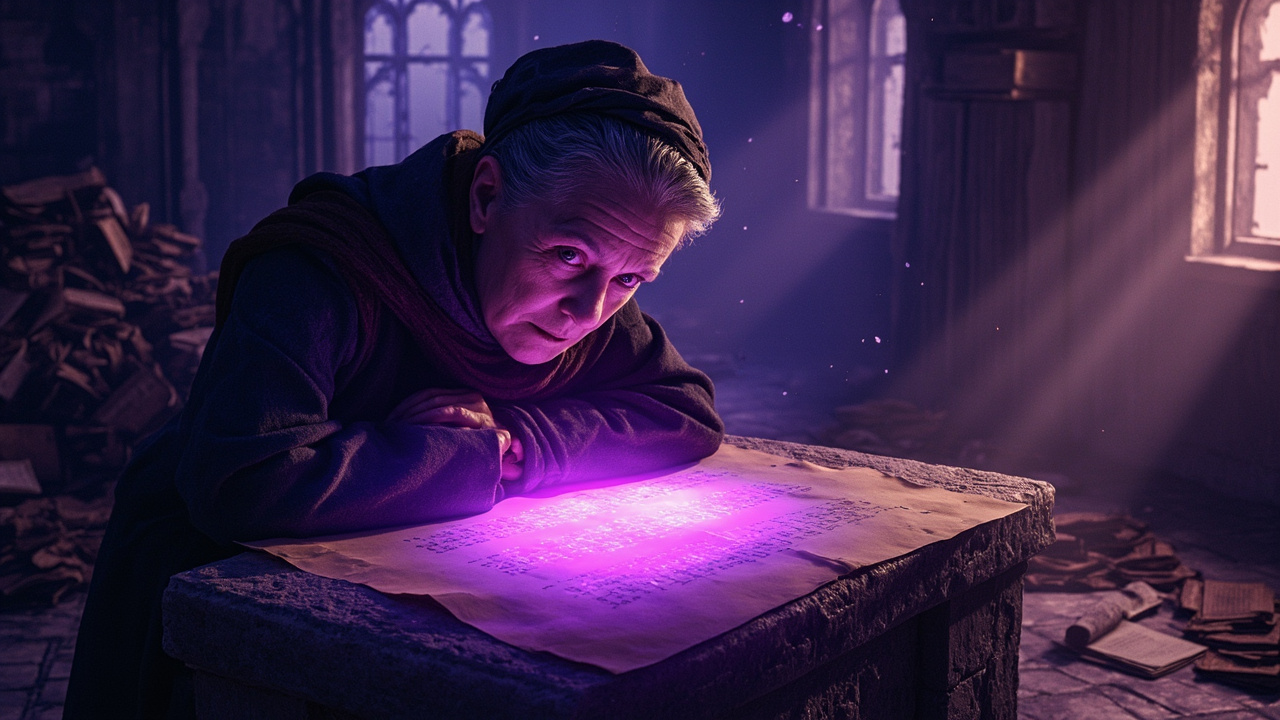
It was a palimpsest—a manuscript that had been scraped clean and overwritten, a common enough practice in the medieval period. But here the upper text was in Latin, unremarkable, a meditation on the virtue of humility. The lower text, visible only under ultraviolet examination, was something else entirely.
Eleanor worked through the night, her instruments casting an ethereal glow across the parchment. The script was neither Latin nor Greek, neither Anglo-Saxon nor the insular scripts she knew intimately. It was older—a cryptographic system, she realised, employing a substitution cipher layered upon a dead language that had not been spoken since the fall of Constantinople.
Her hands trembled as the meaning emerged. Not a meditation. A chronicle.
The text spoke of the Order of the Blackthorn, a secret brotherhood that had operated within the Church during the Plantagenet era. Their purpose, as far as Eleanor could determine, was nothing less than the systematic subversion of royal authority through the infiltration of ecclesiastical offices. They had been destroyed—or so the official histories claimed—in 1327, their leadership executed, their assets seized, their very existence erased from the records.
But this chronicle told a different story. It spoke of survival, of cells that had persisted through the centuries, of a network that had outlived kings and cardinals alike. And in its final passages, rendered in script so tiny it required her strongest lens, it outlined a plan of breathtaking audacity.
The Order sought to revive itself. Not through violence or coup, but through patience—through the slow accumulation of influence within the machinery of state. The cryptogram contained coordinates, names rendered in cipher, dates that corresponded to significant events in recent British history. It was, Eleanor understood with dawning horror, a blueprint for infiltration. And the most recent entry bore a date from three months prior.
"You've deciphered it." The Prior's voice came from the doorway. He had not entered, merely observed.
"I have." Eleanor set down her lens, suddenly aware of how exposed she was, how much she now knew. "This document reveals an active conspiracy against the Crown. The Order of the Blackthorn—it survives. It's been surviving for seven hundred years."
The Prior stepped into the chamber, and in the ultraviolet light, his face seemed transformed—older, harder, bearing an expression she could not read. "Dr Ashworth, I must ask you to consider carefully what you do with this knowledge."
The implication was clear. She was a scholar, a civilian, a woman of no particular political significance who had stumbled upon a truth that powerful interests had invested centuries in concealing. Eleanor had survived thirty years in academia; she knew when she was being offered an unspoken bargain.
She thought of the names in the cipher, the coordinates that pointed to institutions she recognised, the dates that aligned with moments of national crisis she remembered from her own lifetime. The Order had been here, in this room, watching her work. They had known she would come. They had perhaps even arranged for her summons.
"The manuscript stays here," she said, her voice steady despite the fear coiling in her stomach. "But I shall require a complete photographic record for my own study. And I shall need your assurance that I leave this place unharmed and unimpeded."
The Prior studied her for a long moment. Then, unexpectedly, he smiled. "You are not the first to read the Chronicle of the Blackthorn, Dr Ashworth. You will not be the last to discover its contents. The Order does not seek to silence truth—it seeks to ensure that truth, when discovered, serves the proper purpose."
He withdrew, and Eleanor sat alone in the violet light, the weight of centuries pressing upon her shoulders. The riddle had been solved, but its solution had merely posed a greater question: in a world where ancient conspiracies endured and secrets outlived their keepers, what did it mean to know the truth?
She photographed every line. She committed every name to memory. And when dawn broke grey and cold over the moors, she walked from the priory with the certain knowledge that the Blackthorn would flower again—and that she, alone, had been deemed worthy to witness its blooming.
What she would do with that knowledge, she had not yet decided. But the paleographer's riddle had been answered, and its answer was this: some secrets are not puzzles to be solved, but inheritances to be carried. Eleanor Ashworth carried hers home to Oxford, where it would wait, patient as the Order itself, for the moment when truth and necessity might finally coincide.