مفردات لا بدّ منها
| الكلمة | العربية | Deutsch | Español | Français | Italiano |
|---|---|---|---|---|---|
| شفرة | Chiffre | cifrado | chiffre | cifrario | |
| قبو تحت الأرض | Krypta | cripta | crypte | cripta | |
| مُقَبَّب | gewölbt | abovedado | voûté | voltato | |
| إحداثيات | Koordinaten | coordenadas | coordonnées | coordinate | |
| متاهة | Labyrinth | laberinto | labyrinthe | labirinto | |
| بارز | hervorstand | sobresalía | dépassait | sporgeva | |
| دراما مبالغ فيها | Melodrama | melodrama | mélodrame | melodramma | |
| أُعيدَ معايرتها | neu kalibriert | recalibrado | réétalonné | ricalibrato | |
| مؤسسة | Institution | institución | institution | istituzione | |
| الأرصاد الجوية | meteorologisch | meteorológico | météorologique | meteorologico |
القصة
The morning Margaret Chen chose to descend into the disused undercroft of St Pancras International was, by all meteorological accounts, unremarkable. Grey November light filtered through the vast arched windows of the station's western face, casting long shadows across the gleaming rails below. Margaret, sixty-three years old and forty of those spent in the employ of British Rail and its subsequent incarnations, had seen the old station through more seasons than she cared to enumerate. She knew its rhythms as intimately as a cardiologist knows the human pulse.
It was this familiarity that drew her, that particular afternoon, to a maintenance hatch she had not opened in nearly a decade. The undercroft — that vast subterranean labyrinth of brick arches and reclaimed land upon which the station had been constructed — had been sealed for years, condemned to a sort of institutional amnesia by the redevelopment that had transformed St Pancras into the Eurostar terminal the nation now regarded with a peculiar mixture of pride and bewilderment. Yet something about the hatch's proximity to the old freight sidings nagged at her. A loose rivet. A faint draught where none should exist.
She opened it.
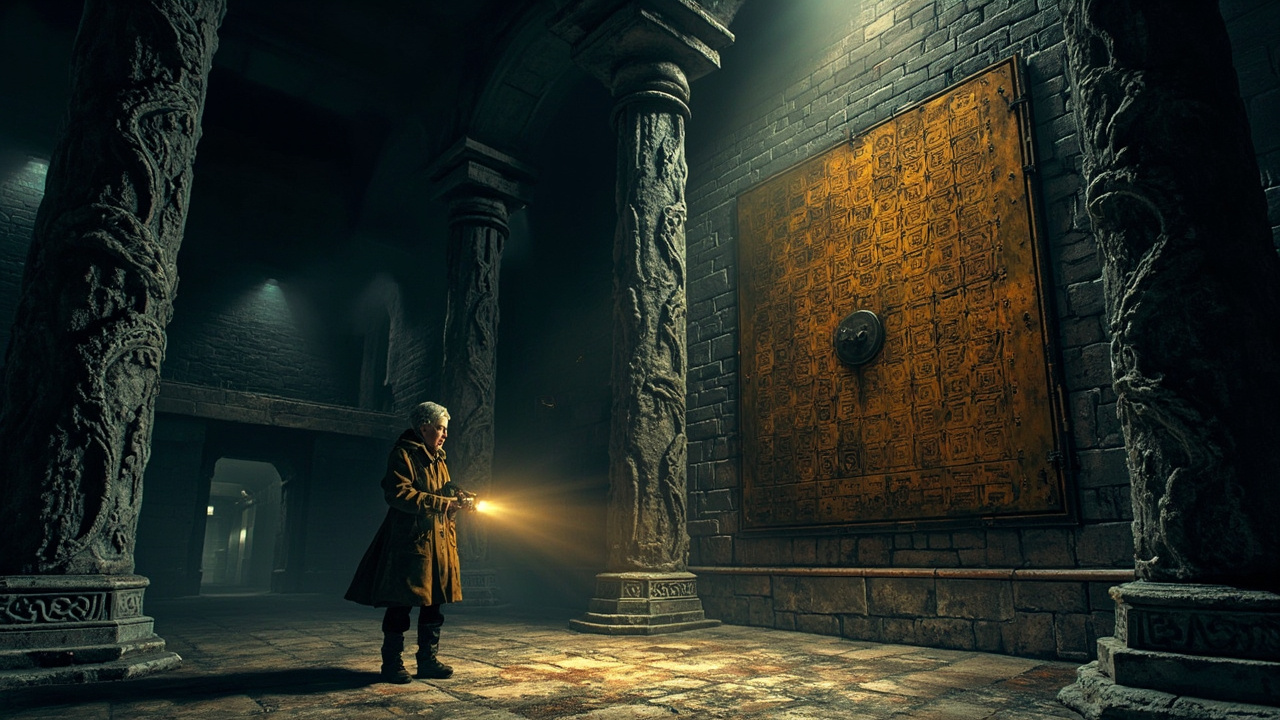
The air that greeted her was cold, mineral, and scented with the peculiar mustiness of Victorian brickwork — a smell she could identify instantly, having spent half her career crawling through the island's railway infrastructure. She descended the rusted ladder, flashlight in hand, and found herself in a vaulted chamber she had never encountered on any survey map. The ceiling was supported by a forest of cast-iron columns, their surfaces ornately decorated with motifs she did not immediately recognise: serpents consuming their own tails, alchemical symbols, and — most curiously — a recurring motif of a locomotive half-consumed by foliage, as though the machine were being slowly reclaimed by nature.
It was on the eastern wall that she discovered the map.
It was not, strictly speaking, a map in the conventional sense. Rather, it was a grid of interlocking brass plates, each inscribed with text in an encoded hand and bearing a series of what appeared to be co-ordinates. The plates had been set into the brickwork with extraordinary precision, and a small brass dial, blackened with age, protruded from the centre of the arrangement. Margaret was not, by temperament, a woman given to melodrama. She was an engineer. She had dismantled mechanical failures on the East Coast Main Line during the extremities of winter, had recalibrated signalling systems under the scrutiny of inspectors whose displeasure could curdle milk. But she felt, in that moment, a chill that had nothing to do with the temperature.
She photographed everything. Then she climbed back to the surface, sealed the hatch, and went home to her flat in Kentish Town, where she spread the images across her dining table and began to research.
The encoding, she discovered, was a variant of the Vigenère cipher, but threaded with railway engineering notation that gave it a layer of obscurity she initially mistook for random damage. It took her three weeks — three weeks of evenings spent with her old railway timetables, her copy of Kryptos, and a quadrilingual dictionary she had owned since university — to decode the first passage. What it revealed made her set down her tea with a hand that trembled, imperceptibly, against the rim of the cup.
"The cargo of the Prometheus Arrangements shall pass beneath the eye of the law through the mechanism of freight. Twelve vessels, twelve chambers, twelve years hence to be reclaimed by those who planted them. The key turns in the lock of the engine house, and the engine house turns in the lock of the nation."
Margaret cross-referenced the co-ordinates with the station's architectural survey records — documents she had access to through the alumni network of the Institution of Civil Engineers. The positions corresponded precisely to a series of sealed chambers located along the old Midland Railway freight tunnels, tunnels that had been officially listed as collapsed and structurally unsound since 1912. No survey had entered them in over a century. The Great Western Railway's own records, obtained through the British Library's manuscript collection, told a different and far more unsettling story.
They told of a secret society among the railway's senior engineers in the final decades of the nineteenth century, men who had access to the construction of St Pancras and who had used that access to create a hidden vault system within the fabric of the building itself. They had called themselves the Syndicate of the Promethean Line. Their purpose, as Margaret pieced it together from coded correspondence between members, was nothing less than the systematic removal of irreplaceable artefacts from the British Museum, the National Gallery, and numerous private collections, to be transported out of the country under the cover of routine railway freight shipments bound for the Continent. The artefacts — sculptures, manuscripts, jewellery, and paintings of incalculable value — were never intended to leave Britain permanently. The coded correspondence spoke of a "temporal escrow," a deliberate concealment of cultural treasures against a future catastrophe the engineers believed was imminent, a future political upheaval they predicted with the grim conviction of men who had seen empire begin to fray at its edges.
The collapse of the tunnels, Margaret realised, had been intentional. The engineers had sealed their own work to protect it, trusting that a future generation would decipher what they had left behind.
She contacted the station's current management. She contacted the British Museum's conservation directorate. She contacted, with considerable reluctance, a journalist she had once helped during a particularly unpleasant episode involving a derailed freight train and a rather defensive public relations department. The journalist, to his credit, understood immediately the magnitude of what she had found and exercised a discretion that Margaret had not known he possessed.
The excavation, when it came, took four months. It required the combined expertise of structural engineers, conservators, cryptographers, and representatives of half a dozen national heritage bodies. The artefacts, when they emerged from the sealed chambers, were wrapped in waxed paper and oilcloth that had survived the intervening century with remarkable efficacy. There were thirty-seven items in total: a Roman marble bust that had been listed as destroyed in a shipping accident in 1887, a Vermeer that had vanished from a Dutch collection in 1892, illuminated manuscripts that pre-dated the Norman Conquest, and a collection of Egyptian funerary objects whose provenance could not be accounted for by any existing museum register.
Margaret Chen attended the press conference in a tweed jacket and flat shoes, looking precisely as she always had — like a woman who had spent her life solving problems that other people preferred to ignore. She declined every interview request. She returned to Kentish Town, made herself a pot of strong tea, and sat by the window watching the trains pass on their way to wherever trains go when they leave St Pancras.
But that night, before she slept, she permitted herself a single thought that she would never share with anyone, not even the journalists who still telephoned with increasing desperation: she had not merely uncovered a conspiracy. She had fulfilled one. The engineers of the Promethean Line had built their vault, encoded their message, and sealed their tunnels with the absolute faith that, in time, someone with the knowledge to read their cipher and the stubbornness to act upon it would come looking. They had been right. They had simply not known, could not have known, that the person who would finally turn their key would be a retired railway engineer from Kentish Town who had gone down into the undercroft on an unremarkable November afternoon because a rivet had seemed, somehow, out of place.