مفردات لا بدّ منها
| الكلمة | العربية | Deutsch | Español | Français | Italiano |
|---|---|---|---|---|---|
| طبقاتية | Stratigraphie | estratigrafía | stratigraphie | stratigrafia | |
| متاهة-like | labyrinthartig | laberíntico | labyrinthique | labirintico | |
| انحراف | Dissonanz | disonancia | dissonance | dissonanza | |
| مُصرف | ausgezahlt | desembolsado | déboursé | erogato | |
| مصنف | geheim | clasificado | classifié | classificato | |
| سجل | Chronik | crónica | chronique | cronaca | |
| بناء | Mauerwerk | albañilería | maçonnerie | muratura | |
| أمين السجل | Registerführer | registrador | greffier | archivista |
القصة
Every night at half-eleven, the clock in the basileus reading room struck a chord of four notes that Eleanor Marsh had never heard anywhere else — a dissonance that resolved, after a half-second pause, into something almost resembling music. She had worked the night shift in the Gresham College library for three years, and she had never grown accustomed to it. She had grown, instead, to expect it, the way one expects the turning of a key in a lock that is not quite perfectly fitted: a small resistance, then entry.
The college itself sat wedged between Kingway and Broad Street, its Georgian façade unremarkable to the passerby, its interior a stratigraphy of centuries. The library occupied the eastern wing, a labyrinthine extension added piecemeal over two hundred years, its shelves described by the college caretaker not as shelves but as stacks — a word Eleanor had always found oddly architectural, as though the books themselves were load-bearing.
On the seventeenth of November, she discovered the first anomaly.
She had gone to retrieve a volume of the Philosophical Transactions from the shelf designated M-7, third shelf from the bottom, when she found nothing. The gap where the bound journal ought to have been was occupied instead by a narrow space — no wider than her hand — that she was certain had not existed that morning. She ran her fingers along the shelf's underside and felt cool air rising from below, faint but distinct, carrying the mineral scent of old stone and something else, something she could not immediately name: ink, but not modern ink. Iron gall, perhaps. The kind that had been used three centuries ago.
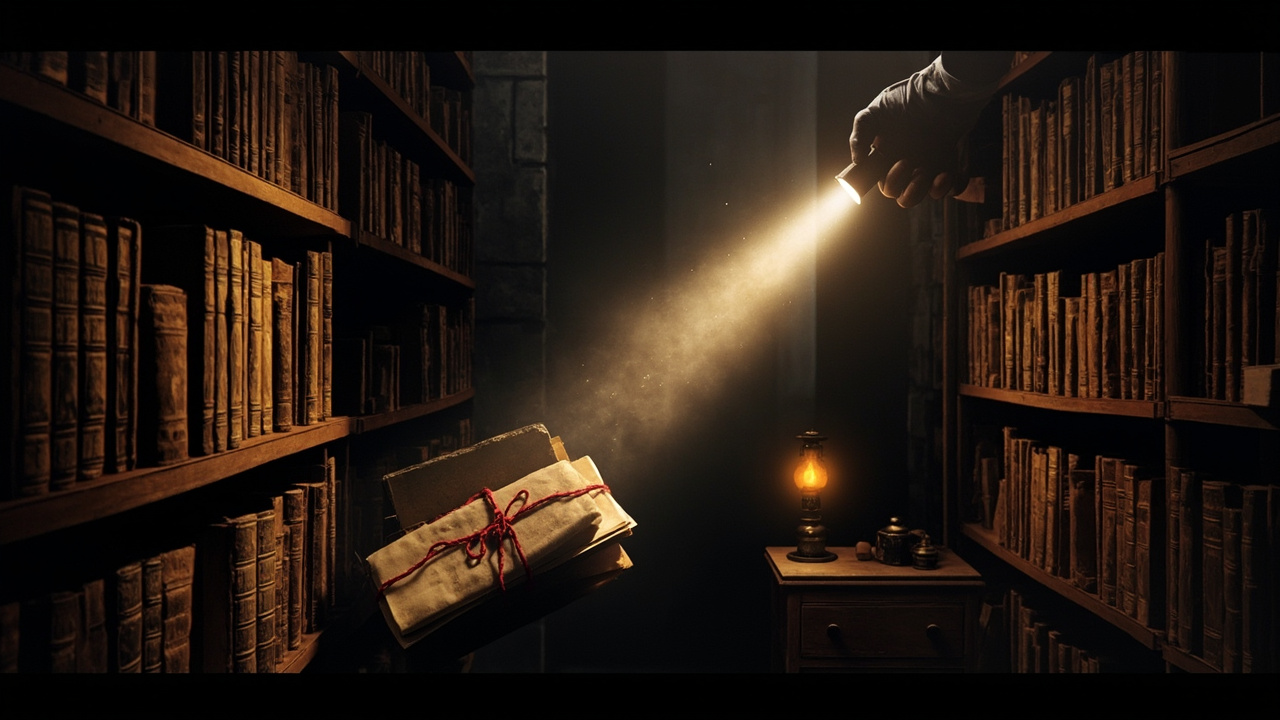
She fetched a torch.
The beam revealed a recess set into the wall behind the shelf, barely wide enough to admit her arm. Inside, resting on a thin ledge of masonry that had the appearance of deliberate construction rather than structural accident, lay a bundle of papers tied with cord the colour of dried blood. She drew it out with the care of an archaeologist handling a bone fragment, carried it to the reference desk, and switched on the lamp.
The handwriting was small, precise, and unlike anything she had seen in the college's official archives. The letters were dated October and November of 1847, and they were addressed to someone named H. Alderton, whose position was given simply as Registrar. The correspondent called himself only V., and his purpose, established in the first paragraph of the initial letter, was unambiguous.
Dear Alderton,
I write to you not as a correspondent but as a conscience. You are aware, as I am aware, of the arrangement concluded at the Ministry in August last. The sum of fourteen thousand pounds was disbursed under classified authorisation to secure the silence of one whose testimony would have proved fatal to the career of the individual I need not name. I have seen the receipts. I have copies.
Eleanor read the letter three times. Her mouth had gone dry. She looked up at the clock: twenty minutes past midnight. The four-note chord was not due for another eleven hours, yet she had the strangest sensation that something in the building had already shifted — that she had passed through a doorway she could not now close.
Over the following nights, she found more. The stacks did not merely conceal the letters; they delivered them, as though the architecture itself had been designed with this purpose in mind. Each evening, a different shelf would betray a new gap, a new recess, a new bundle. She developed a system: photograph each letter in situ, remove the bundle, catalogue its position, then sit with them at the desk until she had read every word. She slept, when she slept, in the small room behind the enquiry office, on a camp bed that smelled of canvas and printer's toner, and she dreamed of shelves that breathed.
The letters formed a chronicle. V. — whose identity she could not establish, though she searched the college records, the census, the directories of the 1840s, and found nothing — wrote with the meticulous fury of a man who had discovered a betrayal and could find no legal means to address it. The scandal he described centred on a minor secretary of state who had, in 1846, accepted a bribe to suppress evidence of financial misconduct by a railway company with parliamentary connections. The railway company had since been absorbed into a larger concern. The secretary of state had died in 1851, honoured and uninvestigated. The silence, V. wrote, had been purchased with public money.
I have placed copies of everything in locations known only to the architecture, V. wrote in his final letter, dated December 1847. Should the truth ever be needed, the building will remember what men have chosen to forget.
There was no further correspondence. Eleanor searched every shelf, every recess, every gap the torchlight could reach. The stacks gave up nothing more. Either V. had exhausted his supply of hidden alcoves, or the building had decided that she had heard enough.
She sat with the letters for a long time after the last discovery. It was past four in the morning, and the library was silent in the way that only very old buildings can be — not the silence of absence, but the silence of attention, as though the walls themselves were listening. She thought about what V. had written. Fourteen thousand pounds in 1847. An equivalence in today's currency that she could not bring herself to calculate. And behind it, not just corruption but the deliberate engineering of forgetting — the systematic replacement of memory with silence, of truth with convenience.
She thought about what to do. The scandal was a century and three-quarters old. The men involved were long dead. The railway company had become, through a chain of mergers and rebranding so complex it would have defeated a forensic accountant, a household name. The documents were, as far as she could determine, genuine. And they were, in any meaningful legal sense, worthless — evidence of crimes beyond any statute of limitations, accusations against the dead that named, as accessories, men whose descendants might still be living.
But V. had not hidden them for legal purposes. He had hidden them, she understood, for the same reason she was sitting here at four in the morning, unable to leave: because some truths are not meant to be acted upon but to be known. To exist in the record. To stand as a correction to the official narrative, however late the correction arrives.
Eleanor placed the bundle back in its recess behind the shelf in M-7. She photographed the position, annotated the record, and updated the library's internal catalogue with a single entry: Accession pending review. Collection of nineteenth-century correspondence, provenance under investigation. It was deliberately vague. It was, she decided, also honest.
She switched off the lamp and walked through the stacks to the door. In the hallway, she paused. The clock in the reading room, which she had not heard strike, showed half-past four. The silence pressed against her ears like deep water.
She locked the door behind her and stood for a moment on the step, looking up at the Georgian façade, its windows dark. Somewhere inside, the shelves held their secrets in the dark, and the building breathed its long, patient breath, and waited.