مفردات لا بدّ منها
| الكلمة | العربية | Deutsch | Español | Français | Italiano |
|---|---|---|---|---|---|
| لغز | Rätsel | enigma | énigme | enigma | |
| إشراق | Ausstrahlung | resplandor | rayonnement | radiosità | |
| زخرفة شبكية | Maßwerk | tracería | treillage | traforatura | |
| رمزي | allegorisch | alegórico | allégorique | allegorico | |
| باطني | esoterisch | esotérico | ésotérique | esoterico | |
| هرمي | hermetisch | hermético | hermétique | ermetico | |
| اللونية | Farbwert | cromaticidad | chromaticité | cromaticità | |
| دقيق | sorgfältig | meticuloso | méticuleux | meticoloso | |
| حفظ | Konservierung | conservación | conservation | conservazione | |
| حث بلطف | vorsichtig überredet | convencido con cuidado | persuadé avec soin | convinto con delicatezza |
القصة
The November light filtering through Eleanor's studio windows was the colour of weak tea, diffuse and colourless—the very opposite of what she worked with. For seventeen years she had coaxed radiance back into fractured medieval glass, coaxed the memory of pigment from beneath centuries of oxidation and grime. Nothing in that extensive catalogue had prepared her for the shipment that arrived on that grey morning.
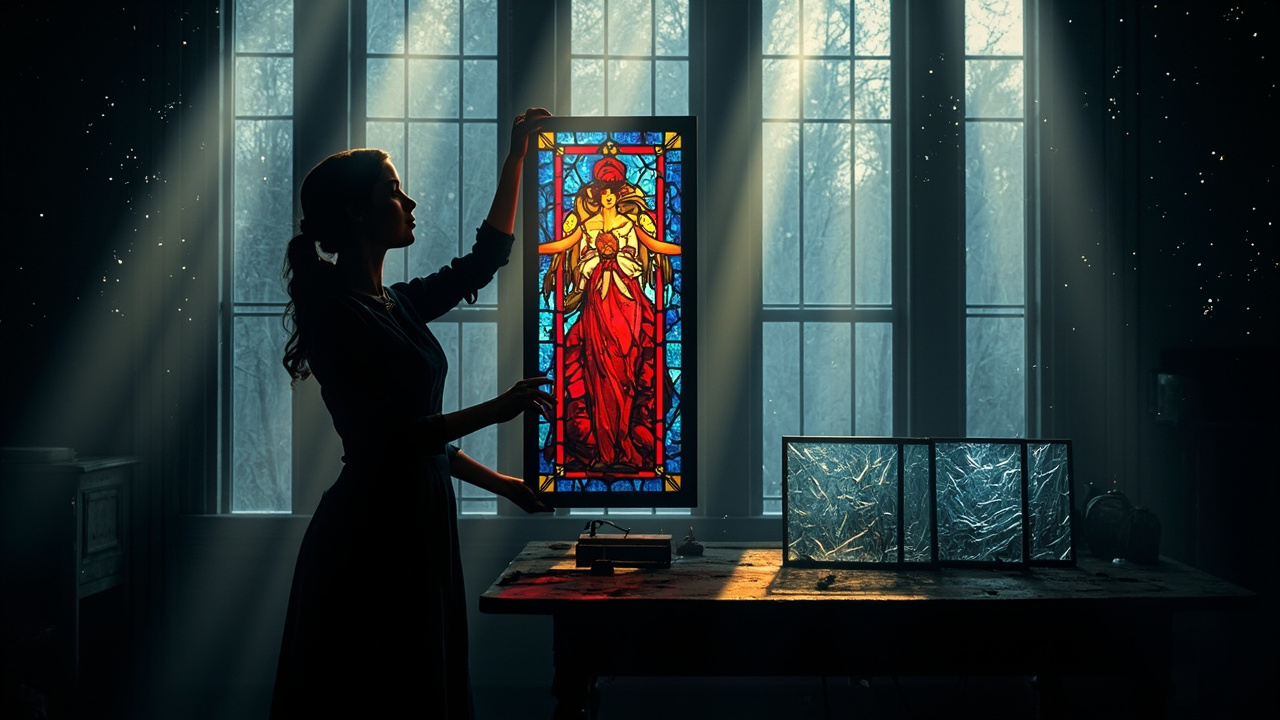
The wooden crates bore no markings beyond the museum's standard inventory tags, but Eleanor noted the care with which they had been packed. Each panel—four in total—had been wrapped in acid-free tissue, nestled within custom-cut foam. Whoever had prepared them understood their value. She unpacked them with the reverent efficiency of long practice, laying each one upon her illuminated viewing table.
The glass was extraordinary. Cathedral-style panels depicting allegorical figures—Temperance, Fortitude, Prudence, Justice—rendered in a style that spoke unmistakably of the mid-Victorian period. The leadwork was sound, the tracery intricate beyond anything produced by mechanical means. Yet the surfaces were dark with accumulated grime, the colours muted to a whisper of their original glory.
Eleanor began her documentation, photographing each panel from every angle. She cross-referenced the museum's acquisition records: the panels had come from a private estate in Gloucestershire, part of a larger set originally commissioned for a private chapel. The original correspondence, preserved in the archives, described them as "lodge glass" commissioned in 1859 for Lord Ashworth's "philosophical glass lodge."
She read the phrase twice. A Masonic connection, perhaps, though she knew better than to assume. The Ashworths had been prominent in certain esoteric circles during the reign of Victoria—she recalled passing references in her undergraduate studies, scholars who had investigated the hermetic traditions that had flourished among certain aristocratic families.
She began the restoration, working with painstaking patience. The surface grime yielded to a soft brush and deionised water. As the layers of decades fell away, Eleanor began to notice irregularities in the glass. Not flaws, but something deliberately placed. The pigment composition was unusual—not merely the standard copper oxides and metallic salts she had encountered in countless restorations, but something more complex embedded within the glass matrix itself.
She paused, holding one panel at an angle to the light. The effect was subtle—a shimmer of deeper colour that seemed to move beneath the surface. She consulted the conservation science laboratory, requesting an analysis of the pigment samples.
Dr. Harrison, the head of scientific analysis, was intrigued. "You're not wrong to be suspicious," he told her three days later. "The composition is unusual. They used a metallic oxide suspension technique—quite advanced for the period. The pigments contain trace elements that would have been expensive and difficult to source. Someone wanted these colours to behave in a very specific way."
"What way?"
"The technical term is angle-dependent chromaticity. The pigments respond differently to light at different angles. It's almost as if—" He hesitated, peering at his notes. "As if they were designed to reveal different things depending on how you look at them."
Eleanor returned to her studio with renewed intensity. She began testing each panel systematically, angling them toward her lamp at various positions, noting the precise degree of tilt at which new colours emerged from the glass. It required absolute darkness, absolute precision. She worked late into the evenings, charting the phenomenon with scientific rigour.
What she discovered stole her breath.
The pigments, when illuminated at specific angles, revealed not merely colour shifts but entire images—additional figures, architectural forms, symbols that had been invisible to casual observation. The panels were not four separate works but parts of a unified whole, their secrets accessible only to those who understood the correct relationship between light, angle, and observation.
She called her colleague Priya, a specialist in Victorian decorative arts. "Tell me I'm not imagining this," she said, adjusting the angle of her lamp until the hidden image materialised in Justice's outstretched hand—a landscape, perfectly rendered, that vanished when she moved the light by a single degree.
"You're not imagining it," Priya confirmed, her voice hushed. "Eleanor, this is... this is remarkable. But what does it mean?"
Eleanor had been asking herself the same question. She spent the following weeks mapping every hidden element across all four panels, documenting the precise conditions required for each revelation. She found that certain pigments responded only to specific wavelengths of light. Some of the symbols were alchemical in nature; others appeared to be letters in an unfamiliar alphabet. And running through the composition like a thread through tapestry, she found a series of numbers—coordinates, perhaps, or a cipher key.
On the last night before she was due to submit her preliminary report, Eleanor worked alone in the darkened studio. She had arranged the four panels in their calculated relationship, adjusting her lamps to precisely the correct angles and intensities. Slowly, as if developing in a photographic bath, the full message emerged.
It was a map. A map and something more—a set of coordinates pointing to a location in the grounds of the former Ashworth estate, together with a date. Not a historical date, she realised with a start, but a date that had not yet arrived. A date three weeks in the future.
The Brotherhood of the Luminant Way, for such she had determined they were called, had encoded their final message in glass and light, trusting that someday, someone would understand how to read it. They had waited, these Victorian mystics, for a reader equipped with the knowledge they could not have foreseen—LED lighting, digital photography, spectroscopic analysis. The message had been patient. It had been waiting for precisely this moment.
Eleanor photographed the completed revelation, then sat for a long time in the darkness, considering what to do with knowledge that had been entrusted to her across the span of more than a century and a half. In the morning, she would contact the museum director. She would explain that the restoration was complete, that the panels were intact, that their secrets had been preserved. And then she would tell him about the coordinates, the date, and what they might mean.
Some messages, she understood now, were not meant to be delivered. They were meant to be discovered.