مفردات لا بدّ منها
| الكلمة | العربية | Deutsch | Español | Français | Italiano |
|---|---|---|---|---|---|
| فهرس | Katalog | catálogo | catalogue | catalogo | |
| أرشيف | Archiv | archivo | archives | archivio | |
| عمدة | Bürgermeister | burgomaestre | burgmestre | borgomastro | |
| دفتر حسابات | Hauptbuch | libro mayor | grand livre | libro mastro | |
| تعداد سكاني | Volkszählung | censo | recensement | censimento | |
| إخلاء | Evakuierung | evacuación | évacuation | evacuazione | |
| رحمة | Gnade | misericordia | miséricorde | misericordia | |
| ينحسر | zurückgehen | retroceder | se retirer | ritirarsi |
القصة
The water had been rising for three days when Eleanor Marchetti began her catalogue.
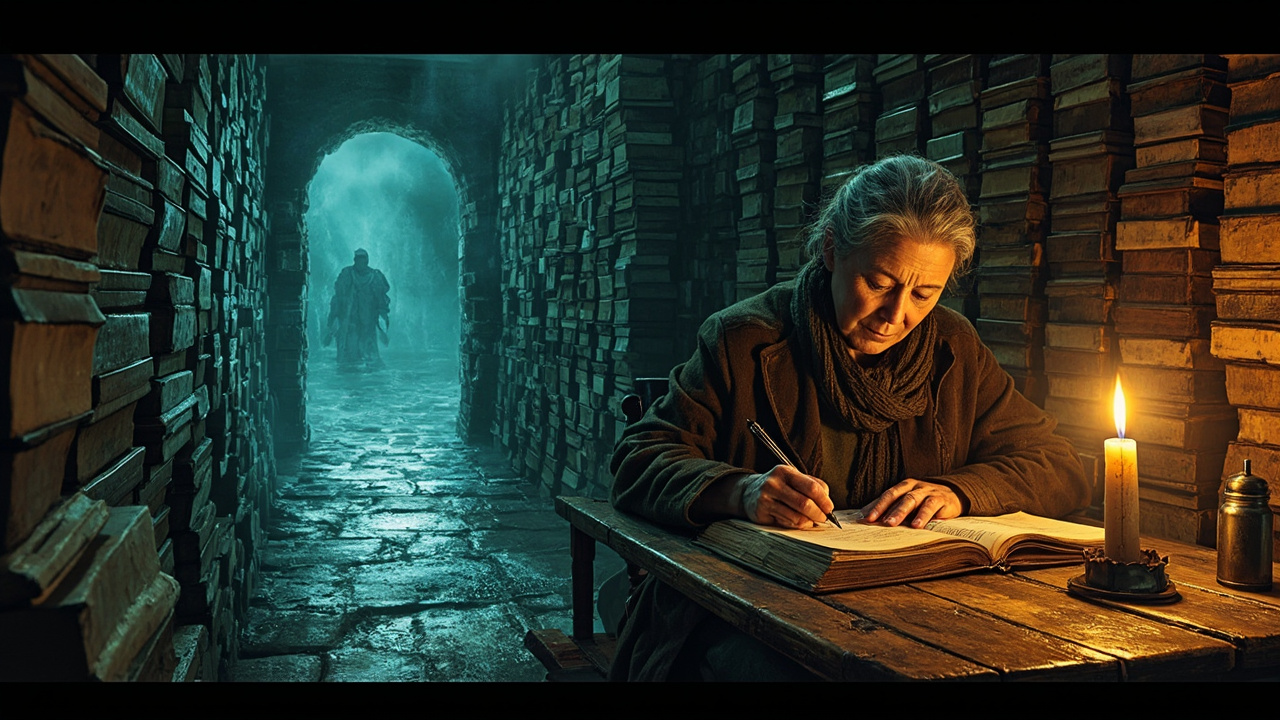
She had not intended to document anything. The archive she maintained in the basement of the town hall—records stretching back two centuries, census data, property deeds, the faded correspondence of long-dead burgomasters—had occupied her working life so completely that she had never considered it could be interrupted. But the flood had not reached the basement, and when the evacuation order came, she had descended the cellar stairs with the irrational conviction that the documents required her presence more urgently than she required safety.
The water never came. But the solitude did.
She was sitting among the dry stacks, listening to the muffled sounds of catastrophe above, when she heard knocking at the heavy door. She opened it to find the daughter of her neighbour—a girl of perhaps nine, shivering in a sodden macintosh—holding out a thermos.
"Mum says you might be hungry," the child said. "She says the soup is still hot."
Eleanor took the thermos. She wanted to say something profound about community and crisis, but the girl was already turning back into the grey afternoon, splashing through puddles toward higher ground. Eleanor watched her go. Then she opened the thermos, and the smell of it—lentils and thyme, made with the last clean water in the district—made her weep for the first time since the rain had begun.
That evening, she found a ledger in the supply cupboard. It was old, bound in cracked leather, its pages yellowed with age. She did not remember ever using it. She opened it to the first blank page and wrote:
Day one of the flood. Margherita Benedetti's daughter brought soup to the archive. The child was nine years old, perhaps ten. She walked through standing water in shoes that must have been soaked through. She did not complain. She did not ask for thanks. She merely delivered what her mother had asked her to deliver.
Small mercy, Eleanor wrote at the bottom of the page. Then she stared at the words for a long time.
---
The entries accumulated. She did not seek them out; they came to her, or she witnessed them, or she heard about them from the trickle of people who passed through the basement seeking dry ground and somewhere to sit and catch their breath. Father Aguilar, the old priest, had baked bread in a neighbour's oven when his own was underwatered. He brought half a loaf to the archive, still warm, and Eleanor ate it standing among the census records of 1847. The Brennans had carried elderly Mrs. Vasquez down three flights of stairs on a kitchen chair. Vera Okafor, who owned the corner shop, had given away her entire stock of candles to anyone who asked. Margaret Chen had opened her upstairs flat to six strangers and brewed tea for them until the power returned.
Eleanor wrote each one down. She did not edit or summarise; she tried to record each act with the specificity it deserved. Name, date, description. If someone mentioned another kindness—someone had shared a phone charger, someone had offered a dry blanket—she followed up. She walked through the flooded streets when she could, notebook in hand, asking questions, listening. Most people were glad to tell her. Some were surprised that anyone would want to know.
"It's nothing," they said. "It's just what you do."
"That's precisely why it matters," she replied, and wrote it down.
By the end of the first week, she had filled forty pages. The floodwaters had begun to recede, but the town was still submerged in its aftermath—electrical fires from rewired generators, gas leaks from submerged furnaces, the slow misery of saturated belongings. The council had set up an emergency centre in the school gymnasium, and Eleanor collected most of her entries there, sitting on a folding chair with the ledger on her knee while officials barked into radios about sandbag priorities and evacuation logistics.
One evening, Father Aguilar sat beside her and watched her write.
"You're keeping a record," he said. It was not a question.
"I'm keeping a catalogue," she said. "Of small mercies."
The priest nodded slowly. "Someone should. In fifty years, no one will remember the exact water level or how many houses were destroyed. But they might remember this. That people fed each other. That they did not forget."
Eleanor said nothing. She had not thought that far ahead. She was thinking only of the moment, the thermos of soup, the warmth of it in her hands.
---
The weeks that followed were busy in the way that crises always are—frantic, exhausting, punctuated by setbacks and small victories. Eleanor returned to the archive when the streets became passable. She catalogued the flood damage to the upper floors, the ruined furniture, the documents that had absorbed moisture and now curled and moulded in the damp air. She filed insurance claims. She answered emails from the regional authority. She did not stop writing in the ledger.
The mercies continued. A farmer she had never met offered his tractor to clear debris from the churchyard. A retired nurse set up a clinic in her front room. Two teenage boys who had previously been suspended for vandalism spent their days sandbagging the homes of residents who could not lift heavy bags. A woman named Priya, who ran the nail salon on Market Street, drove two hours to the next town and returned with forty bottles of clean water when the supply lines failed.
Eleanor wrote them all down. She did not arrange them by importance; she entered them in the order they came to her, which was often the order in which they occurred. A page might contain a long account of the Okafor family's candle distribution, followed by a brief note that someone had lent a neighbour a phone charger. Both mercies. Both recorded.
The town rebuilt. Slowly, painfully, with funding that arrived in driblets and volunteers who came for a week and stayed for a month. The mill remained closed; some families left for cities where the waters had not reached. Eleanor stayed. She had no particular reason to leave, and the archive still needed her, even if half of its contents were now ruined. She salvaged what she could, dried what remained, and made notes for restoration that she suspected would never be funded.
One afternoon in late autumn, a woman arrived at the archive door. She was young—late twenties, perhaps—and she introduced herself as a researcher from the university. She had heard about the flood, and about the collection Eleanor had assembled.
"I'd like to see the catalogue," the researcher said. "If it's real."
Eleanor hesitated. She had not shown the ledger to anyone since the crisis had passed. She had not known what to do with it—where it belonged, what it was for. But the researcher was polite and persistent, and eventually Eleanor led her down to the basement and handed her the leather-bound book.
The researcher opened it. She read in silence for a long time. When she looked up, her eyes were wet.
"This is remarkable," she said. "It's—it's the other history. The one that never gets written."
Eleanor shrugged. "It's just what's true. People helped each other. That's all."
"That's everything," the researcher said. "Don't you see? Every official record of this flood will document the damage, the displacement, the death toll. They'll talk about infrastructure failures and economic impact. But this—" she touched the page, the cramped handwriting, the accumulated evidence of ordinary grace—"this is what people need to know. What people were to each other when everything fell apart."
Eleanor said nothing. She was not sure she believed it. The ledger sat in her hands like any other document—a census, a deed, a letter from a burgomaster who had been dead for a century. Evidence of the past. Nothing more.
But the researcher took photographs of every page. She promised to preserve them, to include them in an archive of oral histories and documentary records that she was assembling for the regional museum. She thanked Eleanor profusely. She left.
That night, alone in the basement, Eleanor opened the ledger to a random page. She read an entry from the second week of the flood:
The Brennan twins carried Mrs. Vasquez down three flights of stairs on a kitchen chair. They are fifteen years old. Their arms must have ached. They did not ask for help. They simply began.
Small mercy, she had written. And beside it, in smaller letters:
She called them heroes. They blushed and went to find dry clothes.
Eleanor closed the book. She sat in the dark for a long time, listening to the hum of the archive's emergency lighting, the distant drip of water from the ruined upper floors. The flood had taken so much. It had taken certainty, and safety, and the illusion that the world was predictable. It had taken thirty-one lives and four hundred homes and a mill that would never reopen. It had taken the belief that preparation and planning could prevent catastrophe.
But it had not taken this. It had not taken the soup delivered by a shivering child. It had not taken the bread broken in silence. It had not taken the small, stubborn, irreducible acts by which people had refused to let each other drown alone.
Eleanor placed the ledger back on its shelf. She ran her fingers along its spine—leather, cracked with age, now swollen slightly with the damp that had crept into everything. It would need special care. Acid-free boxes. Controlled temperature. Preservation by专业人士 who understood the fragility of paper and the resilience of memory.
She would ensure it received that care. She owed it to the soup, and the bread, and the candles, and the small and nameless mercies that had carried them all through.
She turned off the light. She climbed the stairs. Above her, the autumn sky was clear, and the last of the floodwater had long since drained away. But the catalogue remained, waiting in the dark, a record of what people had been to each other when the world had failed them.