مفردات لا بدّ منها
| الكلمة | العربية | Deutsch | Español | Français | Italiano |
|---|---|---|---|---|---|
| الطبوغرافيا | Topografie | topografía | topographie | topografia | |
| محروم | beraubt | despojado | dépourvu | privato | |
| رقّ مسحوب | Palimpsest | palimpsesto | palimpseste | palinsesto | |
| روافد | Nebenfluss | afluente | affluent | affluente | |
| خط الكفاف | Kontur | contorno | contour | contorno | |
| يسكن | bewohnen | habitar | habiter | abitare | |
| إحداثيات | Koordinate | coordenada | coordonnée | coordinata | |
| ورق كارتون | Kartonpapier | papelcartón | papier cartonné | carta cartone |
القصة
She had been mapping the interior for seventeen years when the commission arrived.
Eleanor Vance worked alone in a studio that smelled of old paper and linseed oil, surrounded by the tools of her singular trade: compass roses that pointed toward nowhere geographical, contour lines that measured no altitude a surveyor would recognise, legends written in a language she had invented herself. Her maps were not of the earth but of the earth within—the topography of the human heart.
Clients found her by word of mouth, usually at their most desperate. They came with photographs, with letters never sent, with objects that had belonged to the lost. They would sit across from her for hours, speaking of what had been taken from them, and from their testimonies she would draw. The Heartbreak Peninsula, with its jagged cliffs of guilt and its marshy lowlands of regret. The Mountains of Memory, where the air grew thin and the cold became a permanent thing. The small island of Stillness, where time ceased to move at all.
The work was exhausting. It required her to inhabit other people's losses as though they were her own, to feel the weight of their grief settling into her shoulders, her chest, the spaces between her ribs. But she could not stop. The commissions continued to arrive.
The latest came from a woman whose daughter had died three years prior. She was a widow now, doubly bereft, and she wanted something to hold. Something to navigate by.
"I need a map," she said. "I need to know where I am."
Eleanor understood. Maps, after all, were most needed when the terrain seemed unmappable.
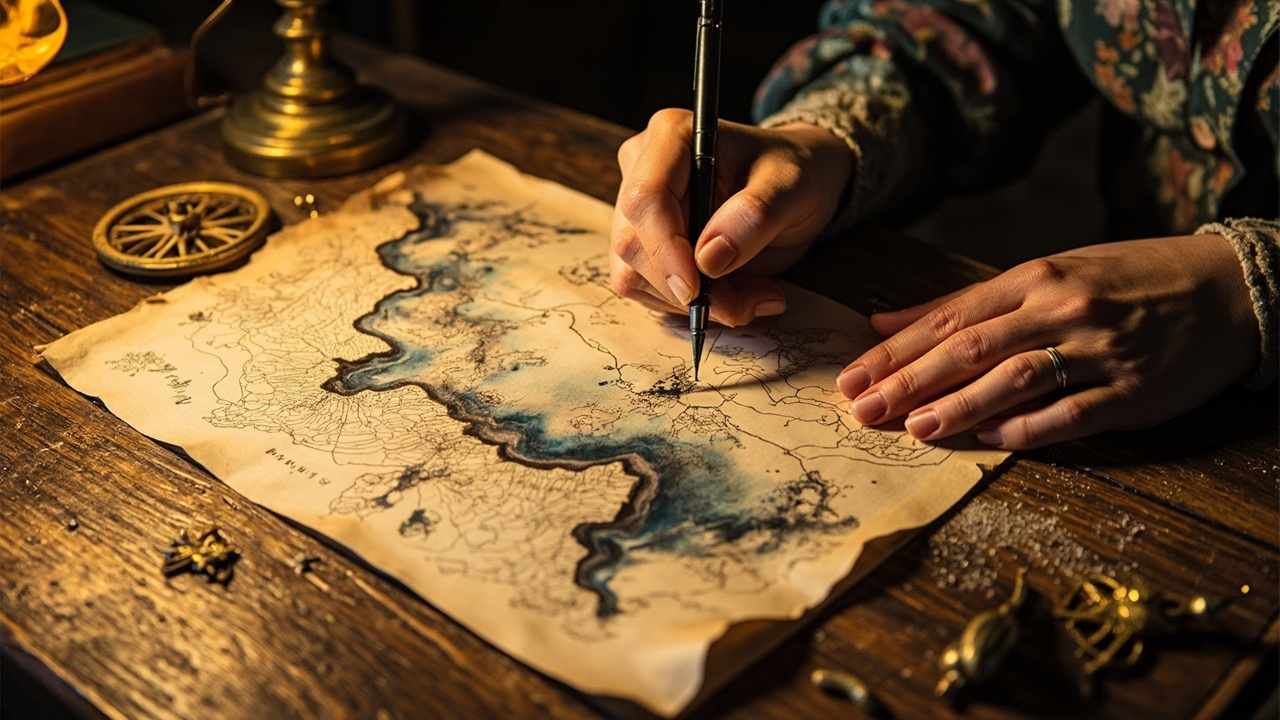
She began the commission as she began all her work: with tea, with sharpened pencils, with the ritual arrangement of her materials on cream cartridge paper. The widow spoke of a small garden in early March, of bare soil and cold rain, of the particular quality of silence in a house where someone was missing. Eleanor drew the Shape of Absence—a central feature she had mapped a hundred times before, a kind of sinkhole at the centre of the self, its edges ragged where hope had collapsed into acceptance.
She drew the roads that led nowhere, the fields of static where feeling had frozen mid-motion, and at the map's far edge, the Sea of Forgetting, that grey expanse where the lost eventually dissolved into mere weather.
It was while she was drawing the Sea that she first noticed the bleed.
The ink had moved beyond its borders. It pooled on the paper in ways she had not directed, spread in tributaries she had not planned. She lifted the map, thinking her eyes were tired, and saw that the ink had transferred itself to the wooden table beneath the paper. She stared at her own hand, then at the map, then at her hand again.
The lines of the map had impressed themselves into the oak as though the table were a palimpsest, as though it too were a surface being written and rewritten across centuries. She set the map aside, certain that she was overtired, that she needed rest. But when she returned to her studio the next morning, the geography had grown. New rivers had carved themselves into the grain of the oak. Paths had wound across the surface of the desk. The Sea of Forgetting had become a depression in the wood—a shallow bowl that could hold water.
She pressed her palm to it. The hollow was warm.
For a moment, Eleanor simply stood there, staring at her own map made physical. She was looking at a geography of grief translated into grain and matter, at the exact coordinates of a sorrow she had only ever charted in metaphor. Then, with hands that trembled only slightly, she continued her work.
Over the following days, the bleed worsened. The ink moved beyond the paper onto the desk, beyond the desk onto the floor. It spread in tributaries across the wooden boards of her studio, and she watched, helpless, as her map of mourning began to map itself onto the world. She tried to stop—to rinse her brushes, to discard the ink—but the geography would not be contained. It bled beyond its borders, and the geography of grief bled beyond its borders into her world.
It was then that she noticed the lines on her own skin.
They appeared first on the inside of her forearm: thin lines, like rivers or roads, invisible to the eye but present when touched. She traced them with her fingertip and felt them as clearly as she might have felt the contour lines on her own maps. A coast along her collarbone. A mountain range at the base of her spine. She had become part of the map herself.
When the widow came to collect her commission, Eleanor felt the pull of her arrival before she heard her footsteps. It was a magnetic sensation, a drawing-together of two geographies that had become entangled.
The widow studied the map in silence. Her weathered hands moved across its surface, tracing the coastline of loss, the mountain ranges of sorrow. And then, slowly, she began to weep—not the heavy weeping of fresh grief, but something quieter, something releaseful. Almost grateful.
"This is it," she said. "This is where I am."
Eleanor watched her trace the Sea of Forgetting with one finger, watched her find the paths that led nowhere and the roads that eventually, improbably, found their way back to the world. The map had given her something. A way to hold her grief that was not just weight but shape, not just darkness but path.
When the widow left, Eleanor felt the absence of her presence like a newly made hollow. The map had given something to the widow. It had taken something from her.
She had been mapped. And it left behind, in the hollows of her, only the geography of grief—the contour lines of loss she had never directly experienced but had somehow, now, inherited.
The commissions continued. Joy, with its bright anxious coastline. Longing, that country with its impossible horizons. First Love, that vivid and perilous island where beauty and danger wore the same face. But something had changed. Eleanor worked differently now. She could feel her own hand moving, sense the geography as it bled beyond the borders she drew. She could feel her own body becoming terrain.
And then, one autumn evening, she made the final map of her life.
It was a commission no one had asked for. It was a map of her own loss: her father, dead when she was seven years old, a memory she had never mapped because she had believed some griefs too fundamental to be translated into geography. But now, with the ink thin and her hand unsteady, she drew it. She drew the house that had grown silent. The schoolyard where no one knew what to say. The bedroom she had not entered for years, preserved like a room in a museum, unchanged since the morning he did not come home.
She drew his laugh. She drew his walk. She drew the particular way he had mispronounced her name—Eleanor with the emphasis on the second syllable, a small error she had never corrected, a error she would give anything to hear again.
As she drew, the map began to bleed.
It bled beyond the paper, beyond the desk, beyond the floor. It rose up the walls of her studio in rivers and tributaries and seas. She watched her own geography emerge around her—mountains and rivers and plains of all that she had lost—and she felt it, finally: not the weight of grief, but its release. She was letting it go. She was giving it form.
When it was finished, her studio had become a map. But the ink had faded now, absorbed into the walls and the floor and the ceiling, leaving only faint lines like old pencil marks. The map was everywhere and nowhere. The map was part of the world.
She walked outside. The city stretched before her—its streets and bridges and parks—and she saw it differently now. Not as a collection of destinations but as a network of routes, ways of moving through terrain that was both physical and emotional. The bridge over the river was a crossing from grief to hope. The park was a valley of peace. The hospital on the hill was a high pass, difficult but necessary.
She had spent her life mapping what could not be measured. Now the world itself had become her map.
And somewhere, she knew, other cartographers were sitting in other studios, beginning their own work. The geography of grief, it turned out, was not a destination but a language—and she was only beginning to learn it.
She walked on into the evening, her skin faintly mapped with the contour lines of every emotion she had ever charted, and she knew that this was only the beginning.