مفردات لا بدّ منها
| الكلمة | العربية | Deutsch | Français | Русский |
|---|---|---|---|---|
| لهجة | Dialekt | dialecte | диалект | |
| الكورنية | Kornisch | cornique | корнский | |
| كوخ | Hütte | chaumière | хижина | |
| قديم الطراز | archaisch | archaïque | архаичный | |
| لغوي | linguistisch | linguistique | лингвистический | |
| الحفاظ | Erhaltung | préservation | сохранение | |
| الخث | Torf | tourbe | торф | |
| ساحلي | Küsten- | côtier | прибрежный | |
| تآكل | Erosion | érosion | эрозия | |
| خشب الطفو | Treibholz | bois flotté | плавник |
القصة
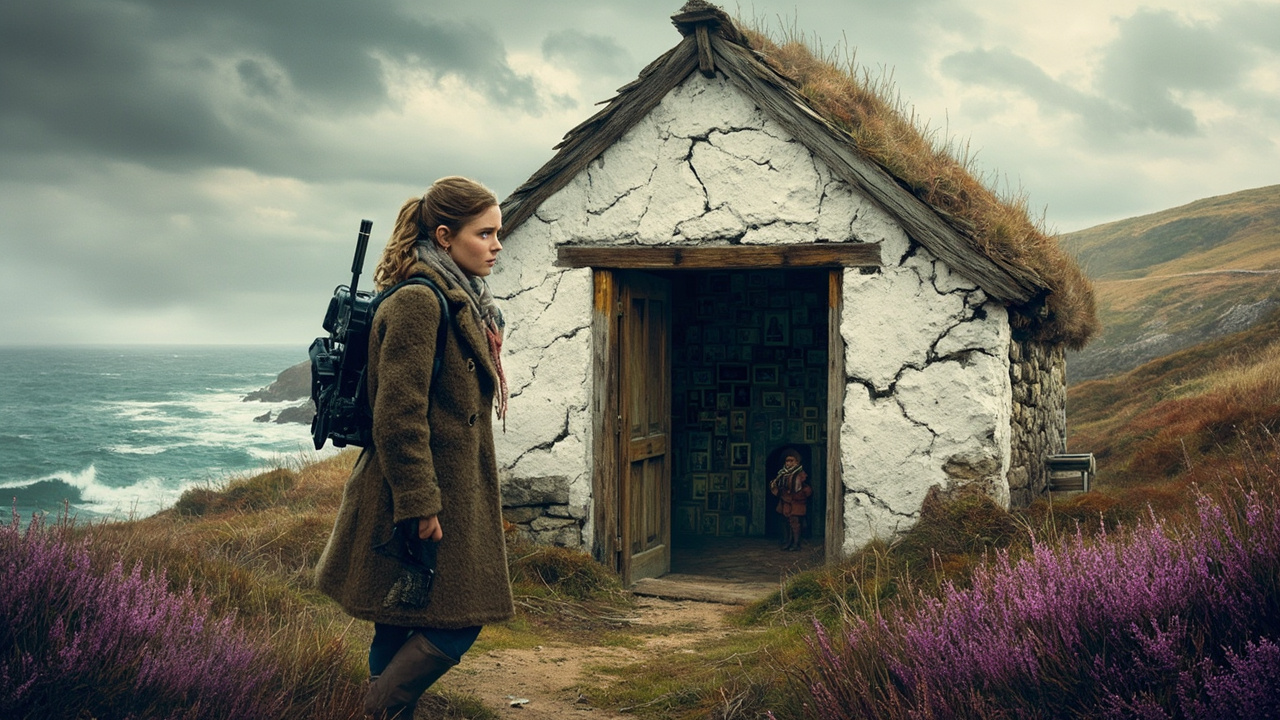
The cottage stood where the lane petered out, its whitewashed walls holding back the Atlantic wind that scoured the coast. Dr. Eleanor Marsh had driven three hours from Bristol, navigating country lanes that seemed determined to lead nowhere, following the kind of whispered directions that suggested someone still remembered what things had been called before they had proper names. She carried her recording equipment and a list of prompts she had compiled over months of preparation, but as she climbed from her car, a sudden uncertainty seized her—she had forgotten what she had come to ask.
The cottage door opened before she could knock. The woman who stood there was small and ancient, her face a map of coastal erosion, yet her eyes held a surprising brightness. "Dr. Marsh," she said. Not a question.
"Yes. How did you—"
"Your grandmother's name was Mary Ellen. She would have told you to call me Auntie Maggie, but you never knew her well enough to ask."
Eleanor's carefully prepared greeting dissolved on her tongue. She had been warned about this woman—Margaret Trevelyan, the last confirmed speaker of the Penwith dialect, a version of Cornish so archaic that even other Cornish linguists struggled to follow it. But no one had mentioned that she would know things. No one had mentioned that she would know her.
"Please," said the old woman, stepping back into the shadows of the cottage. "Come in. The wind is from the north and it carries bad humour."
Eleanor followed, her recorder slung uselessly across her shoulder, and understood immediately why the academic papers had described Margaret Trevelyan as 'uniquely valuable to linguistic preservation'. The cottage smelled of peat and dried herbs, and photographs crowded every wall—generations of faces, formal and informal, some studio-lit, others caught mid-motion as if the camera had surprised them breathing.
They sat at a kitchen table worn smooth by decades of use, and Margaret poured tea from a pot that had seen better centuries. "You speak Kernewek," the old woman said, and Eleanor startled.
"I—I'm learning. My research focuses on—"
"You speak it the way they taught it in universities. Clean. Correct. Dead." Margaret smiled, and it was not unkind. "Your grandmother spoke it differently. She said whethow ghwyr for sea, not môr. Do you know why?"
"I don't."
"Because whethow ghwyr means 'the breathing of the world'. Because when she was a girl, the sea spoke Cornish, and she learned to listen."
Eleanor's hands were trembling. She had not told this woman her grandmother's name. She had not told her anything at all. And yet—
"How do you know about my grandmother?"
Margaret Trevelyan reached across the table and took Eleanor's hand. Her fingers were cold and rough, like driftwood worn smooth by tides. "Because I have been waiting for you to come. Because Mary Ellen made me promise. Because some debts outlive the people who owe them."
"I don't understand."
"No. You wouldn't. You were born in Bristol, weren't you? In a house with gas fires and walls you could see your reflection in. Your grandmother went to the sea only once, when she took you to the pier, and you remember the taste of candyfloss and the way the gulls screamed, and that is all of Cornwall you have ever known."
Eleanor felt the room tilt. This was impossible. This woman could not know these things. Unless—
"Your grandmother left Cornwall in nineteen fifty-two," Margaret continued. "She left after Thomas died. She left because she could not bear to hear anyone speak the dialect of their childhood, because every word reminded her of what she had lost." The old woman's voice shifted, dropping into a lower register, and Eleanor recognised the cadence of authentic Cornish speech—not the reconstructed Kernewek of modern revivalists, but something older, rougher, alive. "Ha fatella outgenes? Ha fatella hedrowgh why?Yw whethow gansow dhe arghasa? Yw an amser a sewy?"
"I don't—" Eleanor's voice cracked. "Please. Who was Thomas?"
"Thomas was the man your grandmother loved. Thomas was the father of the child she was carrying when he died in the war. Thomas was my son."
The words hung in the air between them, impossible and undeniable. Eleanor's grandfather had died before she was born, but she knew the official story—war, tragedy, a marriage cut short. She had never been told there had been a child. She had never been told the child had survived.
"Who was the child?"
"You," said Margaret Trevelyan. "Or rather, your mother. Who was born too early, too small, and not expected to live. Who your grandmother carried to Bristol because the doctors there were better, and because she could not bear to stay."
Eleanor thought of her mother, who had died when she was twelve, who had never spoken of Cornwall or childhood or any family beyond the small nuclear unit they had made in their council flat. She thought of her grandmother, who had raised her after that, who had been quiet and English and uninterested in the past.
"She never told me."
"No. She was protecting you. She was protecting herself." Margaret released Eleanor's hand and sat back. "Some things are too heavy to pass on until the right person comes to carry them."
"But why now? Why tell me this now?"
The old woman smiled, and this time there was something sad in it, something ancient. "Because I am the last. Because I have kept the dialect alive for eighty years, and when I die, the words will die with me unless someone remembers them differently. Unless someone hears them as more than academic data." She reached up and touched one of the photographs on the wall—a young woman with dark hair, standing on a cliff, laughing at something beyond the frame. "Mary Ellen wanted you to know who you were. She wanted you to know where you came from. She just couldn't bear to say it herself."
Eleanor looked at the photograph. The woman in it was a stranger, but she recognised the angle of the jaw, the set of the shoulders. She had seen those features in mirrors all her life.
"Teach me," she said. "Teach me the dialect. Not as research. Not as preservation. Teach me because she would have wanted you to."
Margaret Trevelyan closed her eyes, and when she opened them again, they were bright with something that might have been tears. "Dell wreugh vy kowska dhis anedha. I have been waiting for you to ask."
Outside, the wind from the north howled against the cottage walls, carrying the salt and the stories of the sea. And in the kitchen where her grandmother had once sat as a girl, Eleanor Marsh began to learn the words for home.