مفردات لا بدّ منها
| الكلمة | العربية | Deutsch | Français | Русский |
|---|---|---|---|---|
| نباتات حسينية | Flechte | lichen | лишайник | |
| الجزء الخضري | Thallus | thalle | таллом | |
| ركيزة | Substrat | substrat | субстрат | |
| التنوع البيولوجي | Biodiversität | biodiversité | биоразнообразие | |
| أوغام | Ogham | ogham | огхэм | |
| مهجور | verfallen | délabré | заброшенный | |
| تقارب | Konvergenz | convergence | схождение | |
| النباتات | Flora | flore | флора | |
| عينة | Exemplar | spécimen | образец | |
| عالم | Gelehrter | érudit | ученый |
القصة
Dr Morag Campbell had spent seventeen years studying lichen, and she had never encountered anything quite like the specimens she now held beneath her lens.
The Henderson estate had stood abandoned for over a century, its Georgian façade slowly surrendering to the relentless damp of the Wester Ross coastline. Morag had received permission from the Scottish Land Commission to survey the grounds, part of a broader project cataloguing the biodiversity of derelict Highland properties. The estate's owner, a distant cousin of the embattled family that had once presided over three thousand acres, had expressed neither interest nor objection. The land, it seemed, had been forgotten by everyone except the wind and the sea.
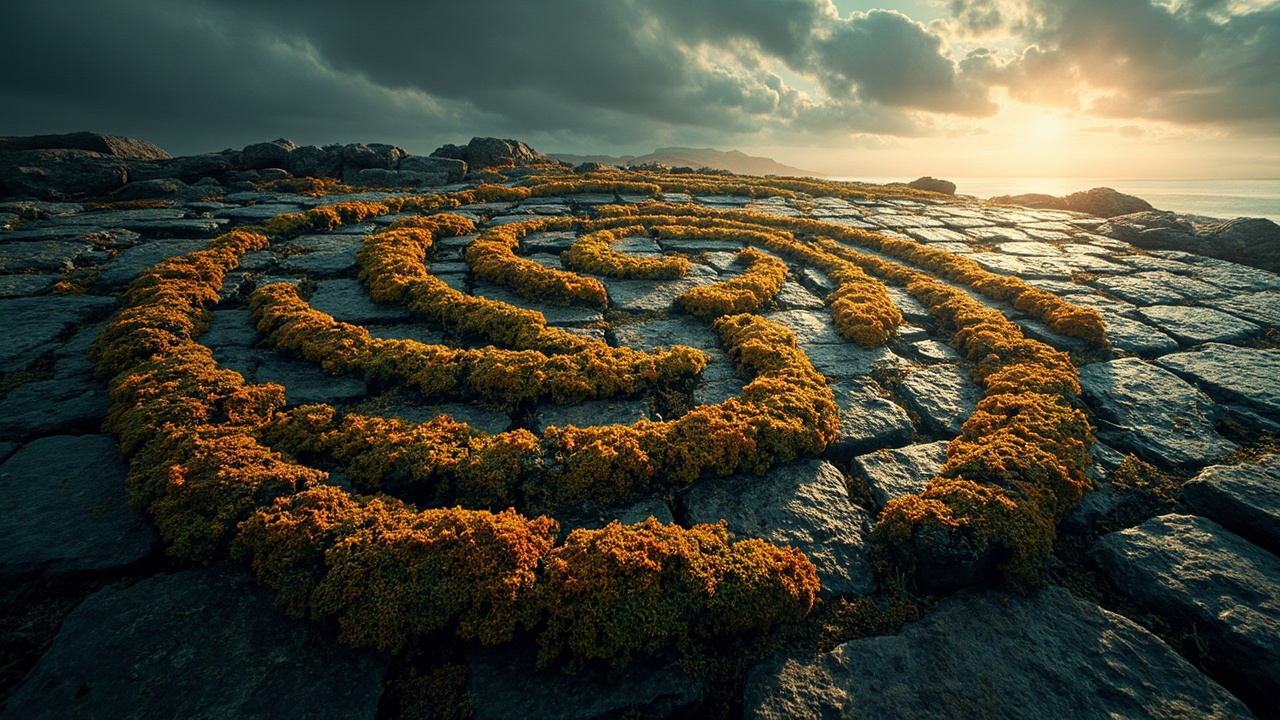
She had expected the usual fare: Xanthoria parietalis splashed across the south-facing stones, yellow and defiant; the delicate grey filigree of Flavoparmelia caperata climbing the older oaks; perhaps the rare Lobaria pulmonaria if fortune favours the foolish. What she had not expected was the colony clinging to the far wall of the old ice house, a sprawling mass of dark olive and burnt amber that seemed, even to her experienced eye, somehow deliberate in its arrangement.
Lichen, by their nature, grow in response to light, to substrate, to the invisible chemistry of stone and bark. They are not random. But neither are they geometric. And yet here, beneath her hand-lens, she observed growth patterns that defied every ecological principle she had devoted her career to understanding. The thalli arranged themselves in spirals that tightened toward points of apparent convergence. Where the calcium-rich mortar met the older granite, the lichen seemed almost to cluster into clusters that suggested—impossibly—letterforms.
She photographed everything. She marked the GPS coordinates. She slept poorly that night in her rented cottage twelve miles distant, and rose before dawn to return.
The following weeks saw Morag becoming something of a fixture at the university library in Inverness, where Dr Alistair Forehand presided over the department of Celtic studies with the weary authority of a man who had spent four decades coaxing meaning from fragments. He was the foremost living authority on Pictish, that tantalisingly obscure language preserved in stone carvings and the sparse accounts of Roman observers who had found the northern tribes incomprehensibly fierce. When Morag showed him her photographs, his reaction was not disbelief but a sharp intake of breath that she would not soon forget.
"These formations," he said, adjusting his spectacles with fingers that trembled slightly. "You've compared them to the ogham inscriptions?"
"I've compared them to everything I can find. Dr Forehand, these shapes are consistent across seventeen separate colonies on the estate grounds. That's not ecological coincidence. That's communication."
The old scholar was quiet for a long moment. When he spoke again, his voice had dropped to something barely above a whisper. "The Picts had a concept—scholars argue about its precise meaning—that translated roughly as 'the land remembers.' They believed that natural formations could record warnings. Events too significant to trust to the fragility of human memory."
"You're suggesting the Picts deliberately cultivated this lichen to preserve a message."
"I'm suggesting something far more unsettling." Forehand reached for a volume bound in leather so ancient it seemed to sigh as it opened. "I'm suggesting they didn't cultivate it at all. I'm suggesting the lichen learned."
The translations came slowly, painstakingly assembled from Forehand's reconstruction of the Pictish lexicon. The lichen's growth patterns, viewed through digital enhancement and cross-referenced against known Pictish letterforms, yielded their secrets with grudging reluctance. The message, if message it was, read:
Ben-fhiona sleeps. Her turning shakes the ground. The stone that was placed holds but an age. When the mosses speak this word again, flee to the eastern sea.
Morag read the translation twice. Three times. "Ben-fhiona," she said. "I've never encountered that term in any Pictish text."
"Because I believe I may have invented it," Forehand replied quietly. "Or rather, I believe the original name was deliberately obliterated from the historical record. The Romans had a phrase for it: Monsanguis. The Bloody Mountain." He paused. "There is no mountain by that name in any surviving catalogue. But there is a hill, three miles from the Henderson estate, that local tradition forbids anyone to approach. The locals call it Cnoc Fhiodha. The Listening Hill."
The Geological Survey records, when Morag finally accessed them, told a story that required no translation. The bedrock beneath the Henderson estate sat atop a dormant magma chamber of unusual configuration—one that, according to the most recent survey data, had begun exhibiting microseismic activity three years prior. The activity was not public knowledge. It had not yet reached the threshold that would trigger mandatory disclosure.
But the lichen knew. Had perhaps always known, in the patient way of organisms that measured time in centuries rather than news cycles. The Picts had named what slumbered beneath: a presence, a pressure, a turning that would one day shake the earth and bring the mountain's wrath down upon everything built above it. They had recognised the signs and had encoded their warnings in the only medium they trusted to outlast empires.
Morag submitted her findings to the relevant authorities. She was politely ignored. She submitted them again, with Forehand's corroboration, to the scientific press. She was branded a sensationalist. The owner of the estate remained unreachable. The tenants who had begun tentatively returning to the Highlands, drawn by the promise of remote work and cheap property, continued their lives in blissful ignorance of what stirred beneath.
But in the autumn of her frustration, Morag received a letter from an unexpected source: a community council in a village forty miles south, writing to inform her that the lichen on their own ancestral stones had begun, in the previous season, to exhibit similar patterns. They did not understand what they were seeing. They had found her name in an old academic paper and hoped she might explain.
She packed her equipment that very evening. As she drove through the gathering dark, headlights cutting through Highland mist, she thought of the ancient people who had watched the land and learned its language. They had not possessed our instruments, our surveys, our systems of measurement. But they had possessed something we have largely forgotten: the patience to listen, and the wisdom to heed what they heard.
The lichen had been waiting, all this time, to be heard again.
And now, it seemed, the listening had begun in earnest.