L'histoire
Emma pushed open the familiar creak of the shop door, and the scent of lanolin and aged wood rushed to meet her. The Cotswolds village of Bourton-on-the-Water had not changed at all—still picturesque, still impossibly charming—but standing here in her grandmother's wool shop felt strangely unfamiliar. Gran had passed six months ago, and Emma had finally found the courage to sort through the building she had inherited.
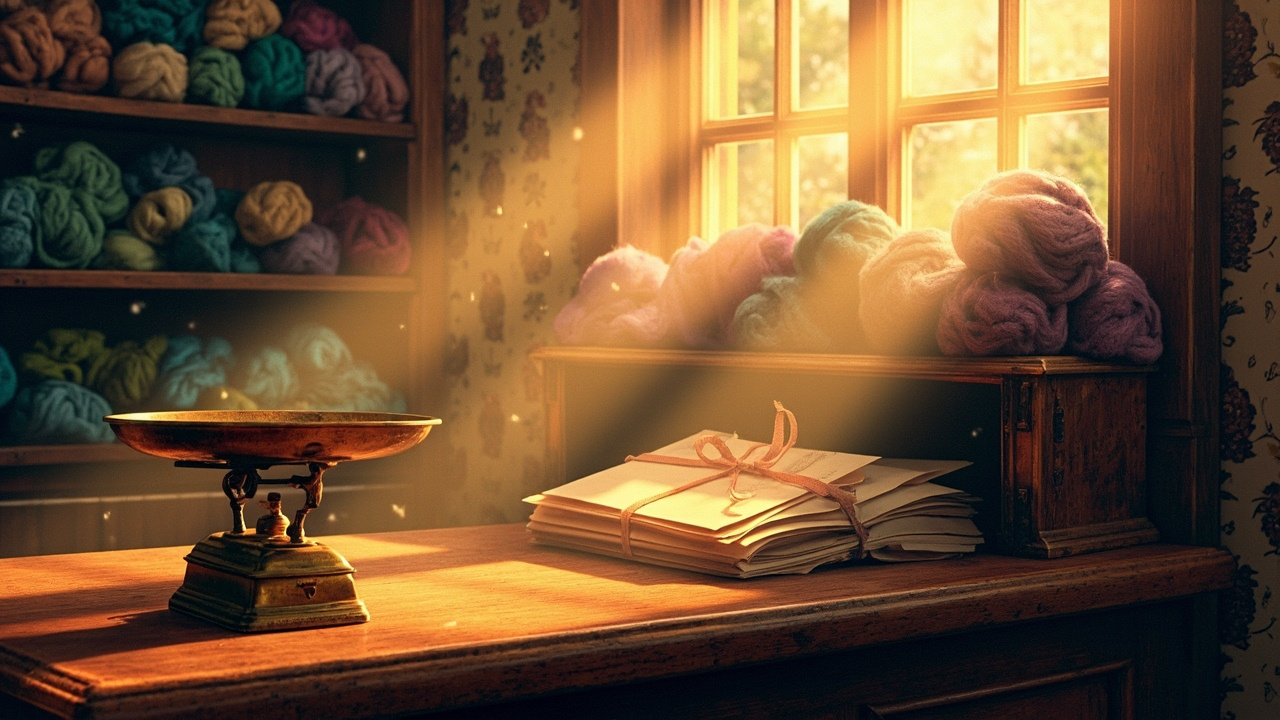
She had not visited regularly in years. Life in London with its relentless pace had made the journey seem unnecessary. Now, standing in the silence, Emma realised how much she had missed. The shop retained its old-world charm—shelves lined with balls of wool in every conceivable colour, the brass scales on the counter, the faded wallpaper with its pattern of tiny roses. Gran had run this shop for over fifty years, yet Emma knew almost nothing about her life before it.
"Your grandmother was always a private person," her mother had remarked at the funeral. "She kept herself to herself."
On the second afternoon, while searching for old stock that might be worth selling, Emma noticed something peculiar. One section of the wooden panelling behind the counter did not quite align with the rest. She ran her fingers along the edge and felt a slight give. Pressing firmly, she heard a soft click, and a hidden panel swung open.
Inside was a bundle of letters, tied with faded pink ribbon. Dozens of them. Emma lifted them carefully, her hands trembling slightly. The envelopes were addressed simply to "Rose"—her grandmother's maiden name. The first was dated August 1943.
She took the letters upstairs to Gran's small kitchen and sat at the wooden table by the window. The handwriting was elegant, the ink brown with age. "My dearest Rose," the first letter began, "I write this knowing you may never read it..." It was signed simply "William".
As Emma read through the correspondence, a love story emerged that spanned months of wartime correspondence. William was in the army, stationed in the south of England, and his letters spoke of plans for after the war, of a cottage somewhere quiet, of their future together. They had clearly been deeply in love.
Yet Emma had never heard this name before. There were no photographs of William in the house, no mention of him in any family record. Gran had married Edward in 1946, Emma's grandfather, and had remained married to him until his death in 1989. The letters stopped abruptly in June 1944. The last one, dated the fourteenth, spoke of leaving for France the next day. "If I do not return," William wrote, "know that you were my greatest treasure."
Emma found a small notice in an old newspaper among the letters. Lance Corporal William Hartley, 2nd Battalion, The Gloucestershire Regiment, killed in action in Normandy on 15th June 1944. He was twenty-three years old.
She sat back, overwhelmed. Her grandmother had loved someone else before her grandfather—a young soldier who had never come home. She had never spoken of him, not once in all the years Emma had known her. The hidden letters told of a secret kept faithfully for eight decades.
But there was more. Tucked beneath the correspondence, Emma found a birth certificate dated March 1944, registering a child born to Rose Hartley. The father's name was listed as William Hartley. Below it, a letter from a solicitor explained that the child had been adopted shortly after birth through a private arrangement.
Gran had had a child with William, a child she had given up, a secret she had carried alone all her life. Emma replaced everything exactly as she had found it and closed the panel. Some stories were not meant to be shared beyond their author.
She locked the shop that evening and walked slowly back through the village, past the river and the ancient stone bridges. The letters had told her something precious—that her grandmother, quiet and reserved as she had always seemed, had once loved so completely that she had hidden the evidence in the walls of her shop for the rest of her days.