Vocabulaire essentiel
| Mot | العربية | Deutsch | Français | Русский |
|---|---|---|---|---|
| منسقة حفلات الزفاف | Hochzeitsplanerin | wedding planner | организатор свадеб | |
| عتيق | Vintage | vintage | винтажный | |
| مقبرة كنيسة | Kirchhof | cimetière d'église | кладбище при церкви | |
| مؤخرة الصدر | Mieder | buste | лиф | |
| خط نحاسي | Kupferstich | écriture calligraphique | каллиграфический почерк | |
| سجل选举ي | Wählerverzeichnis | liste électorale | избирательные списки | |
| إعلان وفاة | Nachruf | nécrologie | некролог | |
| يتدهور | verschlechtern | détériorer | ухудшаться | |
| تذكاري | Gedenkstätte | mémorial | мемориал | |
| هجر | verlassen | abandonner | покидать |
L'histoire
Elena had spent fifteen years arranging other people's perfect days. As a wedding planner in Edinburgh, she had coordinated over three hundred ceremonies, and yet she never tired of watching couples exchange vows beneath flower arches and fairy lights. But lately, something had begun to feel hollow about the work. Every wedding blurred into the next, and she found herself searching for meaning in places she had never thought to look.
It was a rainy Thursday afternoon when she wandered into "Yesterday's Treasures," a cluttered vintage shop tucked away in the shadow of Greyfriars Kirkyard. The bell above the door chimed softly as she stepped inside, and the air smelled of old paper and lavender sachets. She was not looking for anything in particular, yet the shop seemed to pull her deeper into its maze of antique furniture and dusty display cases.
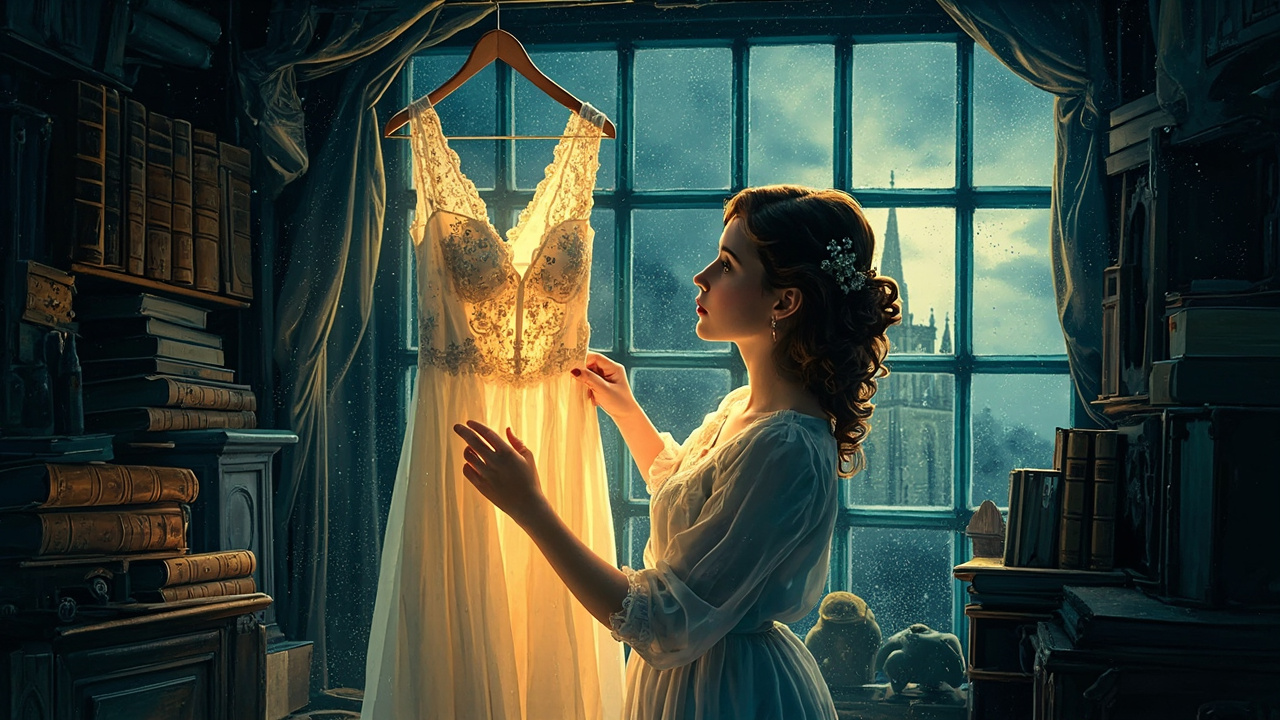
Near the back, half-hidden beneath a moth-eaten woollen coat, she found it: a wedding dress of ivory silk, its bodice embroidered with tiny seed pearls. Even beneath the layer of dust, the craftsmanship was extraordinary. Elena lifted it carefully and discovered a label sewn into the lining. The name had faded, but she could just make out the words: Miriam Sutherland, 1962. A yellowed envelope was pinned to the hem with a rusted safety pin.
Inside the envelope was a handwritten note in elegant copperplate script. It read simply: "Dearest Miriam, I cannot give you the life you deserve. I release you from this promise. Be happy. —James." The date was 14th June 1962. Elena's heart tightened. Here was a wedding that had never happened, a bride who had been left at the altar without ever knowing it.
She bought the dress for twenty pounds, driven by an urgency she could not explain. Back at her office, she began to research. James and Miriam Sutherland. Edinburgh addresses from the early 1960s. Electoral rolls, newspaper archives, obituaries. It took three days, but eventually she found her: Miriam Sutherland, née Campbell, who had passed away only six months ago in a care home in North Berwick, a coastal town thirty miles east of the city.
More digging led her to Miriam's niece, a retired schoolteacher named Fiona, who lived in a stone cottage in the Pentland Hills. Fiona listened politely as Elena explained what she had discovered, but her expression shifted when Elena mentioned the name James.
"Oh, Aunt Miriam spoke of James Ritchie," Fiona said slowly. "He was the love of her life, apparently. They were engaged for two years. But then one morning in June 1962, he simply vanished. No letter, no explanation. My aunt was heartbroken. She never married anyone else."
Elena handed her the note.
Fiona read it twice, her eyes glistening. "She never knew," she whispered. "She always believed he had simply run away, that she had been unworthy of his staying. She spent the rest of her life wondering what she had done wrong."
They sat together in Fiona's cottage, the dress spread across the kitchen table between them, as the story emerged in fragments. James Ritchie had not been a coward or a cad. He had been diagnosed with a progressive lung disease in the spring of 1962, and he had made the devastating decision to disappear so that Miriam would not have to watch him deteriorate. He had sent the note and the dress back to her family home, but it seemed the package had never reached her. Perhaps a relative had hidden it away, hoping to spare her further pain. By some strange coincidence, it had waited for sixty years in that dusty shop, until Elena walked in.
"He loved her enough to break his own heart," Fiona murmured. "And she loved him enough to spend sixty years mourning a man she thought had abandoned her."
Elena arranged for the dress to be displayed, along with James's letter, at a small memorial gathering in Miriam's honour. Friends, neighbours, and former students came to hear Fiona share the true story of her aunt's extraordinary, heartbroken love. It was not the kind of wedding Elena usually organised, but it was, she decided, the most meaningful ceremony she had ever overseen.
Driving home that evening past the golden sandstone buildings of Edinburgh's Old Town, she felt something she had not felt in years: the quiet certainty that some things, even after they have been forgotten, still deserve to be remembered.