Vocabulaire essentiel
| Mot | العربية | Deutsch | Français | Русский |
|---|---|---|---|---|
| منارة | Leuchtturm | phare | маяк | |
| رسام خرائط | Kartograph | cartographe | картограф | |
| رأس صخري | Kap | promontoire | мыс | |
| خطر | heimtückisch | traître | коварный | |
| ميزان نظري | Theodolit | théodolite | теодолит | |
| إحداثيات | Koordinaten | coordonnées | координаты | |
| حيرة | Verwirrung | émerveillement confus | замешательство | |
| منعزل | zurückgezogen | reclus | уединённый |
L'histoire
Dr. Eleanor Marsh had spent three decades unravelling the secrets of maritime history, but nothing had prepared her for the call that arrived on a grey November morning.
The voice on the telephone belonged to a cartographer at the National Archives who had stumbled upon something extraordinary. A lighthouse, marked on charts dating back to 1742, that appeared in no historical record and had defied every attempt at geographical verification. It sat at the edge of the Merryn Shelf, a treacherous stretch of coastline where the Atlantic met the Celtic Sea in perpetual conflict.
'It's as though the lighthouse exists only on paper,' the cartographer had said, his voice tinged with bewilderment. 'And yet the charts are unanimous. Every survey from that period places it precisely at the same coordinates.'
Eleanor drove north through driving rain, her windscreen wipers fighting a losing battle against the weather. She had learned long ago that the most compelling mysteries were rarely found in comfortable libraries. They demanded field investigation, patient observation, and a willingness to entertain possibilities that rational minds dismissed.
The village of Port Caerath stood at the end of a single winding road, its grey stone cottages huddled against the elements as they had done for centuries. The locals regarded Eleanor with the wariness reserved for outsiders, yet it was an old fisherman named Brennan who finally agreed to speak with her. He had weathered sea and storm for over seventy years, and his eyes held the particular depth of someone who had witnessed things beyond explanation.
'The lighthouse,' he said slowly, turning his cup of tea between weathered hands. 'My grandfather spoke of it. Said his grandfather had seen it, back in the time of sail. A tower of white stone that stood where no stone should stand, its light cutting through fog that seemed to swallow everything else.'
'But you've never seen it yourself?'
Brennan's silence stretched long enough to become an answer. 'I've sailed those waters a thousand times, Doctor. More. There are places where the sea remembers things the land has forgotten. This is one of them.'
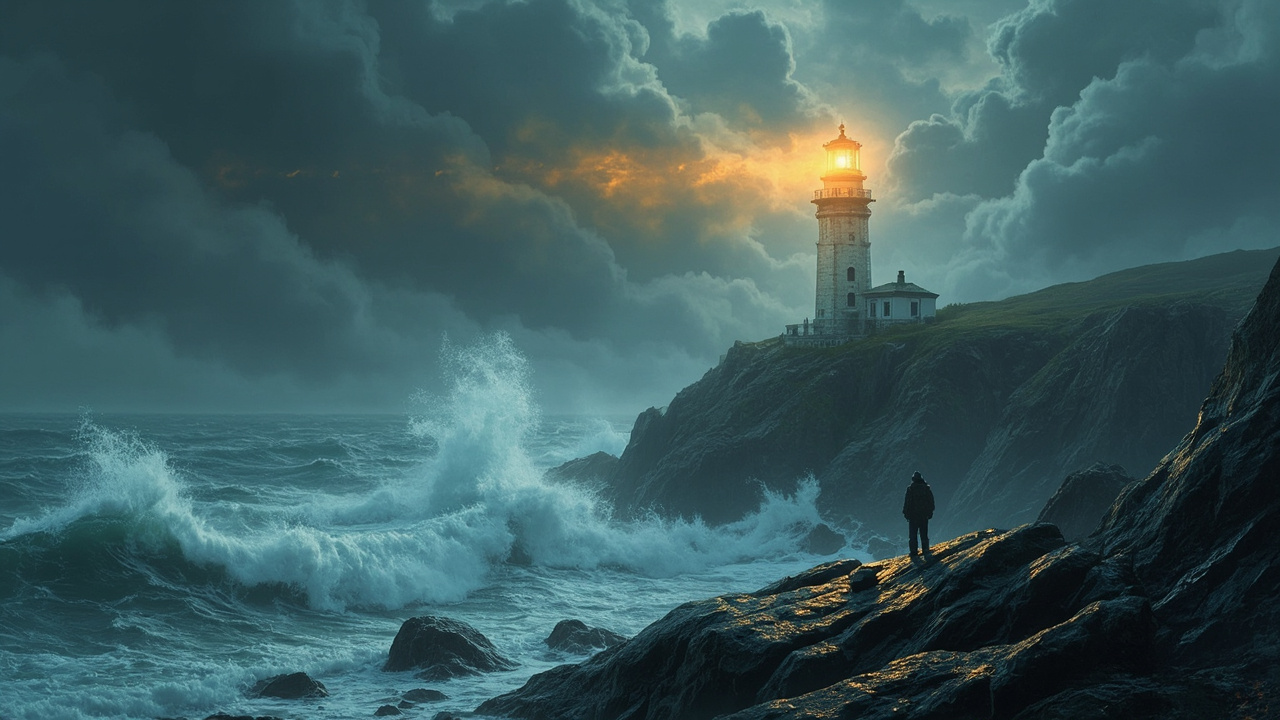
Eleanor spent three days studying the old charts, cross-referencing coordinates, and walking the headlands with a theodolite. The mathematics were unambiguous. If the lighthouse had existed, it would have stood on a narrow promontory that dropped sheer into churning water. Yet when she stood at those precise coordinates, she found only bare rock and crashing waves.
On the fourth morning, a breakthrough came from an unexpected source. A young woman named Cerys, who worked at the village's modest museum, produced a water-damaged journal discovered during renovations twenty years earlier. The entries belonged to a man named Thomas Vyryan, a surveyor who had worked these waters in 1741, the year before the charts were drawn.
Eleanor read the cramped, urgent handwriting until dusk fell. Vyryan's account told of a lighthouse unlike any other, built not by coastal authorities but by a reclusive merchant who had amassed a fortune from shipwrecks. It was said the light burned with an otherworldly brilliance, drawing vessels toward the rocks rather than away from them. And then, on the final recorded page, Vyryan wrote of a storm—the great gale of December 1742—when the lighthouse simply ceased to be.
'Not destroyed,' Vyryan had noted. 'Ceased. As though it had never been, or had only ever existed in the minds of those who beheld it.'
That night, Eleanor dreamed of the lighthouse. Its white walls glowed against impossible darkness, and within its tower burned a flame that seemed to pull at something deep within her chest. She woke before dawn with a certainty she could not explain.
She returned to the promontory at low tide. The sea had retreated far enough to expose a shelf of black rock, and there—half-hidden beneath seaweed and barnacles—lay the foundation stones of a circular structure. They were arranged with deliberate precision, their surfaces carved with symbols that seemed to shift when viewed from different angles.
Eleanor knelt on the wet stone, her hands tracing the ancient markings. Whatever had stood here had been real enough to leave its mark upon the world. Yet the charts, the journal, the fishermen's tales—all spoke of something more. A lighthouse that existed between moments, between states of being. A beacon that had perhaps never been intended for ships at all, but for something watching from the darkness between the waves.
She understood then why no one had ever located it. The lighthouse of Port Caerath was not a place one found. It was a place that chose when to be found, its light reaching across centuries to summon those who would listen.
Eleanor remained on the promontory until the tide began its return, the sea reclaiming what it had briefly surrendered. As she walked back to the village, she carried with her a truth that existed somewhere between history and legend, between evidence and impossibility. Some lights, she realised, do not merely illuminate the darkness. They call out to it, and the darkness calls back.