Vocabulaire essentiel
| Mot | العربية | Deutsch | Français | Русский |
|---|---|---|---|---|
| مُرمِّم | Restaurator | restaurateur | реставратор | |
| تشققات السطح | Rissbildung | craquelure | кракелюр | |
| ورنيش | Firnis | vernis | лак | |
| مُذيب | Lösungsmittel | solvant | растворитель | |
| مُنسوب | zugeschrieben | attribué | приписываемый | |
| صبغة | Pigment | pigment | пигмент | |
| حفظ وترميم | Konservierung | conservation | консервация | |
| مصدر المنشأ | Herkunft | provenance | провенанс | |
| لوحة الألوان | Palette | palette | палитра | |
| مقياس الطيف الضوئي | Spektralphotometer | spectrophotomètre | спектрофотометр |
L'histoire
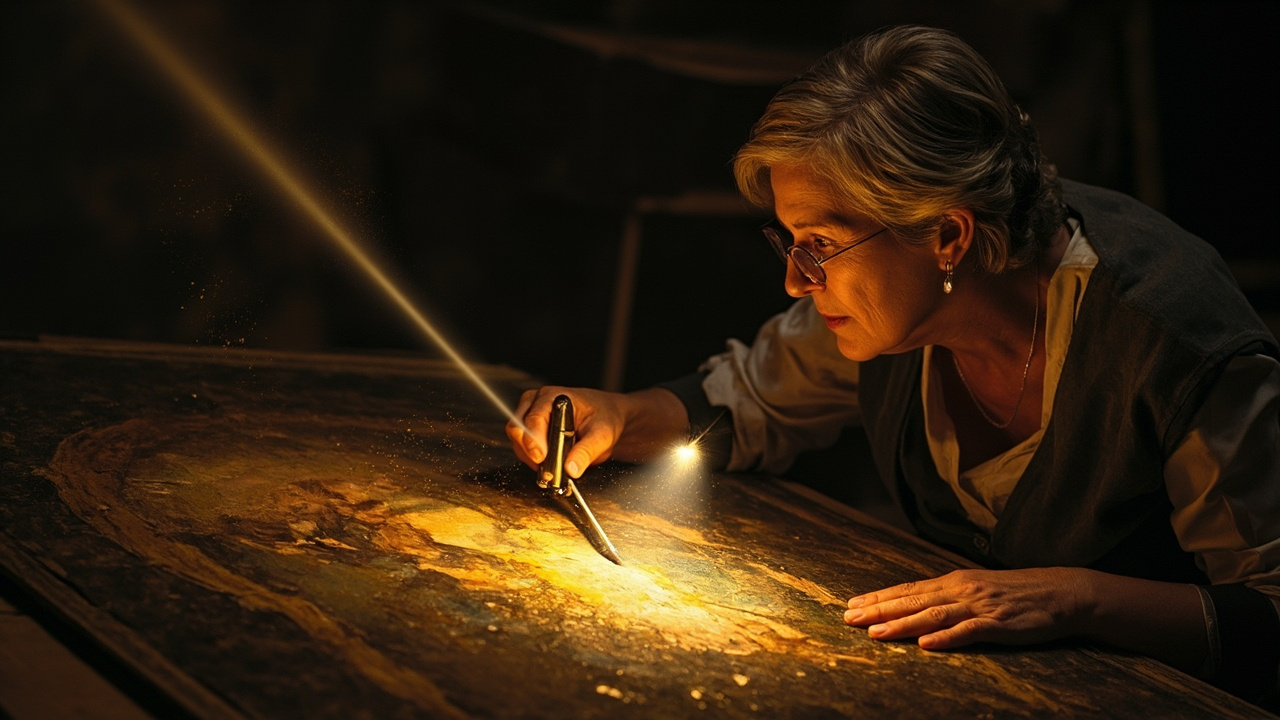
Dr Eleanor Marsh had spent eleven years breathing life back into masterpieces that time and neglect had tried to erase. At fifty-three, she had grown accustomed to the peculiar intimacy of her work—the way centuries-old pigments seemed to whisper their secrets if only one listened closely enough. What she had not grown accustomed to, on this grey November morning, was the tremor in her hands as she scraped away the final layer of discoloured varnish from a painting she had studied since her doctoral thesis.
The Virgin and Child with Saint Anne, attributed to a follower of Leonardo da Vinci, had hung in Storage Room C for decades. Unremarkable. Unloved. A footnote in the catalogue raisonné. But Eleanor had always suspected there was more beneath the surface—quite literally more. The craquelure, the fine network of cracks that spoke of age, had always seemed wrong somehow. Too uniform. Too deliberate.
And now, as the solvents lifted the grimy veil of centuries, she understood why.
Beneath the derivative Renaissance composition, rendered in that careful, lifeless hand typical of workshop copies, something extraordinary emerged. A brushstroke of such confidence, such breathtaking audacity, that Eleanor felt her breath catch in her throat. The palette knife work alone—confident strokes laid down wet-on-w wet—that was the hallmark of a master. Of the master himself.
She sat back in her conservation chair, her heart hammering against her ribs. Her torch beam danced across the emerging form: the suggestion of a face, perhaps a self-portrait, painted over and deliberately obscured. Someone, centuries ago, had buried Leonardo's work beneath a lie.
The implications unfolded in her mind like a dark flower. If this was genuine—and every instinct told her it was—then the history of High Renaissance art would need to be rewritten. Scholars would weep. Auction houses would recalculate. And certain people, Eleanor realised with a chill, would stop at nothing to ensure this discovery never saw the light of day.
She should have reported it immediately. Protocol demanded as much. Instead, she found herself photographing the layers in secret, her fingers trembling as she documented what she had uncovered. She told herself she was being thorough, exercising proper scholarly caution. But some deeper voice, the voice of self-preservation perhaps, whispered that once certain parties knew, there would be no controlling what happened next.
The first warning came three days later.
Her office had been searched. Not obviously—the intruders had been meticulous, leaving no trace of forced entry, no disturbed papers, no displaced books. But Eleanor knew. The particular angle at which she had left her spectrophotometer. The slight twist in the arm of her desk lamp. Someone had been here, and they had been looking for something.
She made copies of her photographs that evening, hid them in three separate locations across London. She told no one, not even her closest colleague, Marcus, with whom she had shared every triumph and setback for a decade. Trust, she had learned, was a currency that could be spent only once.
The phone call came on a Tuesday, when the rain streaked down the tall windows of the conservation studio like tears on glass. A voice she did not recognise, low and measured, with an Italian accent that seemed almost apologetic.
"Dr Marsh," it said, "you have found something that does not belong to you. Something that belongs to everyone, and therefore to no one. We would ask you, as a professional courtesy, to reconsider your next steps. History is written by those who control the narrative. Surely you understand."
Eleanor said nothing. She let the silence stretch until the caller hung up. Then she sat very still, watching the rain, and came to a decision that would change everything.
She would not be silenced. She would not be bought. She would bring the hidden Leonardo into the light, whatever the cost.
That night, she worked by lamplight, her hands steady now, as she prepared the documentation that would shake the art world to its foundations. The riddle of the restorer's discovery had become her riddle to solve—and she intended to solve it with the only weapon that mattered: the truth.