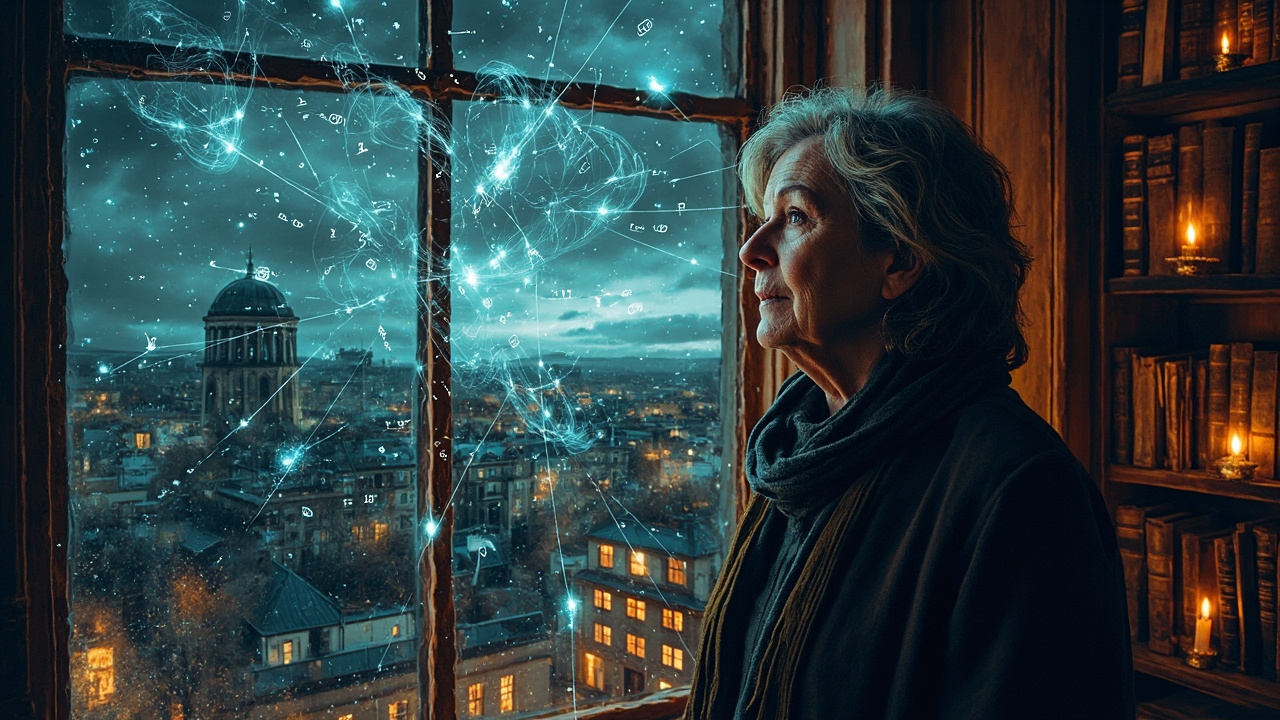
العناوين الإدارية: معادلات إدنبرة
وصلت الرسالة الأولى يوم الثلاثاء، انزلقت تحت باب مكتب مارغريت سينكلير في كلية الرياضيات بجامعة إدنبرة. اكتشفت وجودها عندما وصلت في الساعة السابعة والنصف، أبكر من المعتاد، كأن المبنى نفسه كان ينتظرها. لم تحمل المظروف أي ختم بريد—بل اسمها فقط، مكتوب بخط نسخ دقيق كان يوحي إما بتعليم قديم أو تكلّف مقصود. في الداخل، احتوت ورقة كريمية واحدة على سلسلة من الأرقام والرموز ظنتها في البداية مراسلات إدارية قبل أن تتضح طبيعتها المشفرة. عملت على حلها بين المحاضرات، وذهنها يتعثر في اللغز رغم نفسها. كانت المعادلات مختلفة عن أي شيء صادفته في ثلاثة عقود من نظرية الأعداد. بدت وكأنها تطوى على نفسها، تكرارية وغريبة، تتطلب إطاراً مختلفاً تماماً لفك شفرتها. بحلول الوقت الذي اكتشفت فيه النمط، كانت الساعة تقترب من منتصف الليل، والحل أرعبها أكثر من رياح الخريف التي تهز نافذة مكتبها. corresponded the numbers to a place—the student residences on Lauriston Gardens—and a time, two days hence. Should she reported it. Instead, she made herself a cup of tea that went cold on her desk, and said nothing.
On Thursday evening, she walked through the Meadows as darkness gathered. Near the specified building, she watched a young woman approach along the path. A man emerged from the shadows. Margaret called out—some inane remark about the time—and the woman turned back toward the well-lit road. The man melted away. When the cipher's predicted hour passed without incident, Margaret felt something between relief and unease settle in her stomach. Had she prevented a crime, or merely interrupted a future that would find another expression? The second letter arrived a fortnight later, more complex, the mathematics more elaborate. Whoever had crafted this understood Galois theory at a level that suggested professional training. Perhaps even another academic. The cipher described a theft at the Museum of Scotland, a specific object, a precise time. Margaret contacted the police, who listened with the polite condescension reserved for eccentrics. She mentioned she was a professor of mathematics; this earned her nothing but a case number and an appointment that would arrive too late. The theft occurred exactly as predicted. Margaret began a log. The letters, the solutions, the events. She was methodical by nature—a number theorist's temperament, always searching for patterns in the abstract—and the pattern was unmistakable now. These were not random predictions. The mathematics was doing something that should have been impossible. The third cipher spoke of an elderly professor at the university, a colleague she had known for years. The predicted crime was violent. Margaret warned him as best she could without explanation, speaking of threats and vigilance. He humoured her with the patience of the truly astonished. The following week, his daughter was abducted. She was recovered, unharmed, but the experience left him shattered. When he called Margaret, his voice hollow, she had no comfort to offer—only the bitter knowledge that she had seen it coming and done nothing effective. The fourth letter changed everything. It was longer, the encryption more sophisticated, incorporating a timestamp that required her to reconsider everything she thought she knew about number theory. The solution pointed not to a stranger but to herself—her office, her hour, her person. Margaret sat in her office as the appointed time approached, staring at the darkened campus beyond her window, the accumulated letters spread across her desk like evidence in a trial she did not understand. The door opened. She had not heard footsteps on the worn linoleum. The man who entered was older than she had imagined, with a face weathered by years and eyes that held the particular exhaustion of someone who has carried an impossible secret. He sat across from her without invitation. "You solved them," he said. It was not a question. "Who are you?" Margaret demanded. "What are these equations?" He smiled, thin and tired. "They are not predictions. They are descriptions. I discovered them thirty years ago—patterns in the fabric of events themselves. The mathematics does not cause the crimes. It merely reveals them, the way a physicist might describe gravity. The crimes were always going to happen. The equations simply tell us when and where." Margaret shook her head. "That's not possible. Mathematics describes; it does not dictate." "Perhaps that distinction is an illusion," he said. "We discover mathematics, we do not invent it. If the equations describe what must happen, then mathematics itself becomes a kind of fate—necessary, not imposed." "And your letters? Your warnings?" "My small rebellion against the inevitable. I cannot change what the equations reveal. But perhaps you can. Your gifts exceed mine. You see what I could not." Margaret considered the letters, the warnings she had issued, the crimes she had failed to prevent. "If the mathematics reveals what must happen," she said slowly, "then surely preventing one outcome merely produces another. The equations would account for that." The old man nodded. "Perhaps. Or perhaps there are branches we cannot see, futures that remain unwritten. I have spent thirty years not knowing. You will have to discover which it is." He left before she could respond. Margaret sat alone in the darkness of her office, surrounded by the accumulated mysteries of her strange correspondence, and wondered whether some equations had no solution at all.
Die Edinburgher Gleichungen
Der erste Brief kam an einem Dienstag, unter der Tür von Margaret Sinclairs Büro an der Fakultät für Mathematik der Universität Edinburgh durchgeschlüpft. Sie entdeckte ihn, als sie um halb acht eintraf, früher als gewöhnlich, als hätte das Gebäude selbst gewartet. Der Umschlag trug keinen Poststempel—nur ihren Namen, in einer sorgfältigen Rundschrift geschrieben, die entweder auf eine alte Bildung oder absichtliche Affektiertheit hindeutete. Darin enthielt ein einzelnes Blatt cremefarbenes Papier eine Folge von Zahlen und Symbolen, die sie zunächst für dienstliche Korrespondenz hielt, bevor die Verschlüsselung offensichtlich wurde. Sie arbeitete daran zwischen den Vorlesungen, ihr Geist blieb trotz allem am Rätsel hängen. Die Gleichungen waren anders als alles, was sie in drei Jahrzehnten Zahlentheorie erlebt hatte. Sie schienen sich in sich selbst zu falten, rekursiv und seltsam, und erforderten einen völlig anderen Rahmen zur Entschlüsselung. Als sie das Muster knackte, war es fast Mitternacht, und die Lösung entsetzte sie mehr als der Herbstwind, der ihr Bürofenster rüttelte. Die Zahlen entsprachen einem Ort—den Studentenwohnheimen in Lauriston Gardens—und einer Zeit, zwei Tage später. Sie hätte es melden sollen. Stattdessen machte sie sich eine Tasse Tee, die auf ihrem Schreibtisch kalt wurde, und sagte nichts.
Donnerstagabend ging sie durch die Meadows, während sich die Dunkelheit zusammenbraute. In der Nähe des angegebenen Gebäudes beobachtete sie, wie eine junge Frau den Pfad entlangkam. Ein Mann trat aus den Schatten. Margaret rief etwas—irgendeine belanglose Bemerkung über die Zeit—und die Frau kehrte zur gut beleuchteten Straße zurück. Der Mann verschwand. Als die vom Chiffre vorhergesagte Stunde ohne Zwischenfall verstrich, fühlte Margaret etwas zwischen Erleichterung und Unbehagen in ihrem Magen. Hatte sie ein Verbrechen verhindert oder lediglich eine Zukunft unterbrochen, die einen anderen Ausdruck finden würde? Der zweite Brief kam zwei Wochen später, komplexer, die Mathematik ausgefeilter. Wer auch immer dies verfasst hatte, beherrschte die Galoistheorie auf einem Niveau, das auf professionelle Ausbildung hindeutete. Vielleicht sogar einen anderen Akademiker. Die Chiffre beschrieb einen Diebstahl im Museum of Scotland, ein bestimmtes Objekt, eine präzise Zeit. Margaret kontaktierte die Polizei, die mit der höflichen Herablassung zuhörte, die für Exzentriker reserviert ist. Sie erwähnte, dass sie Professorin für Mathematik war; das brachte ihr nichts als eine Fallnummer und einen Termin, der zu spät kommen würde. Der Diebstahl geschah genau wie vorhergesagt. Margaret begann ein Protokoll. Die Briefe, die Lösungen, die Ereignisse. Sie war von Natur aus methodisch—ein Zahlentheoretiker-Temperament, immer auf der Suche nach Mustern im Abstrakten—und das Muster war jetzt unverkennbar. Dies waren keine zufälligen Vorhersagen. Die Mathematik tat etwas, das unmöglich hätte sein sollen. Die dritte Chiffre sprach von einem älteren Professor an der Universität, einem Kollegen, den sie seit Jahren kannte. Das vorhergesagte Verbrechen war gewalttätig. Margaret warnte ihn so gut sie konnte, ohne Erklärung zu geben, sprach von Drohungen und Wachsamkeit. Er hörte sie mit der Geduld der wahrhaft Erstaunten an. In der folgenden Woche wurde seine Tochter entführt. Sie wurde unversehrt gefunden, aber die Erfahrung zerstörte ihn. Als er Margaret anrief, seine Stimme hohl, hatte sie keinen Trost zu bieten—nur das bittere Wissen, dass sie es hatte kommen sehen und nichts Wirksames getan hatte. Der vierte Brief veränderte alles. Er war länger, die Verschlüsselung raffinierter, enthielt einen Zeitstempel, der sie zwang, alles zu überdenken, was sie über Zahlentheorie zu wissen glaubte. Die Lösung wies nicht auf einen Fremden, sondern auf sich selbst—ihr Büro, ihre Stunde, ihre Person. Margaret saß in ihrem Büro, während die festgelegte Zeit näher kam, starrte auf den verdunkelten Campus jenseits ihres Fensters, die angehäuften Briefe auf ihrem Schreibtisch ausgebreitet wie Beweise in einem Prozess, den sie nicht verstand. Die Tür öffnete sich. Sie hatte keine Schritte auf dem abgetragenen Linoleum gehört. Der Mann, der eintrat, war älter, als sie sich vorgestellt hatte, mit einem von Jahren gezeichneten Gesicht und Augen, die die besondere Erschöpfung trugen von jemandem, der ein unmögliches Geheimnis getragen hat. Er setzte sich ihr gegenüber, ohne Einladung. "Sie haben sie gelöst", sagte er. Es war keine Frage. "Wer sind Sie?" forderte Margaret. "Was sind diese Gleichungen?" Er lächelte, dünn und müde. "Es sind keine Vorhersagen. Es sind Beschreibungen. Ich entdeckte sie vor dreißig Jahren—Muster im Gefüge der Ereignisse selbst. Die Mathematik verursacht die Verbrechen nicht. Sie enthüllt sie lediglich, so wie ein Physiker die Schwerkraft beschreiben könnte. Die Verbrechen wären immer geschehen. Die Gleichungen sagen uns lediglich, wann und wo." Margaret schüttelte den Kopf. "Das ist nicht möglich. Mathematik beschreibt; sie diktiert nicht." "Vielleicht ist dieser Unterschied eine Illusion", sagte er. "Wir entdecken Mathematik, wir erfinden sie nicht. Wenn die Gleichungen beschreiben, was geschehen muss, dann wird die Mathematik selbst zu einer Art Schicksal—notwendig, nicht auferlegt." "Und Ihre Briefe? Ihre Warnungen?" "Meine kleine Rebellion gegen das Unvermeidliche. Ich kann nicht ändern, was die Gleichungen enthüllen. Aber vielleicht können Sie es. Ihre Gaben übersteigen meine. Sie sehen, was ich nicht konnte." Margaret betrachtete die Briefe, die Warnungen, die sie ausgesprochen hatte, die Verbrechen, die sie nicht hatte verhindern können. "Wenn die Mathematik enthüllt, was geschehen muss", sagte sie langsam, "dann verhindert man doch gewiss ein Ergebnis und erzeugt damit nur ein anderes. Die Gleichungen würden dafür Rechnung tragen." Der alte Mann nickte. "Vielleicht. Oder vielleicht gibt es Zweige, die wir nicht sehen können, Zukünfte, die ungeschrieben bleiben. Ich habe dreißig Jahre damit verbracht, nicht zu wissen. Sie werden herausfinden müssen, welches es ist." Er ging, bevor sie antworten konnte. Margaret saß allein in der Dunkelheit ihres Büros, umgeben von den angehäuften Geheimnissen ihrer seltsamen Korrespondenz, und fragte sich, ob manche Gleichungen überhaupt keine Lösung haben.
Les Équations d'Édimbourg
La première lettre arriva un mardi, glissée sous la porte du bureau de Margaret Sinclair à l'École de mathématiques de l'Université d'Édimbourg. Elle la découvrit en arrivant à sept heures et demie, plus tôt que d'habitude, comme si le bâtiment lui-même avait attendu. L'enveloppe ne portait aucun cachet postal—juste son nom, écrit d'une main appliquée en écriture ronde qui évoquait soit une éducation ancienne, soit un affectation délibérée. À l'intérieur, une seule feuille de papier crème contenait une séquence de chiffres et de symboles qu'elle prit d'abord pour une correspondance du département avant que la nature cryptée ne devienne apparente. Elle travailla dessus entre ses cours, son esprit accrochant au puzzle malgré elle. Les équations ressemblaient à rien de ce qu'elle avait rencontré en trois décennies de théorie des nombres. Elles semblaient se replier sur elles-mêmes, récursives et étranges, nécessitant un cadre complètement différent pour être décodées. Quand elle craqua le motif, il était près de minuit, et la solution la glaça plus que le vent automnal qui secouait la fenêtre de son bureau. Les chiffres correspondaient à un endroit—les résidences étudiantes de Lauriston Gardens—et à un moment, deux jours plus tard. Elle aurait dû le signaler. Au lieu de cela, elle se fit une tasse de thé qui refroidit sur son bureau, et n'en dit rien.
Jeudi soir, elle traversa les Meadows tandis que l'obscurité s'amassait. Près du bâtiment indiqué, elle regarda une jeune femme s'approcher le long du sentier. Un homme émergea de l'ombre. Margaret cria—une remarque idiote sur l'heure—et la femme revint vers la route bien éclairée. L'homme se dissolut. Quand l'heure prédite par le chiffre passa sans incident, Margaret ressentit quelque chose entre soulagement et malaise s'installer dans son estomac. Avait-elle empêché un crime, ou simplement interrompu un futur qui trouverait une autre expression ? La deuxième lettre arriva une semaine plus tard, plus complexe, les mathématiques plus élaborées. Celui qui avait fabriqué cela comprenait la théorie de Galois à un niveau qui suggérait une formation professionnelle. Peut-être même un autre universitaire. Le chiffre décrivait un vol au Musée d'Écosse, un objet spécifique, un moment précis. Margaret contacta la police, qui écouta avec la condescendance polie réservée aux excentriques. Elle mentionna qu'elle était professeur de mathématiques ; cela ne lui valut qu'un numéro de dossier et un rendez-vous qui arriverait trop tard. Le vol se produisit exactement comme prédit. Margaret commença un journal. Les lettres, les solutions, les événements. Elle était méthodique par nature—un tempérament de théoricienne des nombres, toujours à la recherche de motifs dans l'abstrait—et le motif était indéniable maintenant. Ce n'étaient pas des prédictions aléatoires. Les mathématiques faisaient quelque chose qui aurait dû être impossible. Le troisième chiffre parlait d'un vieux professeur à l'université, un collègue qu'elle connaissait depuis des années. Le crime prédit était violent. Margaret le prévint du mieux qu'elle put sans explication, lui parlant de menaces et de vigilance. Il l'écouta avec la patience des vraiment étonnés. La semaine suivante, sa fille fut enlevée. Elle fut récupérée, indemne, mais l'expérience le brisa. Quand il appela Margaret, sa voix creuse, elle n'avait aucun réconfort à offrir—seulement la connaissance amère qu'elle avait vu venir et n'avait rien fait d'efficace. La quatrième lettre changea tout. Elle était plus longue, le cryptage plus sophistiqué, incorporant un horodatage qui la forçait à reconsidérer tout ce qu'elle croyait savoir sur la théorie des nombres. La solution ne pointait pas vers un étranger mais vers elle-même—son bureau, son heure, sa personne. Margaret était assise dans son bureau alors que le moment approchait, fixant le campus obscurci au-delà de sa fenêtre, les lettres accumulées étalées sur son bureau comme des preuves dans un procès qu'elle ne comprenait pas. La porte s'ouvrit. Elle n'avait pas entendu de pas sur le linoléum usé. L'homme qui entra était plus âgé qu'elle ne l'avait imaginé, avec un visage marqué par les années et des yeux qui portaient l'épuisement particulier de quelqu'un qui a porté un secret impossible. Il s'assit en face d'elle sans invitation. « Vous les avez résolues », dit-il. Ce n'était pas une question. « Qui êtes-vous ? » demanda Margaret. « Que sont ces équations ? » Il sourit, maigre et fatigué. « Ce ne sont pas des prédictions. Ce sont des descriptions. Je les ai découvertes il y a trente ans—des motifs dans le tissu des événements eux-mêmes. Les mathématiques ne causent pas les crimes. Elles les révèlent simplement, de la façon dont un physicien pourrait décrire la gravité. Les crimes allaient toujours arriver. Les équations nous disent simplement quand et où. » Margaret secoua la tête. « C'est impossible. Les mathématiques décrivent ; elles n'imposent pas. » « Peut-être que cette distinction est une illusion », dit-il. « Nous découvrons les mathématiques, nous ne les inventons pas. Si les équations décrivent ce qui doit arriver, alors les mathématiques elles-mêmes deviennent une sorte de destin—nécessaire, non imposé. » « Et vos lettres ? Vos avertissements ? » « Ma petite rébellion contre l'inévitable. Je ne peux pas changer ce que les équations révèlent. Mais peut-être que vous le pouvez. Vos dons dépassent les miens. Vous voyez ce que je ne pouvais pas. » Margaret considéra les lettres, les avertissements qu'elle avait émis, les crimes qu'elle avait échoué à prévenir. « Si les mathématiques révèlent ce qui doit arriver », dit-elle lentement, « alors sûrement empêcher un résultat en produit simplement un autre. Les équations en tiendraient compte. » Le vieil homme hocha la tête. « Peut-être. Ou peut-être y a-t-il des branches que nous ne pouvons pas voir, des futurs qui restent non écrits. J'ai passé trente ans à ne pas savoir. Vous devrez découvrir lequel c'est. » Il partit avant qu'elle ne puisse répondre. Margaret resta seule dans l'obscurité de son bureau, entourée des mystères accumulés de son étrange correspondance, et se demanda si certaines équations n'avaient aucune solution du tout.
Эдинбургские уравнения
Первое письмо пришло во вторник, проскользнув под дверью кабинета Маргарет Синклер на математическом факультете Эдинбургского университета. Она обнаружила его, когда пришла в половине восьмого, раньше обычного, словно здание само ждало. На конверте не было почтового штемпеля—только её имя, написанное аккуратным округлым почерком, который говорил либо о старом образовании, либо об умышленной аффектации. Внутри один лист кремовой бумаги содержал последовательность цифр и символов, которые она сначала приняла за служебную переписку, пока не стала очевидна их зашифрованная природа. Она работала над ними между лекциями, её разум застревал на головоломке, несмотря на неё саму. Уравнения были не похожи ни на что, с чем она сталкивалась за три десятилетия теории чисел. Они казались свёрнутыми в самих себе, рекурсивными и странными, требующими совершенно иной системы для расшифровки. К тому моменту, как она разгадала узор, было почти полночь, и решение охладило её больше, чем осенний ветер, сотрясавший окно её кабинета. Цифры соответствовали месту—студенческим общежитиям на Лауристон-Гарденс—и времени, через два дня. Ей следовало сообщить об этом. Вместо этого она сделала себе чашку чая, которая остыла на столе, и ничего не сказала.
Вечером в четверг она шла через Мидоу, пока сгущались сумерки. Около указанного здания она наблюдала, как молодая женщина приближается по дорожке. Из тени вышел мужчина. Маргарет крикнула—какую-то нелепую реплику о времени—и женщина повернула обратно к освещённой дороге. Мужчина растворился. Когда предсказанный шифром час прошёл без происшествий, Маргарет почувствовала, как в её желудке поселилось что-то среднее между облегчением и тревогой. Предотвратила ли она преступление или просто прервала будущее, которое найдёт иное выражение? Второе письмо пришло через две недели, более сложное, математика более изощрённая. Тот, кто это составил, понимал теорию Галуа на уровне, указывающем на профессиональную подготовку. Возможно, даже другой учёный. Шифр описывал кражу в Шотландском музее, конкретный предмет, точное время. Маргарет связалась с полицией, которая слушала с вежливым снисхождением, предназначенным для чудаков. Она упомянула, что она профессор математики; это дало ей лишь номер дела и встречу, которая придёт слишком поздно. Кража произошла точно по предсказанию. Маргарет начала вести журнал. Письма, решения, события. Она была методична по натуре—темперамент специалиста по теории чисел, всегда ищущий закономерности в абстрактном—и закономерность теперь была очевидна. Это были не случайные предсказания. Математика делала что-то, что казалось невозможным. Третий шифр говорил о пожилом профессоре университета, коллеге, которого она знала много лет. Предсказанное преступление было насильственным. Маргарет предупредила его как могла, не вдаваясь в объяснения, говоря о угрозах и бдительности. Он отнёсся к этому с терпением поистине изумлённого человека. На следующей неделе его дочь похитили. Её нашли невредимой, но опыт его разбил. Когда он позвонил Маргарет, его голос был пуст, ей нечем было утешить—только горькое знание того, что она видела это coming и не сделала ничего эффективного. Четвёртое письмо изменило всё. Оно было длиннее, шифр более изощрённый, включающий временную метку, которая заставила её пересмотреть всё, что она думала, что знает о теории чисел. Решение указывало не на незнакомца, а на неё саму—её кабинет, её час, еёperson. Маргарет сидела в своём кабинете, пока приближалось назначенное время, глядя на тёмный кампус за окном, накопленные письма, разложенные на её столе, как доказательства в суде, которого она не понимала. Дверь открылась. Она не слышала шагов на изношенном линолеуме. Мужчина, который вошёл, был старше, чем она представляла, с лицом, изношенным годами, и глазами, которые хранили особую усталость того, кто нёс невозможную тайну. Он сел напротив неё без приглашения. «Вы их решили», — сказал он. Это не был вопрос. «Кто вы?» — потребовала Маргарет. «Что это за уравнения?» Он улыбнулся, тонко и устало. «Это не предсказания. Это описания. Я открыл их тридцать лет назад—узоры в ткани самих событий. Математика не вызывает преступления. Она просто их раскрывает, так же как физик может описать гравитацию. Преступления всё равно произошли бы. Уравнения просто говорят нам, когда и где». Маргарет покачала головой. «Это невозможно. Математика описывает; она не диктует». «Возможно, это различие — иллюзия», — сказал он. «Мы открываем математику, мы её не изобретаем. Если уравнения описывают то, что должно произойти, тогда сама математика становится своего рода судьбой—необходимой, не навязанной». «А ваши письма? Ваши предупреждения?» «Мой маленький бунт против неизбежного. Я не могу изменить то, что раскрывают уравнения. Но, возможно, вы можете. Ваши дарования превосходят мои. Вы видите то, что я не мог». Маргарет размышляла о письмах, о предупреждениях, которые она сделала, о преступлениях, которые не смогла предотвратить. «Если математика раскрывает то, что должно произойти», — сказала она медленно, «то, конечно, предотвращение одного исхода просто порождает другой. Уравнения должны это учитывать». Старик кивнул. «Возможно. Или, возможно, есть ветви, которые мы не видим, будущие, которые остаются ненаписанными. Я провёл тридцать лет в неведении. Вам придётся открыть, какое из них верно». Он ушёл, прежде чем она успела ответить. Маргарет сидела одна в темноте своего кабинета, окружённая накопленными тайнами своего странного correspondence, и wonderедалась, есть ли у некоторых уравнений вообще нет решения.