Vocabulaire essentiel
| Mot | العربية | Deutsch | Français | Русский |
|---|---|---|---|---|
| تآكل | Erosion | érosion | эрозия | |
| شيفرة | Chiffre | chiffre | шифр | |
| غامض | kryptisch | cryptique | загадочный | |
| حفرية | Ausgrabung | excavation | раскопки | |
| شعاب مرجانية | Riff | récif | риф | |
| سفينة | Schiff | vaisseau | судно | |
| سهر | Wache | veillée | бдение | |
| مهجور | verlassen | abandonné | покинутый | |
| عادي | alltäglich | banal | обыденный | |
| حطام | Wrack | épave | обломки |
L'histoire
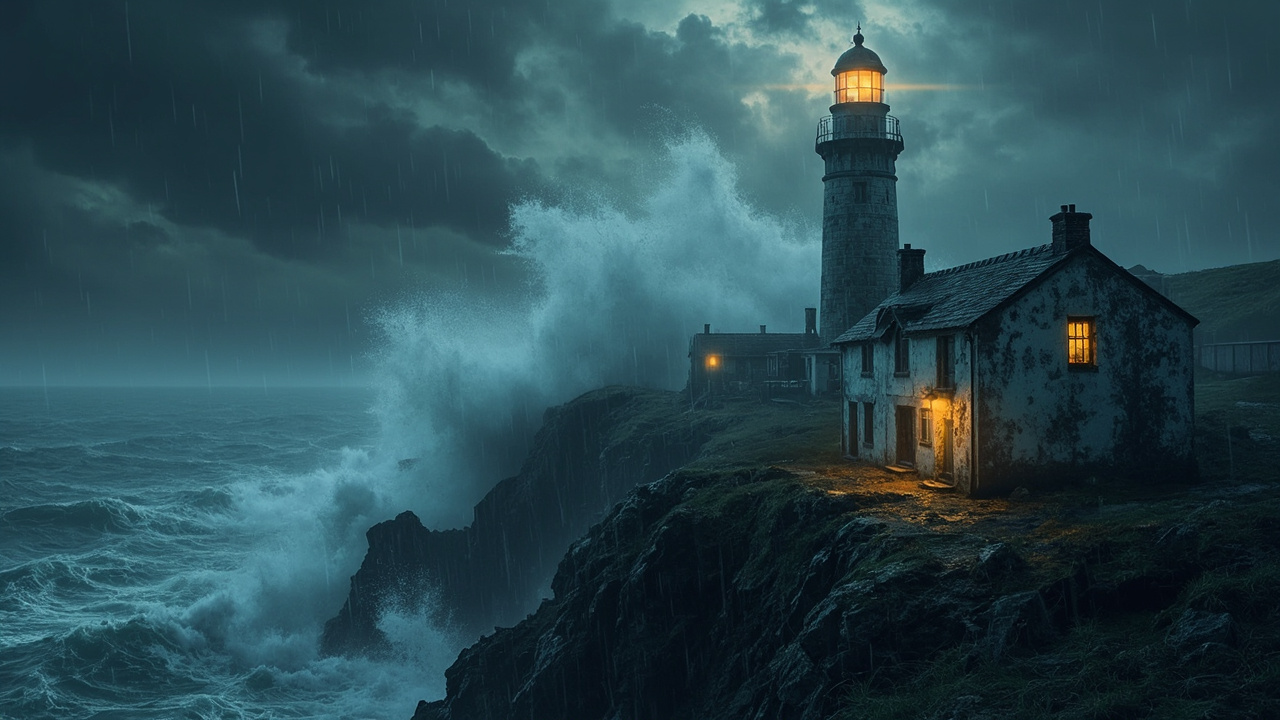
Dr Eleanor Marsh had spent three years mapping the relentless erosion of Cornwall's northern coastline, but nothing had prepared her for what she found in the keeper's cottage at Trevose Head. The building had stood abandoned since 1918, its whitewashed walls surrendering slowly to the salt-laden wind. Within its decaying rooms, amid the detritus of a century's neglect, lay a leather-bound diary, its pages yellowed but remarkably intact.
She had come to study the geological processes reshaping the cliffs, not to uncover ghosts. Yet as she turned the fragile pages in the fading afternoon light, Eleanor found herself drawn into an entirely different kind of excavation—one that demanded she excavate the past rather than the earth beneath her feet. The handwriting was cramped, erratic, and infuriatingly cryptic. Many entries appeared to be written in a cipher of some kind, the letters inverted or substituted according to a pattern she could not immediately discern.
It took Eleanor two weeks to crack the code, working by lamplight in her rented cottage while the Atlantic storms raged beyond the window. The cipher, she eventually realised, was a simple substitution—a childhood game elevated to something more desperate. Once decoded, the entries revealed the hand of Thomas Penrose, who had served as principal keeper at the lighthouse from 1862 until his death in 1887. His words painted a picture of duty, isolation, and ultimately, of something he could not bear to record plainly.
The earlier entries were mundane enough: weather observations, ships sighted, the mundane maintenance of the great lamp. But as she read on, Eleanor noticed a change in tone. Thomas began to write of sleepless nights, of hearing voices in the wind, of seeing shapes in the fog where no shapes should be. 'The sea gives nothing back willingly,' he wrote in October 1869. 'And what she takes, she keeps.'
It was the entry from November the twelfth, 1869, that made Eleanor's blood run cold. 'They will come tonight—the Vagrant, out of Falmouth with thirty souls aboard. The storm is upon us and the rocks are hungry. God forgive me for what I must do. The light must go dark, or they will see the channel and perish upon the reef. Better one life lost to the cold than thirty to the sea.'
There the entry ended, unfinished. The next page was torn out.
Eleanor's hands trembled as she read those words again. The Vagrant—she had seen that name in the maritime records, a small brigantine reported lost with all hands off Trevose Head in November 1869. No survivors. No wreckage ever recovered. The official inquiry had concluded that the vessel had foundered in the storm, its crew victims of the cruel autumn weather that battered that coast each year.
But Thomas Penrose's diary told a different story. Someone had deliberately extinguished the lighthouse, condemning a ship and all aboard her to destruction. Eleanor understood then what the entries had been hinting at. Thomas had sacrificed the Vagrant and her crew to save another vessel—perhaps one carrying passengers he loved, perhaps one he had been ordered to protect. The cryptic, anguished entries of the following weeks confirmed her worst suspicions. 'The light burns again,' he wrote in December. 'But I see their faces in every wave. I hear them calling from the rocks. The sea did not want them, but she took them anyway, and she will not give them back.'
Thomas Penrose died in January 1887, still serving his solitary vigil. His final entry read simply: 'I have kept the secret for seventeen years. Let it die with me.'
But secrets, Eleanor knew, have a way of surfacing. Armed with the diary and the coordinates Thomas had painstakingly encoded within his cipher, she contacted the Maritime Heritage Society. A sonar survey of the indicated coordinates revealed what had eluded searchers for over a century: the wreck of the Vagrant, her hull remarkably preserved in the silt of a deep underwater ravine, thirty bodies still lashed to her deck as the sea had found them on that November night in 1869.
Eleanor stood on the headland as the survey vessel returned to port, the lighthouse beam sweeping its familiar arc across the water. Somewhere beneath those waves lay Thomas Penrose's terrible burden, finally laid to rest after one hundred and fifty years. She thought of the keeper alone in his tower, extinguishing the light that was his sacred duty to keep burning, choosing to damn himself rather than watch thirty souls drown in full view of safety.
It was not heroism, she told herself. It was not even mercy, not truly. But it was a sacrifice made by one man who could not bear the weight of choosing between two impossible options. The sea, as Thomas had written, gives nothing back willingly. But sometimes, very occasionally, she yields up her secrets to those patient enough to listen.