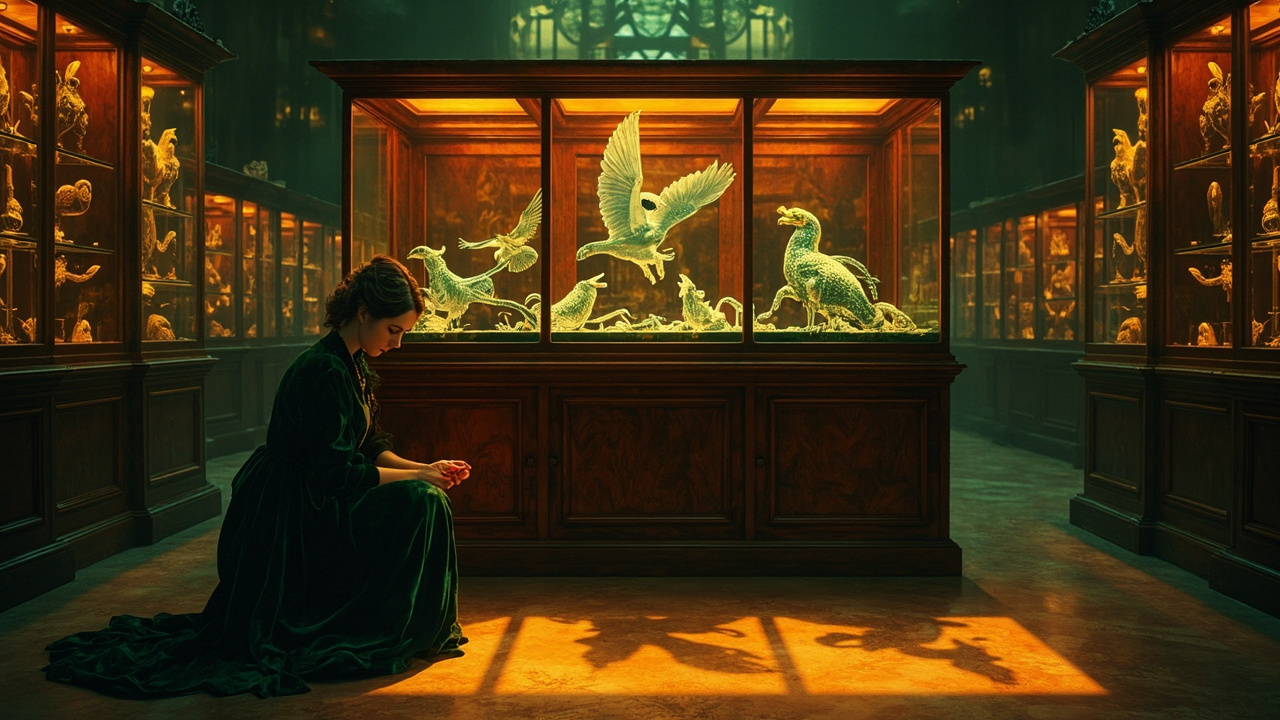
أرجعت رياح الخريف نوافذ المتحف معلقة بمفصلاتها بينما كانلت إلينور مارش راكعة أمام خزانة العرض، مُلقياً مصباحها للحفظ توهجاً دافئاً عنبرياً عبر صفوف من حيوانات الزجاج الهشة. كانت الساعة التاسعة والنصف، وكان المبنى قد غرق في صمت عميق منذ وقت طويل سوى مشعات قديمة تطن في الظلال. كانت قد كُلفت بإعادة ترميم هذه المجموعة الفيكتورية منذ ثلاثة أشهر—مئات المخلوقات المصنوعة بدقة متناهية التي كانت تعود يوماً إلى الجامع الغريب السير إدموند بلاكوود. بوم بأعيون ياقوتية. عائلة أرانب في منتصف قفزتها. أفعى ملتفة كانت حراشفها الزجاجية تلتقط الضوء كالماء المتجمد. كانت كل قطعة تحفة فنية، لكن شيئاً فيها كان دائماً يُقلقها. كانت مثالية جداً، حية جداً، كأن صانع الزجاج لم يلتقط مجرد الشكل بل جوهر موضوعاته ذاته. الليلة، عملت على ثعلب زجاجي صغير، كان جوفه الداخلي خفيف الوزن بشكل مذهل. وبينما كانت تفحص اللحامات التي اتصلت بها القطع، لامست أداة الاستكشاف الخاصة بها شيئاً غير متوقع—لسان صغير مخفي داخل القاعدة، غير مرئي للعين المجردة. تسارع قلبها. بحذر، استخرجت لفافة من الورق قديمة لدرجة أنها بدت مستعدة للتفتت عند لمسها. كان الخط عنكبوتياً وإلحاحياً:
"اكتملت التحويل. الصيغة تعيش داخل الأرشيف. احرسها جيداً، إذ لا يجب أن تقع أبداً في أيدٍ غير جديرة. —إ.ب., ديسمبر 1887"
جلست إلينور على ركبتيها، ونبض قلبها يطن في أذنيها. كان السير إدموند بلاكوود صانع زجاج ذائع الصيت، لكن هذه الملاحظة كانت توحي بشيء أكثر sinister. كان التحويل لغة الخيمياء—السعي الوسيط لتحويل المعادن الرديئة إلى ذهب، لاكتشاف إكسير الحياة نفسه. هل كان بلاكوود عضواً في إحدى تلك الجمعيات السرية التي ازدهرت في إنجلترا الفيكتورية، المتاجرة في المعرفة المحرمة والطقوس الغامضة؟
بدأت بحثها في الصباح التالي، غارقة في أرشيفات المتحف. ما اكتشفته كان مثيراً للاهتمام ومقلقاً في آن واحد. كان بلاكوود قد انتمى بالفعل إلى النظام الهيرمتي للنجم الذهبي، تلك الجمعية المشؤومة من المتصوفين وأصحاب العلوم الباطنية التي كان أليستر كراولي من بين أعضائها. لكن النظام قد تصدع في عام 1903، وتفرّق أعضاؤه كالعصافير المذعورة. كانت أي أسرار احتفظ بها بلاكوود قد ابتلعها الزمن. أم كانت كذلك؟
لفت انتباهها تفصيل في دفتر بلاكوود الأخير—دفعة لحجار بشأن "تجديدات بيت الصيفية، كلايفز إند." عرفت إلينور تلك الملكية. كانت تقف على الساحل البري لنورفولك، مهجورة لعقود، وحدائقها متضخمة ونوافذها مُطرقعة كعيون مغلقة. كانت جدتها قد تحدثت عنها مرة، محذرة إياها من الاقتراب أبداً. "لهذا المكان إحساس غريب," قالت. "كأنه يحبس أنفاسه."
استغرقت الرحلة شمالاً إلينور بالقطار عبر الريف المُمطر، وخيالها يركض أمامها كالسبانيل. عندما وقفت أخيراً أمام بيت الصيفية المهدم، ببنائه الحجري الرمادي نصف المبتلع بوجود اللبلاب، فهمت قلق جدتها. بدا المبنى يراقبها، صبوراً وحياً، كأنه كان ينتظر هذه اللحظة لأكثر من قرن.
داخله، تحت بلاطة أرضية مفكوكة في ما كان يوماً مكتبة، وجدت إلينور صندوقاً مبطناً بالرصاص. ارتجفت يديها وهي ترفع الغطاء. في الداخل استقرت أنبوبة زجاجية واحدة تحوي سائلاً بدا وكأنه يتوهج بضوء داخلي خاص—مستحيل، لكن حقيقي بلا شك. بجانبها كان دفتر جلد مليء بملاحظات بلاكوود الدقيقة.
كانت الصيغة، كما بدا، ليست لتحويل الرصاص إلى ذهب. كانت لش شيء أكثر روعة وأكثر رعباً بكثير. كان بلاكوود قد اكتشف كيف يحبس الجوهر الحي داخل الزجاج—ليس مجرد مظهر الحياة، بل الوعي الفعلي، مجمداً في عنبر أبدي. الثعلب، والبوم، والأفعى: كانوا يوماً لحماً ودماً. كان قد حولهم إلى شيء خالد، شيء لا يمكنه أن يموت ولا أن يعيش حقاً.
تقرأ إلينور أكثر، والرعب يتصاعد بارداً في صدرها. كانت العملية تتطلب تضحية. حيوانات، نعم—لكن ملاحظات بلاكوود الأخيرة أشارت إلى تجارب أكثر ظلمة، إلى متطوعين بشريين كانوا يطلبون الخلود من خلال فنه. "هم لا يعانون," كتب، ببرود عالم. "هم ببساطة... يستمرون."
فهمت الآن لماذا حذرت جدتها منها. فهمت لماذا كلفها المتحف بهذا الترميم بهذه السرية، لماذا لم يُعرض بعض القطع أبداً. كان أرشيف الزجاج لا يحمل مجرد فضول جميلة بل أرواحاً مسجونة، محبوسة في مطهرها البلوري، تنتظر.
اتخذت إلينور قرارها في ضوء العصر الخافت. لن تُدمر الأنبوبة—فذلك لن يُطلق شيئاً. كانت الأرواح داخل الزجاج مقيدة بصيغة بلاكوود، ولا يمكن تحريرها إلا بإلغاء تلك الصيغة. سيستغرق الأمر سنوات من الدراسة، بحثاً دقيقاً، إيجاد آخرين يفهمون الطرق القديمة. لكنها ستكرس نفسها لذلك.
بينما غادرت بيت الصيفية، خبا الريح، والبحر خلفها كان مسطحاً ورمادياً كالصفائح المعدنية. في مكان ما خلفها، شعرت بحيوانات الزجاج في المتحف، تلك الشهود الصامتين، يراقبونها بعيونهما الياقوتية والذهبية. لقد صمدوا لأكثر من قرن. يمكنهم أن يصمدوا لفترة أطول قليلاً.
ومشت إلينور مارش نحو المساء، حاملة وزن الأسرار وشرارة الأمل، عازمة على أنه يوماً ما، سيُحرر أرشيف الزجاج أخيراً.
Die Herbstwinde ließen die Schiebefenster des Hargreave-Museums klirren, während Eleanor Marsh vor der Vitrine kniete und ihre Restaurierungslampe ein warmes, bernsteinfarbenes Licht auf Reihen zierlicher Glastiere warf. Es war halb zehn, und das Gebäude war schon lange in Stille versunken, abgesehen von den uralten Heizkörpern, die in den Schatten tickten. Sie hatte die Aufgabe erhalten, die viktorianische Menagerie seit drei Monaten zu restaurieren—Hunderte von sorgfältig gefertigten Kreaturen, die einst dem exzentrischen Sammler Sir Edmund Blackwood gehört hatten. Eulen mit rubinroten Augen. Eine Familie von Hasen im Sprung. Eine zusammengerollte Viper, deren Glasschuppen das Licht wie gefrorenes Wasser einfingen. Jedes Stück war ein Meisterwerk, doch etwas an ihnen hatte sie stets beunruhigt. Sie waren zu perfekt, zu lebensecht, als hätte der Glasmacher nicht nur die Form, sondern das Wesen seiner Motive eingefangen. Heute Nacht arbeitete sie an einem kleinen Glask Fuchs, dessen hohler Körper bemerkenswert leicht war. Als sie die Nähte untersuchte, wo die Stücke verbunden waren, verfing sich ihr Sondierinstrument an etwas Unerwartetem—einer winzigen Klappe, die in der Basis verborgen war, für das bloße Auge unsichtbar. Ihr Herz beschleunigte sich. Sorgfältig zog sie ein zusammengerolltes Papier hervor, so alt, dass es bereit schien, bei der Berührung zu zerbröseln. Die Handschrift war spinnenhaft und dringlich:
"Die Transmutation ist vollendet. Die Formel lebt im Archiv. Bewacht sie wohl, denn sie darf niemals in unwürdige Hände geraten. —E.B., Dezember 1887"
Eleanor richtete sich auf ihren Knien auf, ihr Puls dröhnte in ihren Ohren. Sir Edmund Blackwood war ein一定程度上 bekannter Glasmacher gewesen, doch diese Notiz deutete auf etwas weit Übleres hin. Transmutation war die Sprache der Alchemie—das mittelalterliche Streben, unedle Metalle in Gold zu verwandeln, den Lebenselixier selbst zu entdecken. War Blackwood Mitglied einer jener Geheimgesellschaften gewesen, die im viktorianischen England gediehen waren, die verbotenes Wissen und arkane Rituale handelten?
Ihre Recherche begann am folgenden Morgen, vergraben in den Archiven des Museums. Was sie aufdeckte, war zugleich faszinierend und beunruhigend. Blackwood hatte tatsächlich der Hermetischen Ordnung vom Goldenen Morgen angehört, jener berüchtigten Gesellschaft von Mystikern und Okkultisten, zu deren Mitgliedern auch Aleister Crowley gezählt hatte. Doch die Ordnung war 1903 zerbrochen, ihre Mitglieder verstreut wie aufgeschreckte Vögel. Alle Geheimnisse, die Blackwood gehütet hatte, waren vom Leben verschlungen worden. Oder etwa nicht?
Ein Detail in Blackwoods letztem Hauptbuch erregte ihre Aufmerksamkeit—eine Zahlung an einen Steinmetz für "Renovierungen am Gartenhaus, Cliffs End." Eleanor kannte diese Immobilie. Sie stand an der wilden Küste von Norfolk, seit Jahrzehnten verlassen, ihre Grundstücke überwuchert und ihre Fenster vernagelt wie geschlossene Augen. Ihre Großmutter hatte einmal davon gesprochen und sie gewarnt, sich ihr nie zu nähern. "Dieser Ort hat ein eigentümliches Gefühl," hatte sie gesagt. "Als würde er seinen Atem anhalten."
Die Reise nach Norden brachte Eleanor mit dem Zug durch regengepeitschte Landschaft, ihre Vorstellungskraft rannte wie ein Spaniel vor ihr her. Als sie schließlich vor dem verfallenen Gartenhaus stand, dessen graue Steinstruktur halb vom Efeu verschlungen war, verstand sie das Unbehagen ihrer Großmutter. Das Gebäude schien sie zu beobachten, geduldig und wachsam, als hätte es auf diesen Moment seit über einem Jahrhundert gewartet.
Drinnen, unter einem lockeren Fliesenstein in dem, was einst ein Arbeitszimmer gewesen war, fand Eleanor eine mit Blei ausgekleidete Truhe. Ihre Hände zitterten, als sie den Deckel hob. Darin lag ein einzelnes Glasfläschchen mit einer Flüssigkeit, die mit ihrem eigenen inneren Licht zu glühen schien—unmöglich, und doch unbestreitbar real. Daneben lag ein Lederjournal, gefüllt mit Blackwoods akribischen Beobachtungen. Die Formel, so schien es, war nicht dazu bestimmt, Blei in Gold zu verwandeln. Sie war für etwas weit Aufregenderes und weit Schrecklicheres bestimmt. Blackwood hatte entdeckt, wie man lebendiges Wesen im Glas einfangen konnte—nicht nur den Anschein von Leben, sondern tatsächliches Bewusstsein, eingefroren in ewigem Bernstein. Der Fuchs, die Eule, die Viper: sie waren einst Fleisch und Blut gewesen. Er hatte sie in etwas Unsterbliches verwandelt, etwas, das weder sterben noch wirklich leben konnte.
Eleanor las weiter, während sich Entsetzen kalt in ihrer Brust ausbreitete. Der Prozess erforderte Opfer. Tiere, ja—doch Blackwoods letzte Einträge deuteten auf dunklere Experimente hin, auf menschliche Freiwillige, die Unsterblichkeit durch seine Kunst gesucht hatten. "Sie leiden nicht," hatte er geschrieben, mit der Distanziertheit eines Wissenschaftlers. "Sie existieren einfach... fort."
Jetzt verstand sie, warum ihre Großmutter sie gewarnt hatte. Sie verstand, warum das Museum sie mit so viel Geheimhaltung mit der Restaurierung beauftragt hatte, warum bestimmte Stücke niemals ausgestellt werden durften. Das Glasarchiv enthielt nicht nur schöne Kuriositäten, sondern gefangene Seelen, eingesperrt in ihrem kristallinen Fegefeuer, wartend.
Eleanor traf ihre Entscheidung im verblassenden Nachmittagslicht. Sie würde das Fläschchen nicht zerstören—das würde nichts befreien. Die Seelen im Glas waren durch Blackwoods Formel gebunden, und nur die Umkehrung dieser Formel konnte sie befreien. Es würde Jahre des Studiums, sorgfältiger Forschung, des Findens anderer, die die alten Wege verstanden, erfordern. Aber sie würde sich dem widmen.
Als sie das Gartenhaus verließ, war der Wind eingeschlafen, und das Meer dahinter lag flach und grau wie Blech. Irgendwo hinter ihr spürte sie die Glaskreaturen im Museum, diese schweigenden Zeugen, die mit ihren rubinroten und bernsteinfarbenen Augen beobachteten. Sie hatten über ein Jahrhundert ausgehalten. Sie konnten noch ein wenig länger durchhalten. Und Eleanor Marsh ging in den Abend hinein, getragen vom Gewicht der Geheimnisse und dem Funken der Hoffnung, entschlossen, dass eines Tages das Glasarchiv endlich frei sein würde.
Le vent automnal faisait craquer les fenêtres à guillotine du musée Hargreave tandis qu'Eleanor Marsh s'agenouillait devant la vitrine, sa lampe de restauration projetant une chaude lueur ambrée sur des rangées de délicates figurines animales en verre. Il était dix-neuf heures trente, et le bâtiment était plongé dans le silence depuis longtemps, hormis les antiques radiateurs qui cliquetaient dans l'ombre. On lui avait confié la restauration de cette ménagerie victorienne depuis trois mois—des centaines de créatures méticuleusement façonnées qui avaient appartenu autrefois aucollectionneur excentrique Sir Edmund Blackwood. Des hiboux aux yeux de rubis. Une famille de lièvres en plein saut. Un serpent enroulé dont les écailles de verre capturaient la lumière comme de l'eau gelée. Chaque pièce était une œuvre magistrale, et pourtant quelque chose l'avait toujours troublée. Elles étaient trop parfaites, trop vivantes, comme si le verrier avait capturé non seulement la forme, mais l'essence même de ses sujets. Ce soir-là, elle travaillait sur un petit renard de verre, dont le corps creux était remarquablement léger. En examinant les jointures où les pièces s'assemblaient, son outil d'exploration accrocha quelque chose d'inattendu—un petit rabat dissimulé dans la base, invisible à l'œil nu. Son cœur s'emballa. Avec précaution, elle extract un morceau de papier roulé si vieux qu'il semblait prêt à s'effriter au toucher. L'écriture était arachnéenne et urgente:
"La transmutation est complète. La formule vit dans l'archive. Gardez-la bien, car elle ne doit jamais tomber entre des mains indignes. —E.B., décembre 1887"
Eleanor recula sur ses talons, le pouls battant dans ses oreilles. Sir Edmund Blackwood avait été un verrier de quelque notoriété, mais cette note suggérait quelque chose de bien plus sinistre. La transmutation était le langage de l'alchimie—la quête médiévale pour transformer les métaux vils en or, découvrir l'élixir de vie lui-même. Blackwood avait-il été membre de l'une de ces sociétés secrètes qui avaient fleuri dans l'Angleterre victorienne, échangeant des connaissances interdites et des rituels arcaniques?
Sa recherche commença le lendemain matin, enfouie dans les archives du musée. Ce qu'elle découvrit était à la fois fascinant et troublant. Blackwood avait bien appartenu à l'Ordre Hermétique de l'Aube Dorée, cette société notoire de mystiques et d'occultistes qui comptait Aleister Crowley parmi ses membres. Mais l'ordre s'était fracturé en 1903, ses membres se dispersant comme des oiseaux effarouchés. Tous les secrets que Blackwood avait gardés avaient été engloutis par le temps. Ou peut-être pas?
Un détail dans le dernier registre de Blackwood attira son attention—un paiement à un tailleur de pierre pour "des rénovation au pavillon d'été, Cliffs End." Eleanor connaissait cette propriété. Elle se dressait sur la côte sauvage du Norfolk, abandonnée depuis des décennies, ses terrains envahis par la végétation et ses fenêtres condamnées comme des yeux clos. Sa grand-mère lui en avait parlé une fois, l'avertissant de ne jamais s'en approcher. "Cet endroit a un sentiment peculiar," avait-elle dit. "Comme s'il retenait son souffle."
Le voyage vers le nord emmena Eleanor en train à travers des campagnes balayées par la pluie, son imagination courant devant elle comme un épagneul. Quand elle se tint enfin devant le pavillon d'été en ruines, sa maçonnerie grise à demi avalée par le lierre, elle comprit l'inconfort de sa grand-mère. Le bâtiment semblait l'observer, patient et vigilant, comme s'il avait attendu ce moment depuis plus d'un siècle.
À l'intérieur, sous une dalle descellement dans ce qui avait été un bureau, Eleanor trouva un coffre doublée de plomb. Ses mains tremblèrent en soulevant le couvercle. À l'intérieur reposait un unique flacon de verre contenant un liquide qui semblait briller de sa propre lumière intérieure—impossible, et pourtant indéniablement réel. À côté se trouvait un journal en cuir rempli des observations méticuleuses de Blackwood. La formule, semblait-il, n'était pas pour transformer le plomb en or. C'était pour quelque chose de bien plus extraordinaire et de bien plus terrible. Blackwood avait découvert comment piéger l'essence vivante dans le verre—non pas simplement l'apparence de la vie, mais la conscience réelle, figée dans l'ambre éternel. Le renard, le hibou, le serpent: ils avaient été chair et sang. Il les avait transformés en quelque chose d'immortel, quelque chose qui ne pouvait ni mourir ni vraiment vivre.
Eleanor continua sa lecture, l'horreur naissant froide dans sa poitrine. Le processus nécessitait un sacrifice. Des animaux, oui—mais les dernières entrées de Blackwood suggéraient des expériences plus sombres, des volontaires humains qui avaient cherché l'immortalité à travers son art. "Ils ne souffrent pas," avait-il écrit, avec le détachement d'un scientifique. "Ils persistent simplement..."
Elle comprit maintenant pourquoi sa grand-mère l'avait mise en garde. Elle comprit pourquoi le musée lui avait confié cette restauration avec tant de secret, pourquoi certaines pièces ne devaient jamais être exposées. L'Archive de Verre ne contenait pas de simples curiosités esthétiques mais des âmes emprisonnées, piégées dans leur purgatoire cristallin, attendant.
Eleanor prit sa décision dans la lumière déclinante de l'après-midi. Elle ne détruirait pas le flacon—cela ne libérerait rien. Les âmes dans le verre étaient liées par la formule de Blackwood, et seule l'inversion de cette formule pourrait les libérer. Cela prendrait des années d'étude, de recherche minutieuse, de recherche d'autres qui comprenaient les anciennes voies. Mais elle s'y consacrerait.
En quittant le pavillon d'été, le vent était mort, et la mer au-delà était plate et grise comme de la tôle. Quelque part derrière elle, elle sentit les créatures de verre dans le musée, ces témoins silencieux, observant de leurs yeux rubis et ambrés. Ils avaient enduré pendant plus d'un siècle. Ils pouvaient endurer un peu plus longtemps. Et Eleanor Marsh marcha vers le soir, portant le poids des secrets et l'étincelle de l'espoir, déterminée que, un jour, l'Archive de Verre serait enfin libre.
Осенний ветер сотрясал оконные рамы музея Харгрив, пока Элеанор Марш стояла на коленях перед выставочным шкафом, а её реставрационная лампа бросала тёплый янтарный свет на ряды изящных стеклянных животных. Было половина десятого вечера, и здание давно погрузилось в молчание, если не считать древних радиаторов, потрескивающих в тенях. Ей было поручено восстановить эту викторианскую коллекцию три месяца назад — сотни кропотливо созданных существ, которые когда-то принадлежали эксцентричному коллекционеру сэру Эдмунду Блэквуду. Совы с рубиновыми глазами. Семья зайцев в прыжке. Свернувшаяся змея, чья стеклянная чешуя ловила свет, как замёрзшая вода. Каждая фигурка была шедевром, но что-то в них всегда её беспокоило. Они были слишком совершенны, слишком жизненны, словно мастер стекла запечатлел не просто форму, но саму суть своих созданий. Этой ночью она работала над маленькой стеклянной лисицей, полое тело которой было удивительно лёгким. Когда она рассматривала швы, где соединялись детали, её исследовательский инструмент зацепился за нечто неожиданное — крошечный клапан, скрытый в основании, невидимый невооружённым глазом. Сердце у неё забилось чаще. Осторожно она извлекла свёрнутый клочок бумаги, такой старый, что он казался готовым рассыпаться от прикосновения. Почерк был торопливый и настойчивый:
"Превращение завершено. Формула живёт в архиве. Храните её хорошо, ибо она никогда не должна попасть в недостойные руки. —Э.Б., декабрь 1887"
Элеанор откинулась назад, пульс стучал в ушах. Сэр Эдмунд Блэквуд был стекольных дел мастером некоторой известности, но эта записка предполагала нечто гораздо более зловещее. Превращение было языком алхимии — средневекового стремления превратить неблагородные металлы в золото, открыть эликсир самой жизни. Был ли Блэквуд членом одного из тех тайных обществ, что процветали в викторианской Англии, торгуя запретным знанием и тайными ритуалами?
Её исследования начались следующим утром, погружёнными в архивы музея. То, что она обнаружила, было одновременно увлекательным и тревожным. Блэквуд действительно состоял в Герметическом ордене Золотой Зари, том печально известном обществе мистиков и оккультистов, среди членов которого был и Алистер Кроули. Но орден распался в 1903 году, его члены рассеялись, как вспугнутые птицы. Любые секреты, которые хранил Блэквуд, были поглощены временем. Или нет?
Деталь в последней книге Блэквуда привлекла её внимание — платёж каменщику за "ремонт летнего домика в Клиффс-Энд". Элеанор знала это поместье. Оно стояло на диком побережье Норфолка, заброшенное десятилетиями, его владения заросли, а окна заколочены, словно закрытые глаза. Её бабушка однажды о нём упоминала, предупреждая никогда туда не соваться. "У этого места странное чувство," сказала она. "Словно оно задерживает дыхание."
Путешествие на север заняло у Элеанор поездом через залитый дождём пейзаж, её воображение мчалось впереди, как спаниель. Когда она наконец стояла перед руинами летнего домика, его серый камень наполовину заглощен плющом, она поняла тревогу своей бабушки. Здание словно наблюдало за ней, терпеливо и настороженно, словно ждало этого момента более века.
Внутри, под расшатавшейся плиткой в том, что когда-то было кабинетом, Элеанор нашла обитый свинцом сундук. Её руки дрожали, когда она подняла крышку. Внутри лежала единственная стеклянная пробирка с жидкостью, которая, казалось, светилась собственным внутренним светом — невозможно, но несомненно реально. Рядом лежал кожаный дневник, наполненный аккуратными наблюдениями Блэквуда. Формула, как оказалось, была не для превращения свинца в золото. Она была для чего-то гораздо более удивительного и гораздо более ужасного. Блэквуд открыл, как поймать живую сущность в стекле — не просто видимость жизни, но само сознание, замороженное в вечном янтаре. Лисица, сова, змея: они когда-то были плотью и кровью. Он превратил их в нечто бессмертное, нечто, что не может ни умереть, ни по-настоящему жить.
Элеанор читала дальше, ужас холодел в её груди. Процесс требовал жертв. Животных, да — но последние записи Блэквуда намекали на более тёмные эксперименты, на человеческих добровольцев, которые искали бессмертия через его искусство. "Они не страдают," написал он, с отстранённостью учёного. "Они просто... существуют."
Теперь она поняла, почему её бабушка её предупреждала. Поняла, почему музей поручил ей эту реставрацию с такой секретностью, почему некоторые экспонаты никогда не должны были выставляться. Стеклянный архив хранил не просто красивые диковинки, но заключённые души, заточённые в своём кристаллическом чистилище, ожидающие.
Элеанор приняла решение в угасающем дневном свете. Она не уничтожит пробирку — это ничего не освободит. Души в стекле были связаны формулой Блэквуда, и только её обращение могло их освободить. На это уйдут годы изучения, тщательного исследования, поиска других, кто понимает древние пути. Но она посвятит себя этому.
Когда она покидала летний домик, ветер стих, и море за ним лежало плоским и серым, как лист железа. Где-то позади неё она чувствовала стеклянных существ в музее, тех безмолвных свидетелей, наблюдающих рубиновыми и янтарными глазами. Они выдержали более века. Они могут выдержать ещё немного. И Элеанор Марш шагала в вечер, неся груз секретов и искру надежды, полная решимости, что однажды Стеклянный архив наконец обретёт свободу.