Vocabulaire essentiel
| Mot | العربية | Deutsch | Français | Русский |
|---|---|---|---|---|
| زائر المكتبة | Bibliotheksbesucher | usager | читатель | |
| مكتب الإعارة | Ausleihe | bureau de prêt | абонемент | |
| مخطوطة | Handschrift | manuscrit | рукопись | |
| حراسة | Nachtwache | veille | бдение | |
| مؤامرة | Verschwörung | conspiration | заговор | |
| راعي/ناصر | Gönner | bienfaiteur | покровитель | |
| دقيق | sorgfältig | méticuleux | тщательный | |
| عصري جورجي | georgianisch | géorgien | георгианский |
L'histoire
Mrs. Eleanor Finch had presided over the circulation desk of the Blackwood Public Library for seventeen years, and she prided herself on knowing her patrons as intimately as one knows the chapters of a beloved novel. She could recall, with a flick of her spectacles, which elderly scholar preferred the leather-bound journals in the east wing, and which student required a quiet word about overdue fines. But nothing in her considerable experience had prepared her for the mystery of the midnight borrower.
It began on a Thursday in late November, when Eleanor arrived for her early shift and found, wedged between the returns trolley and a potted fern, a library card she did not recognise. The name printed upon it was unremarkable—Harold Marsh—and the address led to a Georgian terrace on Wren Street, not three minutes' walk from the library's entrance. Yet Eleanor was certain she had never issued this card, nor seen its owner darken her doorway. The following morning, she discovered the same card again, this time placed with deliberate precision atop the reservation slips.
She consulted the computer system and found her answer: a copy of Walden and Reverence, a modest volume of essays on nature and contemplation, had been checked out at 11:58 p.m. the previous evening. The borrower: Harold Marsh. She examined the transaction more closely. Then she cross-referenced the previous fortnight's records. Her mouth grew dry. For eleven consecutive nights, at precisely eleven minutes to midnight, the same unremarkable book had been removed from the shelves by the same unremarkable patron.
Eleanor was not the sort of woman to leap to conclusions. She was the sort to keep a record. For the next fortnight, she arrived early and stayed late, maintaining a meticulous log of every unusual occurrence. The patterns emerged with the inevitability of a well-constructed plot twist. Mr. Marsh visited the library only after dark, never during opening hours. He selected the same book, returned it by morning, and left the premises with an air of purposeful anonymity. Occasionally, she noticed others—a woman with silver-streaked hair, a young man in a battered corduroy jacket—lingering near the reference section, their conversations dropping to murmurs when she drew near.
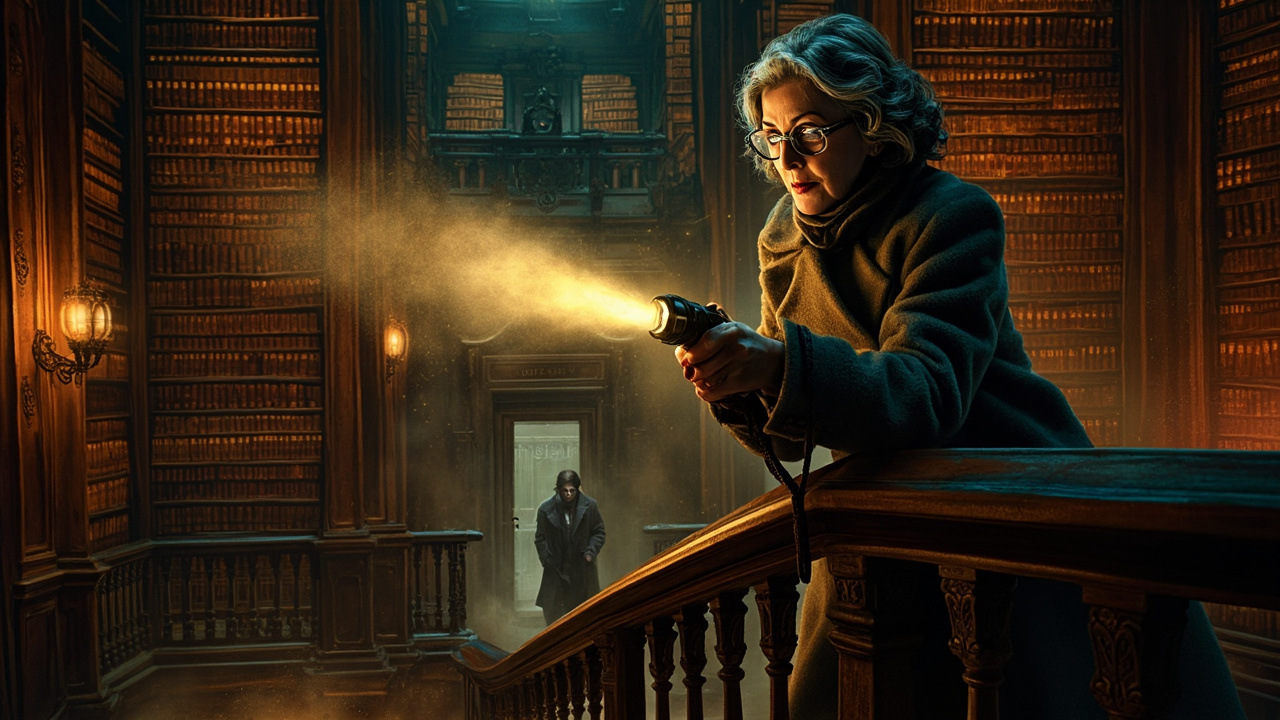
Her curiosity, once awakened, proved insatiable. On the fifteenth night of her vigil, Eleanor donned her sensible coat and positioned herself in the archive room, which offered an unobstructed view of the circulation desk through its ornate ironwork. At four minutes to midnight, Harold Marsh materialised from the shadows. He did not approach the desk. Instead, he ascended the staircase to the restricted upper gallery—accessible only to scholars with special permissions—and disappeared through a door marked 'Staff Only'.
Eleanor counted to sixty, then followed.
The gallery was thick with dust and the musty perfume of forgotten volumes. She navigated by the pale glow of her phone's torch, her footsteps muffled on the threadbare carpet. Voices reached her before she reached the room. She paused outside a heavy oak door, cracked open by an inch or so, and listened.
'...the manuscript has been secured,' a woman's voice intoned. 'The authorities believe it destroyed in the fire, but we have preserved what matters most.'
'And the documentation?' This from Harold Marsh.
'Distributed across seven locations. Each collection contains only fragments, but together, they tell the complete account. No single raid can silence us now.'
Eleanor's breath caught in her throat. She knew, with the instinct of a lifelong reader, that she had stumbled upon something far more significant than a late-night book borrower. She pressed her eye to the gap and saw them: a dozen figures seated around a mahogany table, papers spread before them like a conspiracy of scholars. Maps. Photographs. What appeared to be hand-written transcripts.
At the head of the table sat Mrs. Pemberton—the elderly benefactor whose family had funded the library's restoration thirty years prior. She was speaking, her voice carrying the weight of conviction.
'They told us literature was a luxury,' Mrs. Pemberton declared. 'They believed books could be burned and minds made vacant. But ideas, once planted, have roots deeper than any regime can reach. We have kept their memory alive, and now we shall return it to them.'
Understanding flooded through Eleanor like light through a stained-glass window. The library was not merely a repository of stories. It was a sanctuary—a hidden archive where dissidents had preserved banned writings, suppressed testimonies, and forbidden histories across generations. The midnight borrower was no eccentric. He was a guardian, perpetuating a tradition of quiet resistance that stretched back decades.
For a long moment, Eleanor remained motionless, her world rearranged in the span of a single evening. Then, with deliberate care, she withdrew from the door and descended the stairs. She returned to the circulation desk, retrieved Harold Marsh's library card, and logged it back into the system as active. When he appeared the following night—and the night after that—she greeted him with nothing more than a warm smile.
Some secrets, she had decided, were worth keeping.