Vocabulaire essentiel
| Mot | العربية | Deutsch | Français | Русский |
|---|---|---|---|---|
| تنور زجاجي | Brennofen | four | печь | |
| حارس، أمين | Hüter | gardien | хранитель | |
| تدفق، مادة صهر | Flussmittel | flux | флюс | |
| سيليكا، ثاني أكسيد السيليكون | Siliziumdioxid | silice | кремнезём | |
| نقابة، رابطة حرفية | Gilde | guilde | гильдия | |
| إنذار نهائي | Ultimatum | ultimatum | ультиматум | |
| يكسر الضوء | brechen | réfracter | преломлять | |
| يتولى الطلب | in Auftrag geben | commander | заказывать | |
| تراث | Erbe | patrimoine | наследие | |
| وداع | Abschied | adieu | прощание |
L'histoire
The rain had not ceased in three days when Rhys Morgan descended into the cellar beneath his grandmother's cottage in the Dulais Valley. He had come to clear the house before the estate agents took over, armed with bin bags and a heavy heart. Nain had been gone six weeks now, and the silence of the stone walls felt like an accusation.
He had not wanted this task. For twelve years he had avoided the valley, avoided the kilns and the relentless heat, avoided everything that his father's calling had demanded of him. He had become an accountant in Cardiff, a man of ledgers and VAT returns, and he had been content—or so he had told himself.
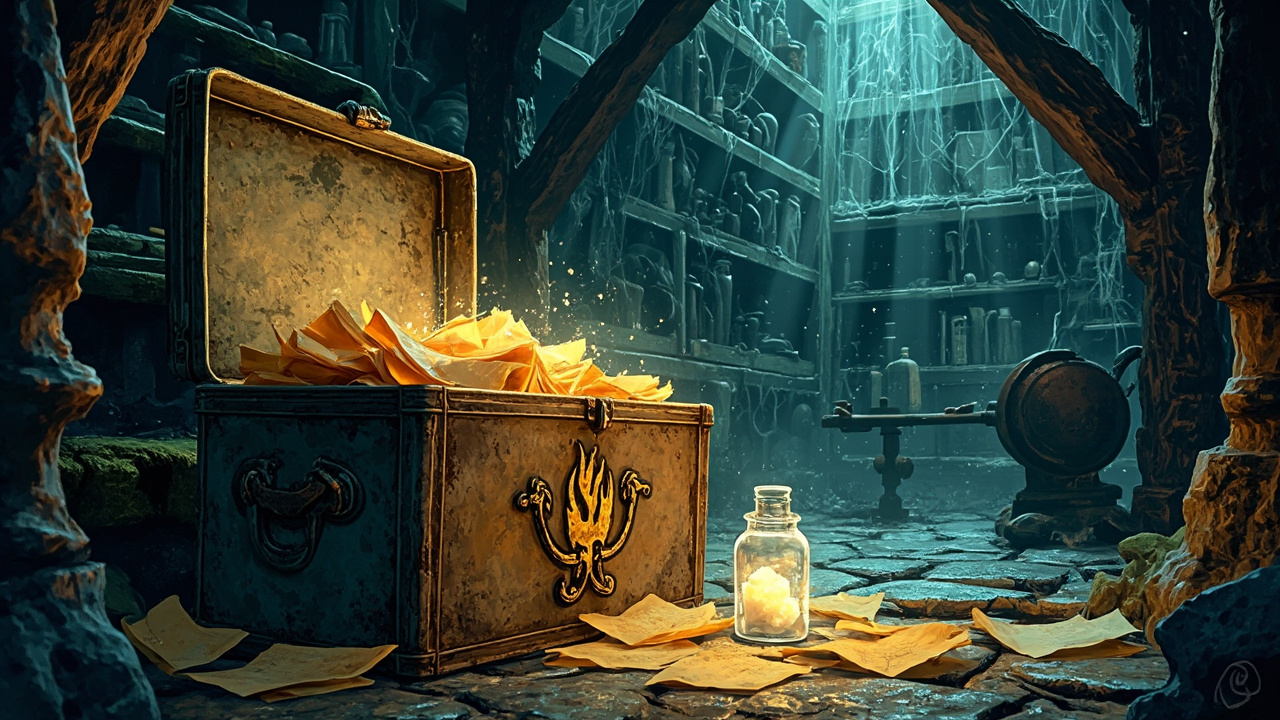
The cellar smelled of damp and something older: wood ash, iron filings, and beneath it all, the faint sweetness of melting sand. Against the far wall, behind a collapsed shelf of preserves, Rhys discovered a tin box bearing a faded crest: a flame wreathed in crystalline threads, rising from a hammer.
Inside, he found letters. Dozens of them, written in a hand he did not recognise, addressed to his great-great-grandfather, Evan Morgan, and signed simply: The Keeper of the Flame.
The documents told a story that had been kept from him all his life.
The Guild of the Crystal Flame
For three centuries, a guild of master glassmakers had operated in the valley, producing the legendary Gwydr Lliw—coloured glass of such purity that it was said one could see the very soul of Wales refracted through its depths. Kings had commissioned their windows, cathedrals had adorned their altars with it, and the Morgan family had served as its foremost custodians for generations.
But the guild had fallen. Not through war or disaster, but through economics—by 1987, only three craftsmen remained, and they had been forced to scatter when Welsh Crystal Industries, a newly privatised entity backed by foreign investment, began offering incentives to those who would share their secrets with automated factories.
Rhys read the final letter, dated just weeks before his father's death in a car accident that Rhys had always believed was entirely accidental. They have approached Evan with an ultimatum, the Keeper had written. Surrender the guild's knowledge or watch it die with us. He has refused. God help us all.
The tin contained one more item: a small vial of crushed silica, accompanied by a hand-written formula for the seventeenColour flux—the secret mixture that transformed ordinary glass into Gwydr Lliw. Beneath the instructions, in ink that had faded to the colour of old bruises, his great-great-grandfather had written: For Rhys. When he is ready.
He had been seven years old when his father died. The cottage had been sealed, his grandmother had refused to speak of the valley, and Rhys had been sent to Cardiff to become someone else entirely. But someone had known he would return.
The Last Furnace
Welsh Crystal Industries had not wasted time. Their promotional materials spoke of heritage and tradition, but the factory floor in Pontardawe told a different story: robots performing the ancient gestures, producing ten thousand pieces a week, each one flawless and utterly without soul. The company's chief executive, a Londoner named Adrian Thorne, had acquired every old furnace in the region. He intended to retire the last human glassmaker by Christmas.
Rhys found the survivors in the most unlikely places. Mervyn Price was seventy-four and worked as a caretaker in a primary school, his hands too arthritic for the pipe but his memory intact. Beryl Hughes, once the guild's only female master, had become a potter in Barry Island—her kilns turned out tourist trinkets, but she still kept a private furnace burning for herself. And young Tomos Elias, barely twenty-three, had been trained by his grandfather in the old ways and had spent two years watching the corporation drive his idol out of work.
They met in secret, as their ancestors had done, in a barn that had not seen use since before the war. Rhys presented the formula. There was silence, then weeping—the raw, shuddering tears of men and women who had believed themselves the last of their kind, only to discover that the flame had been preserved for them.
The Reckoning
Adrian Thorne's acquisition of the valley's remaining craftsmen was scheduled to conclude on St David's Day. The corporation planned to announce the end of traditional glassmaking in Wales, positioning it as a triumph of progress over obsolete craft. The press would be invited. The photographs would be taken. The story would be told as one of inevitable obsolescence.
Rhys had other ideas.
They worked through February, the four of them labouring in secret to produce a single piece: a window, two metres square, depicting the valley as it had been in the guild's first century—green hills and silver rivers, the old forge blazing against the twilight. They used the seventeenColour flux. They followed the ancient formulae. And when it was finished, they invited the press to see it for themselves.
The window was installed in the parish church, where it had once been proposed to build a memorial to the guild. Adrian Thorne came to mock what he called sentimental nostalgia. He left in silence, his face the colour of his own factory-produced glass.
The response was overwhelming. Donations arrived from across the country. The Welsh National Opera commissioned a set of vessels for their new production. Young people who had never considered the trade began writing letters, asking to apprentice.
Rhys Morgan returned to the furnace on the first of March, not as an accountant seeking an escape, but as the twenty-third master of the Guild of the Crystal Flame. The flame had nearly died, but it had not gone out—and in Wales, a flame that survives is worth more than all the factories in the world.
Outside, the rain had finally stopped. The valley glowed.