Vocabulaire essentiel
| Mot | العربية | Deutsch | Français | Русский |
|---|---|---|---|---|
| حرير | Seide | soie | шёлк | |
| دير | Kloster | monastère | монастырь | |
| حفظ | Konservierung | conservation | консервация | |
| شظية | Fragment | fragment | фрагмент | |
| تاجر | Händler | marchand | торговец | |
| صباغة | Färbung | teinture | окрашивание | |
| خث | Torf | tourbe | торф | |
| كوخ | Hütte | cabane | хижина |
L'histoire
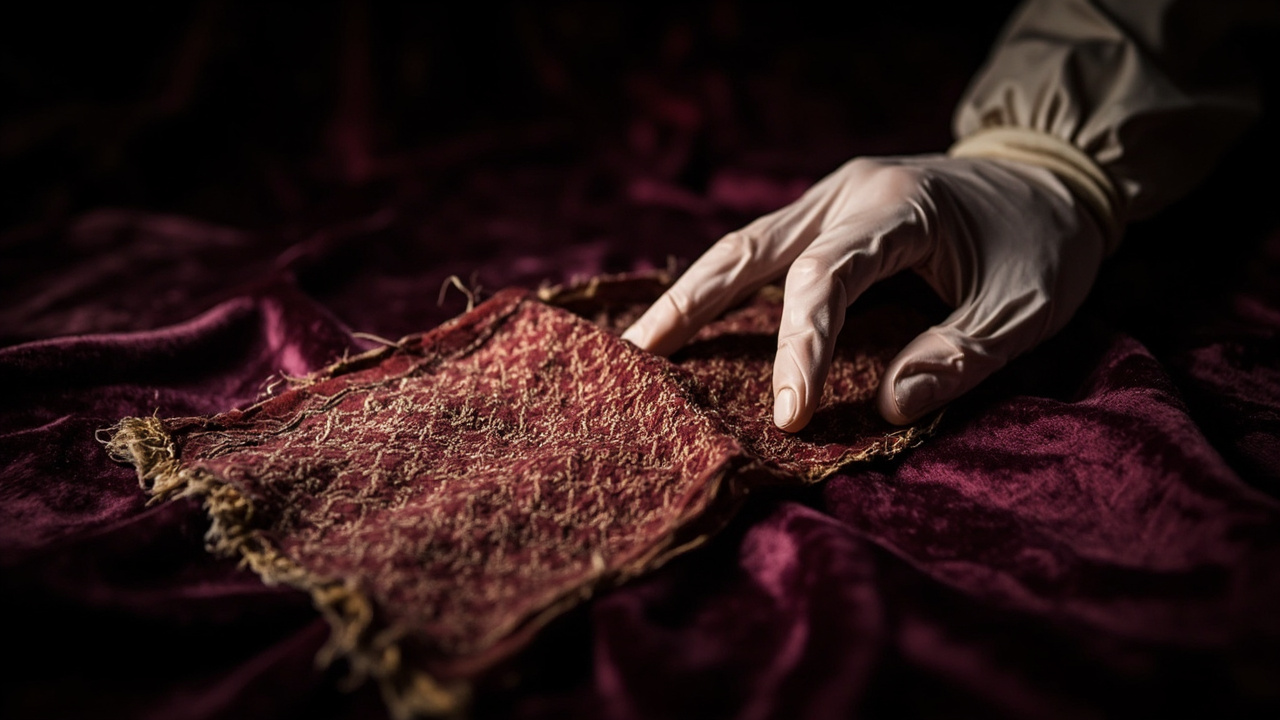
The silk arrived at the museum in November, wrapped in acid-free tissue and accompanied by a handwritten note from the peat-cutter who had unearthed it: "Found this where the moss swallows men. Thought someone should know." Dr Eleanor Ashworth, senior curator of medieval textiles, had seen fragments before—crumbs of history preserved in the anaemic light of display cases—but none had stopped her breath the way this one did.
She unrolled it in the conservation laboratory on a Thursday afternoon when the building had emptied of visitors and all but the cleaning staff. The piece measured no more than twelve centimetres square, its burgundy dye faded to the colour of old wine left too long in the sun. Yet the weave was extraordinary: a complex twill structure that ought not to have existed in these islands before the fourteenth century. Eleanor adjusted her spectacles and leant closer, her heartbeat quickening with a recognition she could not yet name.
Over the following weeks, she subjected the fragment to every analytical technique at her disposal. Mass spectrometry revealed trace amounts of mordant consistent with Byzantine dyeing methods. Radiocarbon dating placed its origin between 1020 and 1150 CE. The implications were staggering. Here, in a Scottish peat bog three miles from the nearest road, lay evidence of trade routes that scholars had never suspected—silk that had somehow traversed continents to end its days in waterlogged isolation, untouched by the worms and moths that had consumed so much else.
Eleanor became, in the parlance of her colleagues, consumed. She cancelled lectures, neglected her correspondence, and began sleeping on the office sofa she kept for late nights. The fragment whispered to her in the small hours, its silence more eloquent than any written record. She traced its probable journey: Constantinople, perhaps, or Damascus, then north through the river networks of the Continent, across the North Sea, into the hands of merchants whose names had been erased from every ledger and chronicle.
The first concrete lead came from an Icelandic saga, transcribed in the seventeenth century from older manuscripts that no longer survived. The Vatnsdœla saga mentioned a monastery on the Scottish island of Skye—holy brothers who had traded in rare goods alongside their devotions. The monastery itself had vanished, its stone repurposed for crofting walls, its memory scattered like ash on the wind. Eleanor booked a flight to Inverness before she had finished reading the passage.
The island in winter was a study in grey: grey sea, grey sky, grey hills that seemed to absorb colour itself. She walked for hours along the coastline, following maps she had drawn from parish records and the recollections of an elderly archivist in Portree who had, after much persuasion, admitted that his grandfather had spoken of a clachan naofa—a saint's town—beneath the peat. The locals regarded her with the suspicion reserved for outsiders asking old questions. She could hardly blame them.
It was in aBothán built for sheep-shearing that she found the first true evidence: a stone carved with an interlocking pattern identical to the weave structure in the silk. The farmer who owned the bothán knew nothing of its history. His grandfather had used it for storage; his father had used it for nothing at all. Eleanor photographed the carving and sent her findings to a colleague in Dublin who specialised in early medieval iconography. Three days later, the reply came: the pattern was not Scottish at all. It was Irish, specifically the heraldic device of a merchant guild that had operated from the monastery on Skye—a guild whose existence had been theorised but never proven.
The guild had been called the Cónaitheoirí Síoda: the Silk Dwellers. They had served as middlemen between the Mediterranean world and the Norse settlements, their monastery a waystation where silk was stored, taxed, and redistributed along routes that bypassed the control of kings and bishops alike. Their records had been destroyed in a fire in 1247, or so the official history claimed. Eleanor suspected otherwise. The fire had been deliberate—the guild had erased its own traces to avoid the attention of a pope who had recently forbidden Christians to trade with Muslims. In doing so, they had erased themselves from memory for seven centuries.
She returned to London with her evidence and her certainty. The scholarly article she eventually published did not merely revise the trade routes of medieval Britain; it conjured from nothing an entire network of commerce, faith, and silence. The silk, that tiny remnant of colour in the endless brown, had become a key that unlocked a door no one had known existed. In her office, framed beside her doctorate certificate, she kept the original note from the peat-cutter. Found this where the moss swallows men. She understood now what he had meant. The bog did not merely preserve—it remembered, patient and implacable, waiting for someone to come asking the right questions.