Vocabulaire essentiel
| Mot | العربية | Deutsch | Français | Русский |
|---|---|---|---|---|
| متاهة | Labyrinth | labyrinthe | лабиринт | |
| مراسلات | Korrespondenz | correspondance | переписка | |
| مبنى ضخم | Gebäude | édifice | здание/сооружение | |
| مبلّغ عن المخالفات | Enthüller | lanceur d'alerte | разоблачитель | |
| يتكلّس | verhärten | se calcifier | окаменеть | |
| خيانة عظمى | Hochverrat | trahison | измена | |
| نفاق | Heuchelei | hypocrisie | лицемерие | |
| نزاهة | Integrität | intégrité | честность | |
| حكمة | Diskretion | discrétion | осмотрительность | |
| يتحلل | verfallen | se décomposer | разлагаться |
L'histoire
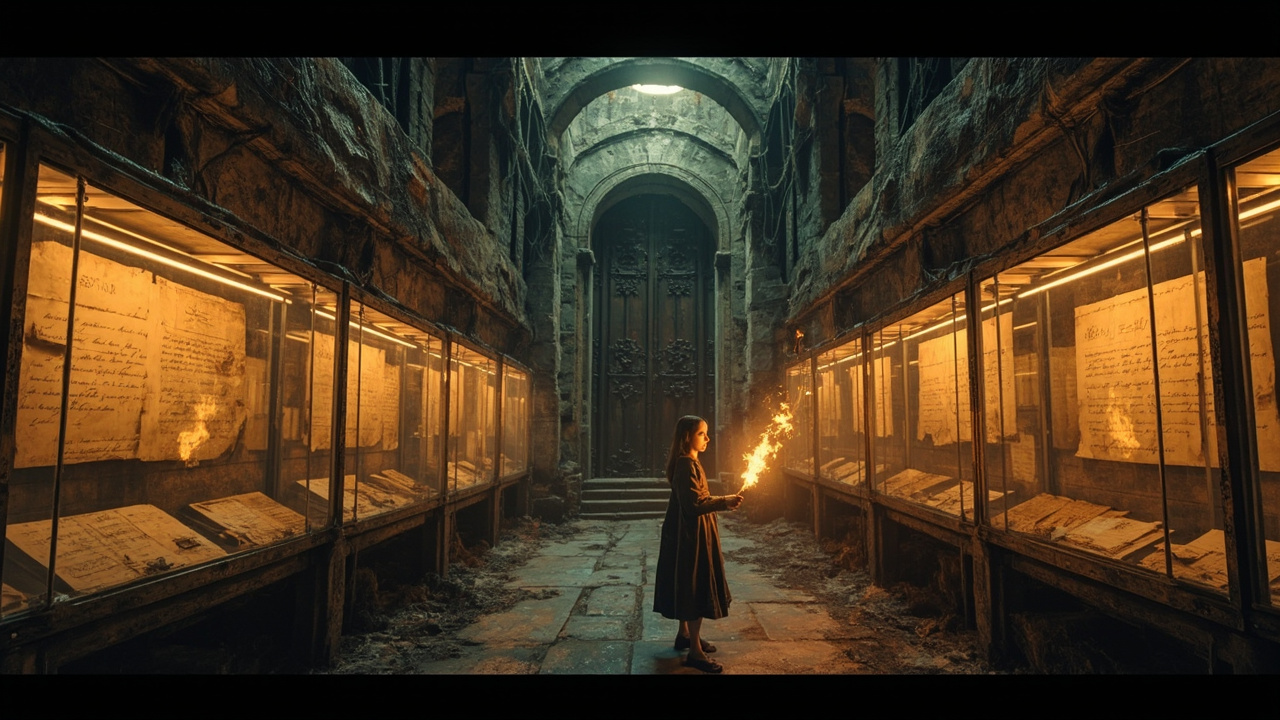
The first thing Eleanor noticed was the smell: damp stone and something older, like letters left too long in a drawer. She had been rerouting cables through the sub-basement beneath the Palace of Westminster, following a labyrinth of forgotten corridors that did not appear on any official plan.
Her torch beam fell upon a door that should not have existed, iron-bound and rusted, yet recently disturbed. Someone had been here. Someone had broken the wax seal.
Inside, she found correspondence. Hundreds of letters, telegrams, memoranda, preserved in glass cases as though exhibited in a museum no one had ever visited. The dates ran from 1912 to 1923. The handwriting was elegant, deliberate, and belonged to men whose names were still spoken with reverence in the corridors above.
Eleanor was not supposed to understand what she was looking at. She was a junior researcher, twenty-seven years old, employed to compile briefings on agricultural subsidies. But she had read widely, and she recognised certain names: diplomats, ministers, intelligence officers whose descendants still held seats in the House.
The letters revealed something unspeakable. A network operating within the very heart of government, feeding information to handlers whose identities were encoded in poetry. Not Soviet agents—there were no such convenient Cold War accusations to hurl—but something more insidious. British patriots who had sold secrets to the Kaiser, and then, after the war, been quietly recruited by the very establishment they had betrayed.
She photographed everything on her phone, then sat on the cold floor and wept.
The historian lived in Islington, in a house that smelled of pipe tobacco and academic melancholia. Dr Marcus Webb had spent forty years writing about the Great War, but Eleanor suspected he knew far more than he published. When she showed him the photographs, he turned white.
"You understand what you've found," he said. It was not a question.
"I understand that history is never quite what we're told."
Webb made tea with trembling hands and spread the prints across his study floor. For three hours, they worked through the correspondence. Names they knew. Names that appeared in their textbooks. The grandfather of a current cabinet minister. A former head of MI6. The whole rotten edifice of respectable opinion, built upon secrets it had never bothered to examine.
"This would destroy careers," Webb said. "Lives. It might bring down the government."
"It might also clear the air," Eleanor replied. "These people were traitors. They were protected because it was convenient. The rot started then, and we're still living with it."
"Or," Webb said carefully, "you would be destroyed. Whistleblowers rarely fare well. You'd be painted as a fantasist, a security risk. Your career would end. Your reputation would be shredded."
She thought of her father, a trade unionist who had fought for what he believed in, and died disillusioned. She thought of her mother, who had told her that integrity was expensive and truth was no one's friend.
"What's the alternative? Pretend I never found it? Let those letters moulder in the dark, keeping their secrets safe?"
Webb looked at her with something like admiration. "I never had the courage," he admitted. "I wrote around the edges for decades. Never touched the centre. Perhaps I was a coward."
"Perhaps we all are," Eleanor said.
The decision came at dawn, after a sleepless night spent reading testimony from 1918—the execution of a junior clerk for similar crimes, while his superiors dined at White's. The hypocrisy was breathtaking. The double standards had calcified into policy, into law, into the very architecture of power.
Eleanor made her choice. She would not hide the truth in a locked room. She would not be another ghost in the parliamentary crypt.
She contacted a journalist at the Guardian, a woman with a reputation for discretion and a spine of tempered steel. Together with Webb, who had decided that forty years of silence was long enough, they prepared the documents for publication.
The story broke on a Tuesday. By Thursday, three cabinet ministers had resigned. By Friday, a parliamentary inquiry had been announced. Eleanor gave evidence on a cold November morning, her voice steady, her conscience clear.
She was called a traitor by some, a heroine by others. Her name was traduced in the tabloids and defended in the broadsheets. She lost her job, received three different death threats, and was offered a position at a university she had never heard of, studying under a professor who believed her.
Years later, walking past the Palace of Westminster, she paused to look at the river. The water was grey, as it always was. And beneath the building, in chambers no architect had drawn, the past slept uneasily.
She had opened the door. She had refused to look away. And whatever the cost, she knew she had done right.
Some truths, she had learned, were worth more than peace.