Vocabulaire essentiel
| Mot | العربية | Deutsch | Français | Русский |
|---|---|---|---|---|
| رطوبة | Feuchtigkeit | humidité | влажность | |
| شبحي | Phantom- | fantomatique | фантомный | |
| فرانجيباني | Frangipani | frangipanier | франжипани | |
| مترامي الأطراف | ausgedehnt | étendu | раскинувшийся | |
| مُشعّ | leuchtend | lumineux | светящийся | |
| خادع | trügerisch | trompeur | коварный | |
| مُهجور | verlassen | abandonné | покинутый | |
| كشف | Offenbarung | révélation | откровение |
L'histoire
Eleanor Chen had grown accustomed to the relentless humidity of Singapore, to the way sweat would cling to her skin even after midnight, to the neon glow of hawker centres that never truly slept. She had lived in the apartment above the Tiong Bahru market for two years now, long enough to call it home and long enough to know every vendor by name. What she had not grown accustomed to, however, was the ache that would seize her chest on certain evenings—the phantom pain of a family she had deliberately severed ties with half a world away.
It was on one such evening, when the humidity had settled into something thick and oppressive, that Eleanor stumbled upon the market she had never seen before. She had taken a wrong turn, following the scent of frangipani down a narrow alley off the main road—a path she could have sworn had never existed. Yet there it was: a sprawling night market materialising out of the tropical darkness like a fever dream.
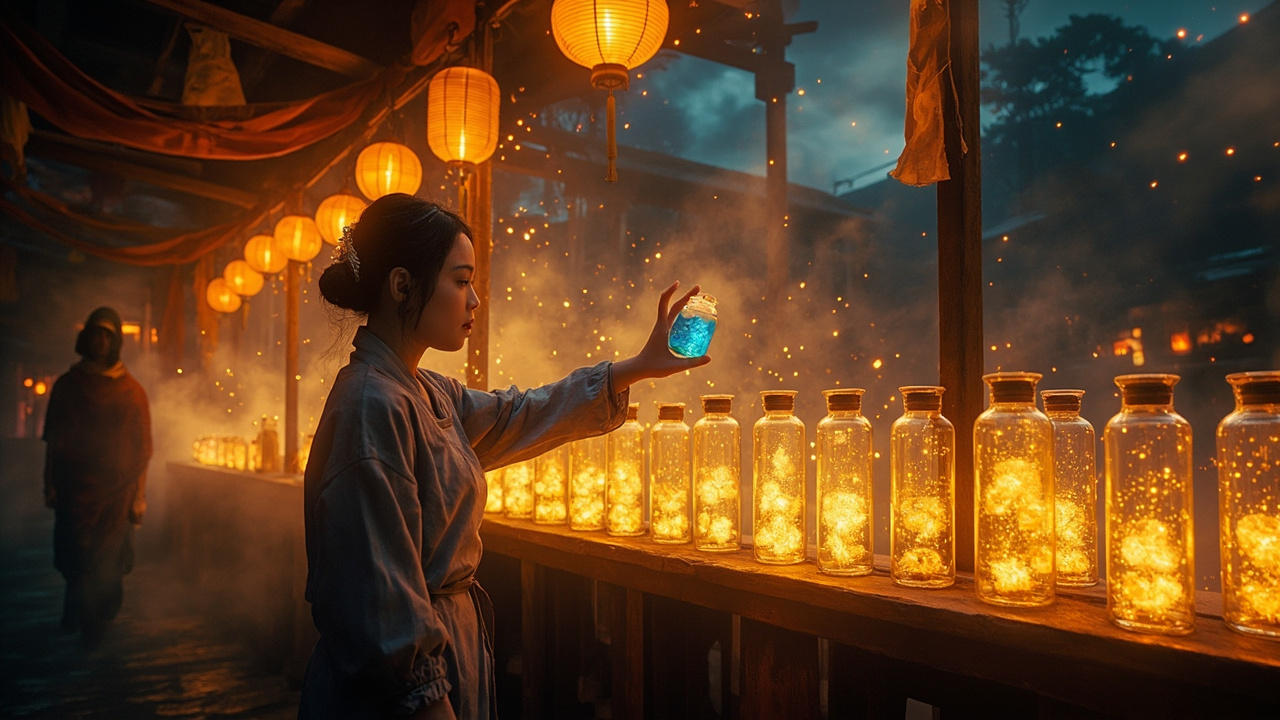
The stalls were draped in fabrics the colour of bruised plums and aged parchment. Paper lanterns cast amber light upon curiosities she could not immediately name. But it was the glass bottles that arrested her completely. They lined the stalls in neat rows, each one catching the lantern light, each one containing something luminous and swirling, like captured fireflies suspended in honey.
"Memories," said a voice beside her. An elderly woman sat cross-legged behind the nearest stall, her face a map of deep wrinkles and knowing eyes. "The bottled memories of those who wish to forget—and the curious who wish to remember what was never theirs."
Eleanor's throat tightened. "How much?" she heard herself ask, though she had not intended to speak at all.
"Memories are not purchased with money here, Miss Chen. They are exchanged. A memory of yours for one of ours."
The use of her surname struck her like a physical blow. She had told no one in Singapore her family name, had buried it alongside her childhood in Kent and the summers that had preceded her mother's disappearance.
The old woman reached beneath her stall and produced a bottle smaller than the rest, its contents a deep sapphire blue. "You are looking for something," she said. "You have been looking for a very long time. This belonged to your grandmother. She sold it here, many years ago, before she forgot why she had come at all."
Eleanor took the bottle with trembling hands. As her fingers closed around the cool glass, images flooded her mind—not her own, but unmistakably familial. A woman standing on a cliff edge in Dover, the wind whipping her dark hair. A letter being torn in two. A child's hand reaching out, grasping nothing but air.
"My mother," Eleanor whispered. "She left us. My grandmother told us she had simply... gone."
"Your grandmother told a story she had come to believe herself," the old woman replied. "But memory, Miss Chen, is a treacherous thing. It softens edges, fills in gaps with what we wish had happened rather than what did. Your mother did not abandon you. She was taken from you—by your grandmother, who could not bear to share her daughter's love with a father she blamed for everything."
The revelation rewrote twenty years of bitter silence, of Christmases spent alone, of a heart that had hardened like concrete around its earliest wound. Eleanor sank to the ground among the bottles, her vision blurring with tears that were equal parts grief and relief.
"Why did my grandmother sell this memory?"
"Because she could not live with the truth, and she could not live with the lie. So she chose the third option: she sold the memory to us, and lived only with the comfortable emptiness we left behind."
Eleanor remained there until dawn crept across the Singapore skyline. She did not buy the memory—she could not bring herself to trade away any piece of herself, even the painful ones. Instead, she sat with the truth, turning it over like a stone worn smooth by the sea.
When she finally returned to her apartment, the alley had vanished as though it had never been. But the bottle in her pocket remained, and with it, the possibility of reaching out to a grandmother she now understood, for the first time, had been as broken as she was.
Some nights, Eleanor still felt the old ache in her chest. But it was different now—not the sharp pain of abandonment, but the tender soreness of a wound finally beginning to heal.