Vocabulaire essentiel
| Mot | العربية | Deutsch | Français | Русский |
|---|---|---|---|---|
| خلنج | Heidekraut | bruyère | вереск | |
| خَثّ | Torf | tourbe | торф | |
| وادٍ ضيّق | Tal | vallée étroite | долина | |
| قشّ | Strohdach | chaume | солома | |
| أُخْدود | Furche | sillon | борозда | |
| أنقاض | Ruine | ruine | руины | |
| قسّ | Pfarrer | ministre | священник | |
| مُنْظَر | Sucher | viseur | видоискатель | |
| مَدْخَنَة | Schornstein | cheminée | труба | |
| صَخْرَة كَبِيرَة | Felsblock | rocher | валун |
L'histoire
The heather was the colour of bruises when Dr Alasdair MacPherson first showed me the Ordnance Survey map. We sat in his cramped study in Dornoch, the peat-wood stove crackling behind us, and he pressed one gnarled finger onto a crease in the paper.
"Allanmuich," he said. "It appears on every map from 1870 to 1892. Parish records mention a crofting community of perhaps forty souls. And then — nothing. No trace. No ruins, no road, no memory. As if the earth simply swallowed it whole."
I was not a believer in mysteries. I made documentaries for the BBC — sober, evidence-driven pieces about overlooked corners of Britain. But the map was genuine, and MacPherson was not given to fancies. He was a retired schoolteacher who had spent forty years mapping every settlement that had ever existed north of Inverness. If he said a village had vanished, then a village had vanished.
I spent three weeks preparing. I filed my route with the mountain rescue team, loaded my equipment onto a Land Rover, and drove north into a landscape so vast and empty that it seemed to exist outside ordinary time. The road dissolved into a track, the track into a footpath, and the footpath into something that barely existed at all.
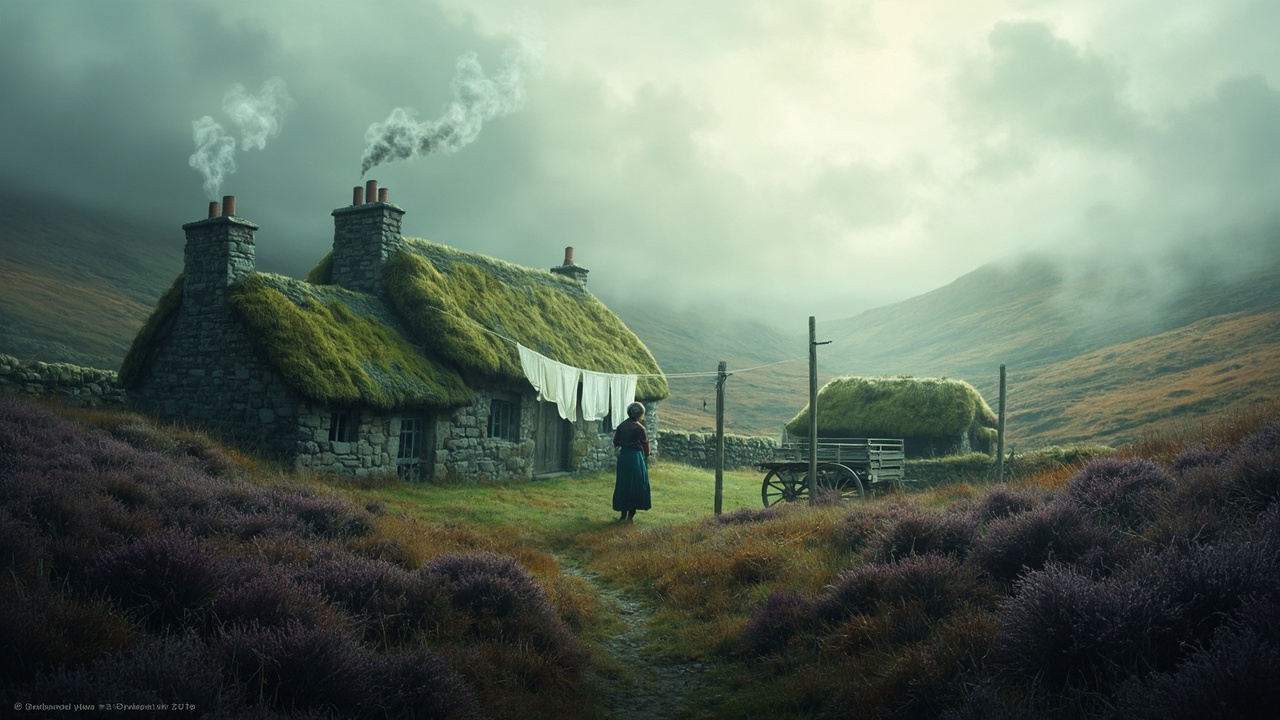
The glen opened without warning. One moment I was navigating a maze of grey boulders; the next, the hills fell away and a small valley lay before me, green and improbably gentle, sheltered from the wind by ridges that curved around it like cupped hands. And there, in the centre of the valley, sat the village.
It was not what I had expected. I had anticipated ruins — tumbled walls, choked doorways, the slow archaeology of abandonment. Instead, the houses stood whole and weathered, their stone walls grey and mossed, their thatched roofs intact. Smoke rose from two of the chimneys. A wooden cart rested beside a low barn. A woman hung washing on a line strung between two posts, the white linen snapping in a breeze I could not feel from where I stood on the ridge.
I descended, my camera already in my hand, and told myself I must have made an error — that this was a working farm, perhaps, or a private retreat. But the Ordnance Survey showed nothing here. No house, no farm, no track. The map was blank where I stood.
The woman by the washing line was perhaps forty, her face lined and brown as old leather. She looked up when I approached and smiled with a warmth that seemed almost excessive, as though she had been expecting me.
"You'll be from the other side of the hill," she said. "Come in, come in. You'll want tea."
The interior of her cottage was dark and fragrant with peat smoke. A man sat by the fire, elderly, his hands folded in his lap. Two children played on the floor with a wooden horse. Everything was ordinary, even comfortable. And yet something was wrong — I could feel it the way one feels a wrong note in a familiar melody.
The calendar on the wall showed September the fourteenth, 1891.
I sat with my tea untouched and watched the villagers through my viewfinder. The precision of it unnerved me. Every gesture was correct — the farmer guiding his horse across the furrows, the children laughing, the minister locking the church door after evening service. But none of it moved forward. I set my camera to record and left it running for an hour. When I played the footage back, I saw that the minister had locked the same door, in the same light, with the same key, seventeen times. The farmer had guided his horse through the same stretch of field, again and again, an infinite loop of ordinary labour.
The woman found me sitting on a stone wall at the edge of the village, the recording device dark in my lap. She sat beside me and for a long while said nothing.
"You've seen it," she said at last. It was not a question.
"The date on your calendar," I said. "It is 1891."
"It has always been the fourteenth of September," she replied. "We were preparing for the harvest festival. The minister was going to read from the book of Ruth. And then — this." She gestured vaguely at the village, the valley, the hills that stood like silent witnesses. "This morning that never ends. But you must not feel sorry for us. We are not suffering. We simply are. And we have been for a very long time."
I thought of the footage on my camera. I thought of the documentary I could make — the kind of programme that would redefine what I had spent my career believing was possible. I looked at the village, at the smoke rising from the chimneys, at the children's faces bright with a joy that had no knowledge of the future.
"I cannot leave this unseen," I said.
The woman turned to me, and for the first time I saw something behind her patience — a weariness as old as the hills, vast and quiet as the sea.
"Others have come," she said. "Not many. A surveyor once, in the early days. He climbed to the ridge, and we watched him go. He never returned. Whatever you choose to do with what you have found here, we ask only one thing: let this be a morning we can keep. Let the minister lock his door, and the children laugh, and the smoke rise from the chimneys, and let none of it be for an audience. We have given enough of ourselves to the world. Let us, at last, simply be left in peace."
I drove back to Dornoch in the dark, the Land Rover's headlights cutting through the Highland mist. The village did not appear in my mirrors. When I looked at the Ordnance Survey map in MacPherson's study, Allanmuich was a blank space, unmarked and empty, exactly as it had been before.
The footage on my camera showed nothing but mist and heather and the long grey spine of a ridge dissolving into cloud. I have it still, stored on a hard drive in my study, unwatched and untouched. I made a different documentary that year — one about coastal erosion, I remember, or perhaps seabirds. Something solid. Something that moved forward in time the way time is supposed to.
Some mornings, though, I take out the hard drive and hold it in my hands. And I think about a village that is still there, still preparing for a festival that will never arrive, still caught in a single amber afternoon when the world briefly opened and let something incomprehensible through. And I wonder if the minister ever does manage to lock his door, or whether that key, like everything else in Allanmuich, is suspended forever in the moment before the lock turns.
I have never gone back to find out.