Vocabulaire essentiel
| Mot | العربية | Deutsch | Français | Русский |
|---|---|---|---|---|
| فداء / تكفير | Sühne | expiation | искупление | |
| رباطة جأش / هدوء | Fassung / Gelassenheit | calme / maîtrise de soi | самообладание | |
| عدم ملاءمة / تنافر | Unangemessenheit | incongruité | неуместность | |
| قائمة / سجل | Katalog / Verzeichnis | catalogue / inventaire | каталог / перечень | |
| مقلق / مزعج | beunruhigend | troublant / dérangeant | тревожный / беспокойный | |
| انتقالي / عابر | Übergangs- | de transition | переходный | |
| متدرب / محاكى | einstudiert | répété / rehearsé | отрепетированный | |
| تضيّق / انكمش | zusammengezogen | contracté / rétréci | сжался / сузился | |
| لم يُلمس / دون مساس | unberührt | intact / intacte | нетронутый | |
| هندسة | Geometrie | géométrie | геометрия |
L'histoire
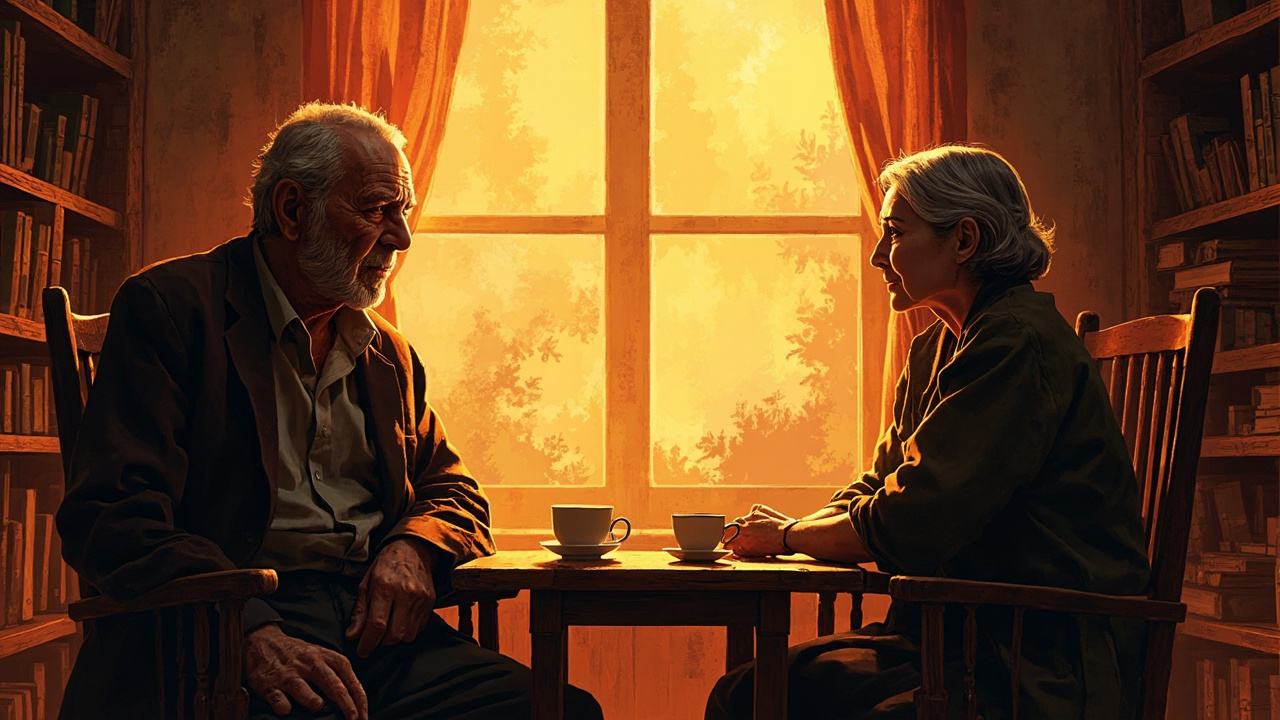
The evening light had turned the colour of old brass when the woman appeared at his door. Martin Ashworth—eighty-three years old, shoulders curved by decades of invisible burdens—recognised something in her face before she spoke. It was the same geometry of loss he had witnessed countless times in the mirror.
"Mr Ashworth," she said. Her voice held no accusation, which somehow made it worse. "My name is Clara Voss. I believe you knew my grandfather."
The name landed like a stone in still water. Martin did not ask her to repeat it. He did not pretend ignorance. He simply stood aside and held the door open wider.
She was perhaps fifty, with grey threading through dark hair and eyes the colour of winter seas. She entered the modest house with the careful composure of someone who had rehearsed this moment a thousand times. Martin offered tea, because he could think of nothing else to offer, and because the ritual of it seemed to acknowledge the obscenity of their circumstances.
Clara sat in the armchair by the window—the one where Martin read letters from people who had found his public speaking both inspiring and profoundly unsettling. She studied him as he moved about the kitchen, and he felt the weight of her catalogue of observations: the photographs on the mantelpiece, the books on peace and reconciliation, the framed photograph of himself shaking hands with a former president at a conference on transitional justice.
"You've done a great deal of work," she said when he returned with the tea. "The memorial stones in the town squares. The lectures at the university."
"I'm not sure that work is the right word for it," Martin replied, settling into the chair opposite her. "It's more like... trying to speak clearly before the tongue goes."
"You were a soldier once."
"I was many things once."
She nodded slowly. "My grandfather was Samuel Voss. He taught mathematics at the village school. He was forty-one years old when—" She paused, and Martin saw her jaw tighten. "You know what happened to him. You were there."
The room seemed to contract around them. Martin looked down at his hands, still bearing the faint scars of a burn he had tried to prevent and failed.
"I was there," he said quietly.
"And you gave the order."
It was not a question. He did not treat it as one.
"Yes."
For a long moment, neither of them spoke. Clara's teacup sat untouched on the small table between them. Outside, a blackbird was singing its evening song, and the incongruity of it—the terrible normalcy of birdsong—made Martin want to weep.
"I've read your memoirs," she said finally. "Your accounts of what happened that night. The village. The... the collection of men in the market square."
"I wrote it because I owed it to them. To your grandfather. To everyone."
"You owed it to them," she repeated, and something shifted in her expression—a minute rearrangement of the features, as if she were testing the weight of a word. "And what did they owe you, Mr Ashworth? When you came to their village with your men and your lists and your orders? What did they owe you?"
Martin closed his eyes. He had asked himself this question every day for fifty years.
"Nothing," he said. "They owed me nothing. That's rather the point, isn't it?"
Clara leaned forward slightly. "I want to understand something. And I want you to tell me the truth, not the version you've told yourself to make your work possible."
"I'll try."
"Do you remember his face? My grandfather's?"
Martin opened his eyes. The memory was as sharp as it had been in 1944: Samuel Voss, tall and lean, with kind eyes that had looked at Martin with something that might have been pity. "He looked at me," Martin said, "as if he understood something I hadn't yet understood myself. He looked at me as if I were already a ghost."
"And what did you feel?"
"Terror," Martin said. "Not of him. Of myself. Of what I was about to do."
"And yet you did it."
"And yet I did it."
Clara sat back in her chair. Her hands were trembling slightly, and she pressed them flat against her thighs as if to still them. "My grandmother survived the fire," she said. "She hid in the root cellar while your men rounded up the men and boys. But she was found later, when the village was being... cleared. She was sent east. She died at a camp the following spring. My mother was three years old. She survived, but she never spoke of any of it. Not once. The silence was its own kind of wound."
Martin felt the tears on his cheeks before he was aware of weeping. "I am so sorry," he said, and the words felt pathetically inadequate, a catalogue of insufficient syllables.
"I didn't come for an apology," Clara said. "I came to see you. To look at the man who destroyed my family. To understand whether there was anything human left in you, or whether you had burned it all away that night."
"And?"
"And I still don't know," she said. "But I think—" She paused, and when she continued, her voice was quieter. "I think my grandmother would have wanted me to see you as you are now. Not the monster in the reports, not the sage on the stage. Just a man who did something unforgivable and has been trying to live with it ever since."
"I don't think I'll ever be finished with it," Martin said. "The trying."
"No," Clara agreed. "I don't suppose you will."
She rose to leave, and Martin walked her to the door. At the threshold, she turned to face him one last time.
"My grandmother used to say that forgiveness isn't about the person who wronged you. It's about whether you're willing to remain trapped by what they did, or whether you choose to walk free." She held his gaze. "I'm not ready to forgive you, Mr Ashworth. I may never be. But I think I can stop carrying the weight of your existence. And that, perhaps, is the closest I will ever come."
She left without waiting for a response. Martin stood in the doorway and watched her walk down the path and disappear into the gathering dusk. The blackbird had fallen silent. The brass light had faded to grey.
He returned to his chair and sat for a long time in the darkness. He did not feel absolved. He had never expected absolution, never wanted it—how could one want forgiveness for the unforgivable? But something had shifted. The ember that had kept him burning all these years had not gone out, but it had changed somehow, become less a fire of self-punishment and more a vigil light, a small and stubborn refusal to let the darkness win entirely.
He thought of Samuel Voss and his kind eyes. He thought of Clara and her grandmother and the child who had grown up in the shadow of a silence she could not break. He thought of all the living things who carried the weight of what he had done, and who would carry it long after he was gone.
The lamp burned on the table beside him. Outside, the stars were emerging, indifferent and eternal. Martin Ashworth sat in his chair and kept his vigil, and for the first time in many years, the night did not seem entirely without hope.