Vocabulaire essentiel
| Mot | العربية | Deutsch | Español | Français | Italiano |
|---|---|---|---|---|---|
| صانع الخرائط | Kartograph | cartógrafo | cartographe | cartografo | |
| رق | Pergament | vitela | parchemin | velluto | |
| بريثوني | Brittonisch | britónico | brittonique | brittonico | |
| معاهدة | Pakt | pacto | pacte | patto | |
| ولاية قضائية | Gerichtsbarkeit | jurisdicción | juridiction | giurisdizione | |
| إقليم | Territorium | territorio | territoire | territorio | |
| علم الآثار | Archäologie | arqueología | archéologie | archeologia | |
| ورقة مطوية | Folio | folio | folio | foglio | |
| تركيب جملة | Syntax | sintaxis | syntaxe | sintassi | |
| ينقش | gravieren | grabar | graver | incidere |
L'histoire
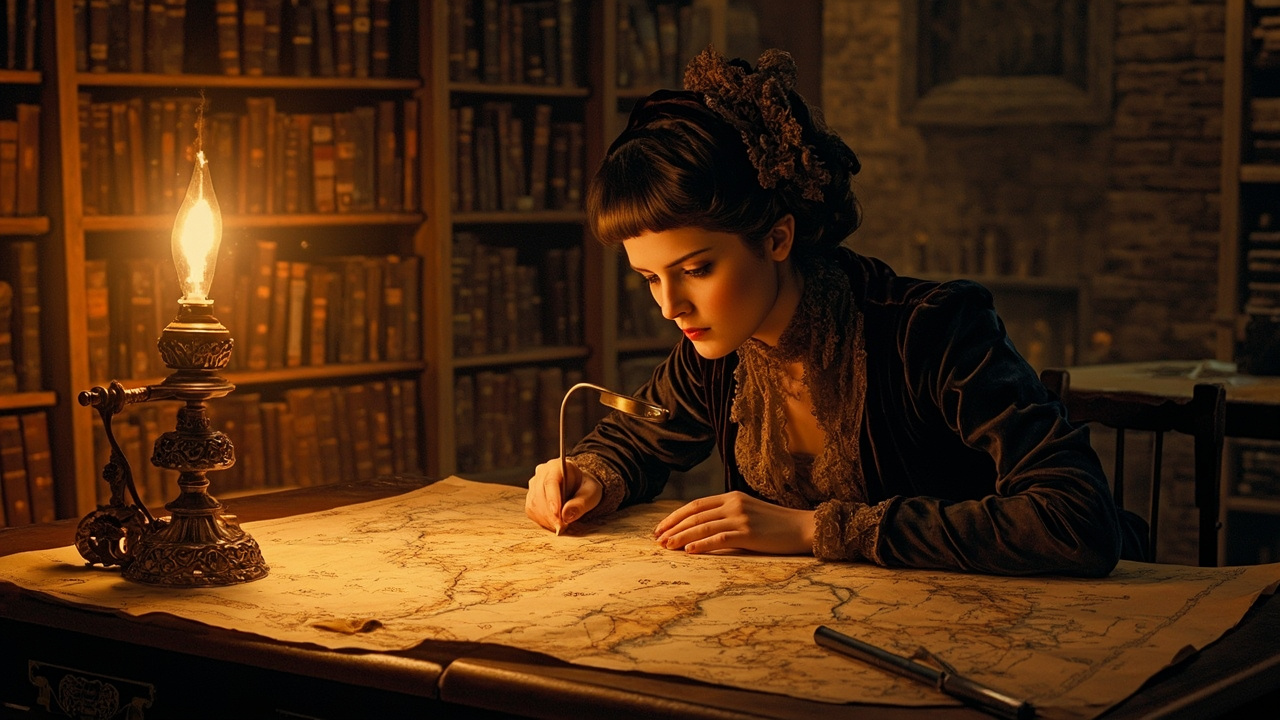
Dr Eleanor Ashworth had spent seventeen years in the service of the Crown's cartographic archives, and in all that time she had never encountered a map that refused to reveal its secrets quietly. The collection housed within the vaulted chambers of the Royal Geographical Institute was vast beyond reckoning—thousands of vellum scrolls, copper-engraved folios, and hand-drawn surveys spanning eight centuries of territorial demarcation. Yet none had ever spoken to her with such insistence as the one she now held beneath the amber glow of her examination lamp.
The document was unremarkable at first glance. A survey of the northern marches, dating from the reign of James VI and I, its coastline rendered in the meticulous style of Dutch cartographers who had dominated the trade during that period. Eleanor had catalogued dozens of such works, their artistry appreciated but their contents largely redundant given the precision of modern Ordnance Survey mapping. It was only when she angled the lamp to inspect a section of the Scottish lowlands that she noticed the anomaly.
The notations were not merely written but etched—carved into the vellum with an instrument so fine that the marks were invisible to the naked eye. To perceive them, one required oblique light and extraordinary patience. Eleanor reached for her jeweller's loupe, the tool she reserved for the most delicate of her examinations, and pressed it to her eye. The world narrowed to a circle of magnification, and within it, a landscape of miniature script unfurled like a hidden garden.
She recognised the script immediately as a form of archaic Brythonic—the linguistic ancestor of Welsh, Cornish, and Breton that had flourished across the island of Britain before the great waves of Germanic migration reshaped its southern shores. Scholars believed it had survived in isolated pockets of Scotland until the twelfth century, after which it vanished entirely from the written record. Yet here it was, encoded within the fibres of a seventeenth-century map, its characters smaller than grains of sand, its message seemingly interminable.
Eleanor set aside her evening's administrative duties and surrendered herself to the work. Hour after hour she bent over the document, transcribing the etched symbols into her notebook, cross-referencing each character against her considerable library of medieval linguistic treatises. The dialect was unlike anything she had encountered: a hybrid tongue, it seemed, blending Brythonic morphology with Gaelic syntax and, most remarkably, with loanwords that appeared to derive from no known language family whatsoever.
By midnight, the first passage yielded its meaning. It was a dedication, written in the third person, addressed to an assembly whose name Eleanor could not immediately translate. "Let it be known to those who gather beneath the mountain's shadow," the text read, "that the borders drawn by mortal hands are not fixed, nor shall they endure beyond the reckoning of the original compact." Eleanor's pen hovered above the page. The language was legalistic, deliberate, and its implications were extraordinary.
Over the following weeks, Eleanor excavated the map's secrets with the methodical devotion of an archaeologist unearthing a lost city. The dedication was merely the prologue. What followed was nothing less than a complete treaty—a compact between seven ancient lineages, predating even the concept of unified kingdoms, establishing boundaries that bore no relation whatsoever to the political geography of modern Britain. The treaty described territories that encompassed vast swaths of contemporary England, Scotland, and Wales within a single jurisdiction, while carving independent zones from regions now considered integral to the Crown. The River Severn, in this forgotten charter, marked not a boundary between England and Wales but the eastern frontier of a realm Eleanor's translation tentatively rendered as "the Land of the First Waters."
The document's final clause was the most striking. It declared that the compact remained in force until such time as "the last voice that remembers the old tongue falls silent, and the maps of strangers supersede the maps of memory." Eleanor sat back in her chair, her mind reeling. The dialect in which the treaty was written had been considered extinct for nearly nine hundred years. By every conventional measure, the compact's condition had been fulfilled. And yet here it was, preserved in micro-etched script, waiting in plain sight for a reader patient enough to uncover it.
She understood, with the sudden clarity that sometimes accompanies genuine discovery, why the map had remained undisturbed for so long. No archivist in living memory had examined it under oblique light. No scholar had thought to search for Brythonic notation within a document ostensibly composed in the conventions of Dutch cartography. The map itself had been the lock, and its makers had trusted—correctly, as it turned out—that the key would never be found.
But Eleanor had found it, and with the finding came an impossible burden of choice. The treaty, if authenticated and presented to the appropriate authorities, would constitute a legal challenge to the constitutional boundaries of the United Kingdom of dimensions that dwarfed any political controversy in modern history. She imagined the headlines, the parliamentary debates, the international complications. She imagined the factional interests that would rush to claim or suppress such a document. She imagined, too, the seven lineages the treaty described—could any of their descendants, scattered across centuries of intermixing and migration, be identified? And if so, what claims might they advanced?
Eleanor removed her loupe and set it beside the map. The amber lamp cast long shadows across her workbench, and beyond the arched windows of the archive, London carried on in its oblivious millions, its legal and constitutional foundations suddenly revealed as contingent rather than immutable.
She reached a decision. She would make the document known—but not to the world, not yet. First she would inform the Keeper of the Archives, a woman of unimpeachable discretion and legal expertise, and together they would determine how best to navigate the extraordinary situation the map had presented. There would be no hasty announcements, no sensational revelations. The silent cartographer who had etched these words into anonymity had earned at least that much respect.
As Eleanor secured the map within its archival housing, she permitted herself a rare moment of wonder. In seventeen years of meticulous service, she had never imagined that the past could speak so directly to the present, that forgotten words could reshape the very ground upon which nations stood. She switched off her lamp and left the chamber, leaving the document in its darkness, patient and potent as it had been for three hundred years. The treaty would wait a little longer. But it would, at last, be heard.