Vocabulaire essentiel
| Mot | العربية | Deutsch | Español | Français | Italiano |
|---|---|---|---|---|---|
| أمين الأرشيف | Archivar | archivista | archiviste | archivista | |
| فهرس | Katalog | catálogo | catalogue | catalogo | |
| دقيق جدا | sorgfältig | meticuloso | méticuleux | meticoloso | |
| تحدى | trotzen | desafiar | défier | sfidare | |
| تراكم | angesammelt | acumulado | accumulé | accumulato | |
| مجزأ | fragmentarisch | fragmentario | fragmentaire | frammentario | |
| واجهة | Fassade | fachada | façade | facciata | |
| سبق في التاريخ | vorher existieren | predatar | prédater | predatare | |
| كشف | Offenbarung | revelación | révélation | rivelazione | |
| تمييز | erkennen | discernir | discerner | discernere |
L'histoire
The letter arrived on a Tuesday, written in ink the colour of old pewter on paper that smelled faintly of cedar and regret. Eleanor Ashworth read it twice, then a third time, as though repetition might alter its impossible contents. She was to report to the Unanswered Library on Ashmore Lane, where she would assume the position of Senior Archivist, a role that had remained vacant for seventeen years.
She had known the library existed, of course. Everyone in the city possessed some fragmentary awareness of it—a rumour overheard, a reference in a footnote, a grandmother who spoke of it only in whispers. But knowledge and experience are different countries, and Eleanor had never crossed the border between them until the morning she stood before its unremarkable door, wondering why her heart beat with such peculiar anticipation.
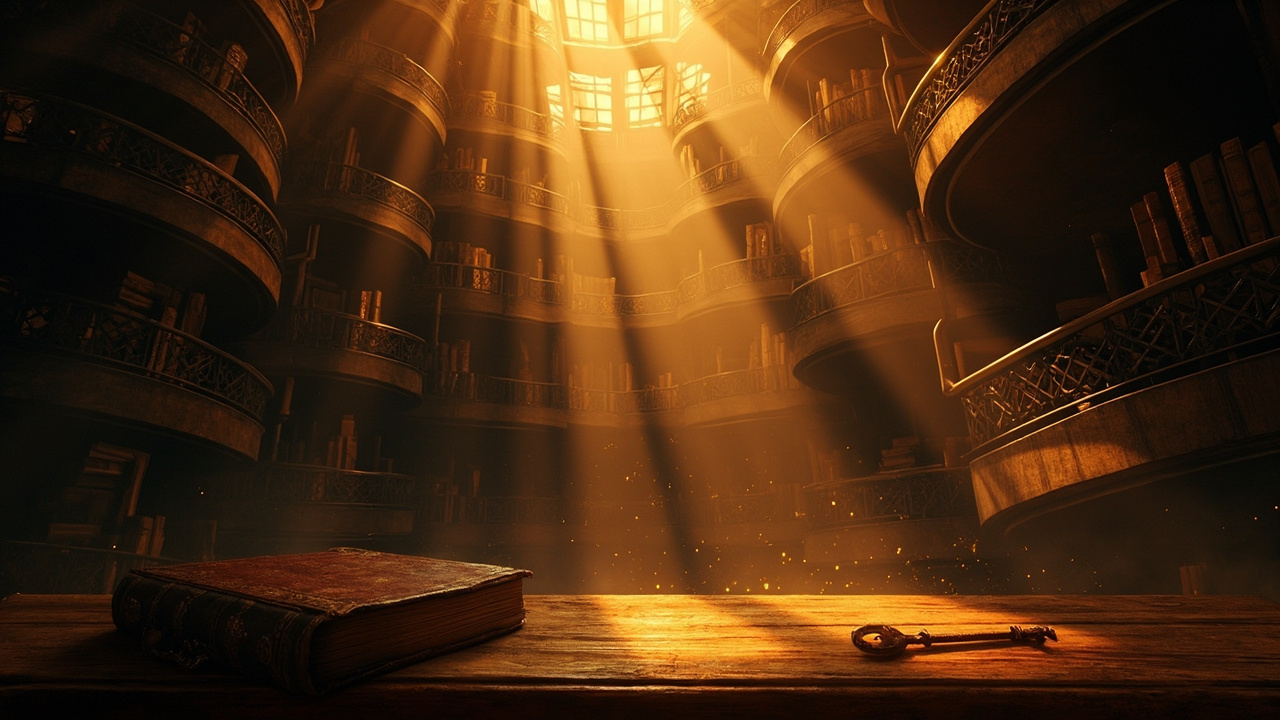
The interior defied the modest facade. Shelves ascended in spirals that seemed to follow their own geometry, their dark wood worn smooth by centuries of hands. The air hung thick with the particular silence of accumulated thought, a silence that pressed against her ears like water against a swimmer's skull. At the central desk sat an elderly man whose name, she would later learn, had been forgotten even by himself. He handed her a brass key and a leather-bound catalogue, then departed without farewell, his footsteps fading into a silence more complete than any she had previously encountered.
The catalogue was unlike any she had studied during her years at the university. Its pages contained no call numbers, no shelf locations, no administrative notation. Instead, each entry was a question, transcribed in careful handwriting that varied wildly in style and age. What became of the drowned city? Why do we dream of places we have never visited? Who first looked upon the sea and understood it was lonely? Thousands upon thousands of questions, organised by no system Eleanor could discern, yet arranged with an internal logic that eluded her.
"The answers are not here," the departing archivist had said, or perhaps Eleanor had only imagined him saying it. "The answers are never here. That is not our purpose."
For her first weeks, she believed him. She learned the library's rhythms, the way morning light fell through windows that seemed to exist in different hours than the world beyond, the method by which new questions were received—always by post, always unsigned, always written in ink the colour of old pewter. She catalogued them with meticulous care, assigning each a place in the endless spiral, marvelling at humanity's accumulated uncertainties. And she did not seek the answers, because the answers were not here. That was not the purpose.
The discovery came by accident, as such revelations often do. She was restoring a damaged shelf in the eastern wing, where the questions grew oldest and most obscure, when she noticed one entry that seemed different from the others. The ink was wrong—not pewter-grey but deep indigo, and the handwriting bore no resemblance to the careful script of the catalogue. The question read: What lies beyond the last horizon?
Below it, in the same strange hand, was an answer.
Eleanor stared at the page for a long moment, then turned to the adjacent entry. Where do forgotten names go when they leave us? Again, an answer: They gather in the spaces between stars, waiting for someone to speak them aloud. She moved to another, and another, and found the same impossible phenomenon repeated throughout the ancient section of the catalogue. Questions that had waited centuries to be asked—questions that predated the library itself—had begun, in the absence of their answers, to provide their own.
"They grow tired," said a voice behind her.
Eleanor turned to find a woman she did not recognise, though something in her face suggested familiarity, as though they had met in a dream and forgotten the meeting. The woman was old in the way that ancient things are old—not frail, but accumulated, bearing the weight of time the way the library bore it.
"The questions," the woman continued, moving along the shelf with proprietary ease. "They wait so long for answers that they begin to construct them themselves. A question unanswered becomes a question transformed. It learns patience. Then longing. Then, eventually, a terrible determination." She traced one of the indigo answers with a finger. "They answer themselves because they cannot bear to remain unanswerable. It is their choice. Their curse. Their gift."
"But if they answer themselves," Eleanor said slowly, "then surely the library serves no purpose. The questions are no longer unanswered."
The woman smiled, and in her smile Eleanor glimpsed all the questions she had ever asked and all those she had been afraid to ask. "The purpose was never to find answers, child. It was to hold the questions safe. To give them a home while they waited. The self-answering ones are not failures of the system—they are its evolution. They are proof that questions, given enough time and enough care, can become something more than questions."
"And what becomes of them then?" Eleanor asked. "The answered questions—where do they go?"
"They become new questions," the woman said. "And new questions breed new uncertainties. The cycle continues, as all cycles do." She gestured toward the spiral shelves, their height now seeming infinite, their depths containing multitudes Eleanor could not fathom. "You are not here to find answers. You are here to keep the questions company. To ensure none of them feels forgotten. To bear witness as they grow, and transform, and perhaps even transcend."
Eleanor considered this. She thought of all the questions she had carried through her life—the ones she had asked aloud, and those she had whispered only to herself in the dark. She understood, then, that the Unanswered Library was not a place of absence but of presence. It held not failure but faith—the faith that every question deserved a home, and every waiting deserved an end, even if that end was of its own making.
She took her place at the central desk, the brass key warm in her hand, and opened the catalogue to the next unanswered question. And in the silence of the spiralling shelves, she began her work—not of answering, but of keeping. Of holding space for the questions that had waited so long, and those that would wait still, and those that had finally, at last, begun to answer themselves.