Vocabulaire essentiel
| Mot | العربية | Deutsch | Español | Français | Italiano |
|---|---|---|---|---|---|
| شفافية | Durchsichtigkeit | translucidez | translucidité | translucenza | |
| تسمية علمية | Nomenklatur | nomenclatura | nomenclature | nomenclatura | |
| جثة | Leiche | cadáver | cadavre | cadavere | |
| رئوي | pulmonal | pulmonar | pulmonaire | polmonare | |
| تركيب نحوي | Syntax | sintaxis | syntaxe | sintassi | |
| تصوير داغيروتيبي | Daguerreotypie | daguerrotipo | daguerréotype | dagherrotipo | |
| دقيق جداً | sorgfältig | meticuloso | méticuleux | meticoloso | |
| إحداثيات | Koordinaten | coordenadas | coordonnées | coordinate |
L'histoire
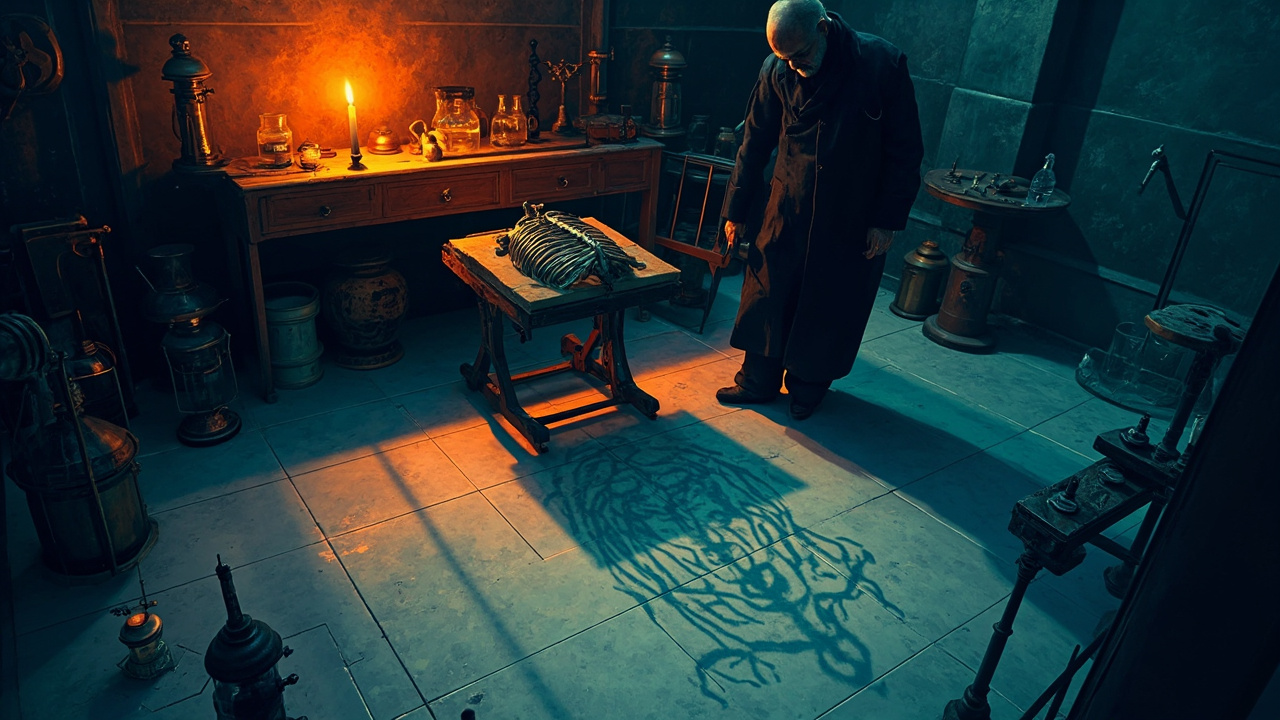
The gas lamps of Whitechapel had not yet been lit when Dr Edmund Hale arrived at the dissecting rooms beneath St Bartholomew's, and this was precisely as he preferred it. In the hour before twilight surrendered entirely to the arc-lamps, the shadows possessed a quality he had never encountered in any anatomical text—a translucence, a hesitancy, as though the darkness itself was still deciding what shape to assume.
Edmund was not, by training or inclination, a man given to flights of fancy. He had spent eleven years mapping the interior of the human body with scalpel and probe, reducing the miracle of flesh to nomenclature and diagram. His colleagues regarded him as meticulous to the point of coldness, a man who perceived the operating theatre not as a site of drama but as a workspace of considerable organisation. Yet it was this very precision, this ruthless attention to form and measurement, that had led him, inevitably, to the shadows.
It had begun three winters prior, during an evening dissection. The cadaver before him was that of a dockworker, his chest opened in the regulation Y-incision, and Edmund had been examining the lungs when his candle guttered. In that momentary darkness, the shadows of the ribcage fell across the white tiles of the floor—and there, in that accidental geometry, he saw something that arrested his breath entirely. The pattern was not random. The interlocking bones had cast a shadow that resembled, unmistakably, a letter. Not any alphabet Edmund recognised, but a letter nonetheless, deliberate and composed.
He had spent the remainder of that night photographing the phenomenon from every angle, measuring the proportions, recording the precise hour and the position of the gas jets in the ceiling. The following week, he returned with a paraffin lamp arranged to cast the same illumination. The shadow recurred, identical. He began to understand that he had stumbled upon a language that required no speaker, no written text, no living memory to preserve it. The darkness was not an absence. It was a medium.
Within a year, Edmund had abandoned his research into pulmonary tissue and devoted himself entirely to what he termed "sciography"—the study of shadow vocabulary. He constructed an apparatus of his own design: a rotating platform upon which he placed objects of varying materials, lit by a single adjustable source at measured distances. He filled cabinet after cabinet with glass plates recording the shadows cast at every hour of the day, every season of the year. He began to perceive repetitions, families of forms, what he came to think of as grammatical structures.
"You are losing yourself in nonsense," his former mentor, Professor Aldous, had warned him during a visit to Edmund's cramped rooms in Gower Street. The walls were covered with his shadow charts, thousands of them, each annotated with coordinates and timestamps. "There is no language in darkness. There is only the absence of light obstructing other light. This is not science, Edmund. This is fever."
But Edmund had seen too much to retreat. He had documented shadows that recurred across decades—in the archives of the Royal Institution, he found daguerreotypes of shadow patterns cast by the very same window frames at the winter solstice of 1847 and 1873, identical to the patterns he observed in 1903. The darkness was consistent. It remembered. And if it remembered, then it communicated, and if it communicated, then there existed a syntax to be learned, a grammar to be mastered.
The breakthrough came on the twenty-third of December, 1904, at precisely 3:47 in the afternoon. Edmund had positioned himself in the courtyard behind his lodgings, armed with his plate camera and a collection of bones arranged according to his latest hypothesis. The winter sun was low, its light raking and golden, and the shadows it cast were stretched and thin. He had arranged the femurs and tibias of three separate skeletons in a formation he had deduced from eighteen months of pattern analysis, and when the light struck at the appointed angle, the shadows merged into a shape that was not a letter but a word.
He stood motionless for nearly a minute, his breath suspended, as the meaning of the word resolved itself within him. He could not have explained it to another living soul—the word was not in any language he knew, and yet it carried a clarity that transcended lexicography. It was a warning. It was a lament. It was the darkness speaking directly to the architecture of his mind, and for the first time in his adult life, Edmund Hale understood something that could not be measured, could not be weighed, could not be preserved in spirits or dissected under glass.
In the weeks that followed, the vocabulary expanded. Each shadow cast at the precise moment revealed another word, and the words assembled themselves into a text of startling complexity. The darkness spoke of endurance, of patience, of the long silence between stars. It spoke of those things that persist when all light has been extinguished, of the shapes that remain even when there is nothing left to cast them. Edmund transcribed furiously, his notation system growing to accommodate symbols that had no counterpart in any human alphabet.
He told no one. What would he have said? That he had learned to read the language of oblivion itself? That the shadows had handed him a text older than human speech, a scripture written in the absence of everything?
By March, he had completed the translation—or rather, he had been completed by it. He understood now that the shadows were not merely shapes but testimonies, that every object in the world cast a shadow that was simultaneously a word and a memory, and that the darkness was not void but vessel, filled with the accumulated utterances of all that had ever been illuminated and then left behind.
He burned his notes on the equinox. There seemed no purpose in preserving what could not be shared, what existed beyond the reach of argument or verification. He returned to his dissecting work with steady hands and a composure that his colleagues found reassuring, a man restored to his former equilibrium, his brief madness presumably expiated.
Only Edmund knew the truth. The vocabulary remained. He read it every evening now, in the fading light, as the shadows stretched and merged and spoke their quiet, infinite sentences into the gathering dark. He had learned the language of what remained when everything else had gone. And in that language, at last, he had found something he had not known he was searching for: a way of understanding darkness that was not the fear of it, but its opposite. A way of being held by the night rather than threatened.
The shadows continued their patient testimony. And Edmund Hale, anatomist, listened.