L'histoire
Eleanor Ashworth had devoted three decades to the study of grey, and in that time she had acquired the patience of stone. She could spend an entire week examining a single square centimetre of monochromatic surface, tracing the ghost of a brushstroke through layers of lead white and vine black, cataloguing the precise ratios of pigment to medium that Renaissance masters had employed to achieve their breathtakingly subtle gradations. It was solitary work, meticulous and often dismissed by her colleagues as the scholarly equivalent of watching paint dry. Yet Eleanor harboured no resentment toward those who pursued the glamour of attribution disputes or the drama of newly discovered titans. She understood, as perhaps few others did, that the truth of an artwork frequently resided not in its bold declarations but in its most quiet silences.
The invitation from the Galleria dell'Accademia came in late November, when the light in Eleanor's Cambridge study had turned the colour of weak tea and her third cup of coffee sat forgotten beside a stack of conservation reports. A small panel painting, recently uncovered during renovations to a private chapel in Umbria, had yielded preliminary X-ray analyses that confounded every expectation. The work was attributed to the circle of Piero della Francesca—a reasonable enough attribution given its origins—but the preliminary findings suggested something unprecedented lay beneath its weathered surface. The museum's director, a woman named Francesca Moretti who had studied alongside Eleanor two decades prior, wanted a specialist's eye before proceeding further. Would Eleanor, she wrote, consider travelling to Florence to examine the painting in person?
She arrived at the conservation laboratory on a Tuesday morning, her small suitcase still bearing the labels of airports she could not consciously remember traversing. Francesca greeted her with the particular warmth of academic friendship—genuine, but shadowed by an urgency that belied the pleasantries. The painting, Francesca explained as they walked, had been declared a lost work by an unknown follower of Piero, a predella panel depicting aLamentation scene in the characteristic grey-brown palette that many Renaissance workshops had employed for works destined for private devotion. Standard attribution. Standard provenance. Standard obscurity. And then, three weeks prior, a routine conservation cleaning had revealed something extraordinary beneath the grisaille surface, and nothing about the painting had been standard since.
Eleanor asked to see it immediately.
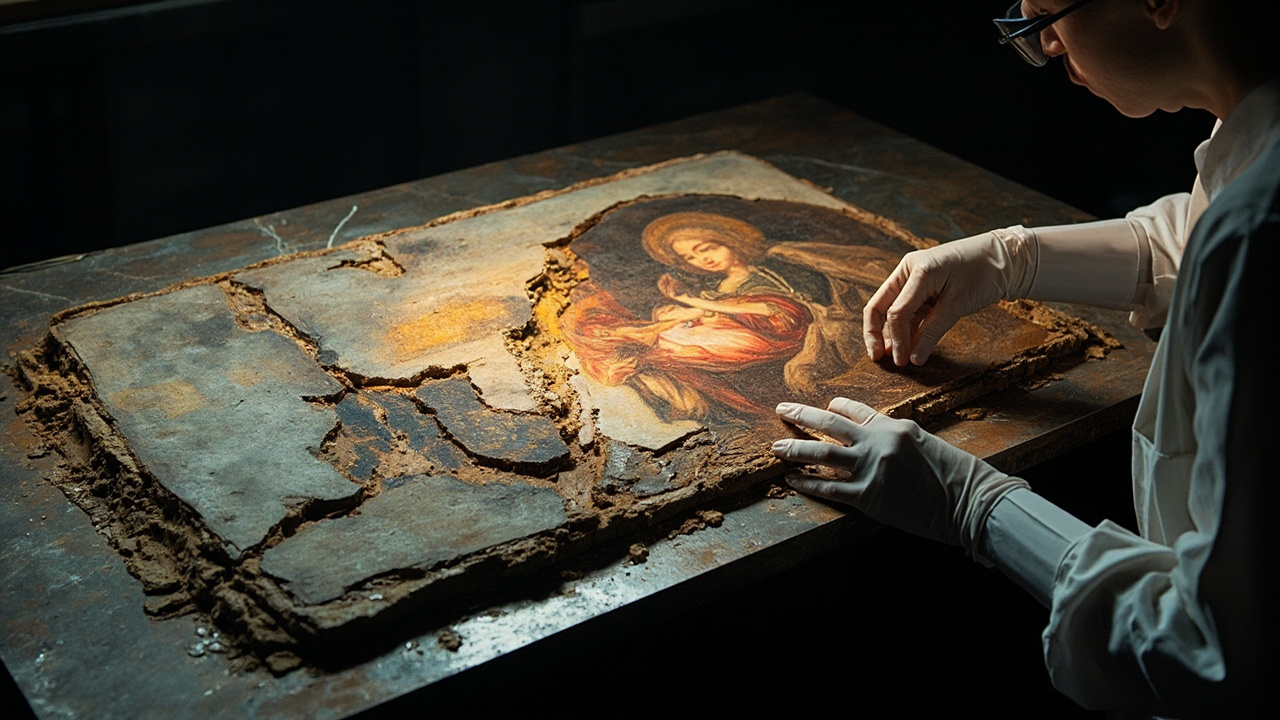
The panel lay on a conservation table under the sterile glow of fibre-optic lamps, perhaps forty centimetres by thirty, its surface bearing the gentle undulations of age. She could see at once the areas that had been partially cleaned—a patchwork of muted browns and ochres breaking through the grey like dawn through fog, their presence both unmistakable and somehow impossible. She adjusted her spectacles and leant closer, aware of Francesca watching her, aware too that the next few minutes would determine not merely her professional opinion but her understanding of what the Renaissance had been, and was, and might yet become.
The hidden pigments told their story in a language Eleanor had spent her career learning to read. Where the surface showed the expected iron oxide earths and lead white, the layers beneath blazed with ultramarine—the genuine article, ground from lapis lazuli and worth, in the fifteenth century, its weight in gold. There was vermilion, vivid as arterial blood. There was malachite green, rendered in an oil medium so refined that it retained a luminosity that four hundred years had failed to diminish. And beneath these, barely visible to the naked eye but unmistakable to her trained perception, lay traces of organic reds derived from cochineal and brazilwood, pigments that had only recently arrived in Italy from the distant trading routes of the east. Every colour the Renaissance was supposed to have lacked, the Renaissance had possessed. It had simply chosen, in this instance, to conceal them entirely.
Eleanor straightened slowly, her mind racing through implications that multiplied faster than she could catalogue them. The conventional narrative held that monochrome painting in the fifteenth century was largely a matter of necessity—expensive pigments being reserved for major commissions while smaller devotional works made do with humble earth tones. Here was evidence of a deliberate aesthetic philosophy that had been hidden, not imposed; of technical mastery employed in the service of invisibility. The artist had possessed the means for colour and had consciously, meticulously, chosen grey. Why?
Francesca produced the X-ray fluorescence scans, the infrared reflectography, the cross-section analyses that confirmed what Eleanor's eyes had deduced. Together, they spread the technical documentation across a neighbouring table, and Eleanor began the slow work of synthesis that she knew would occupy her for months if not years. But one detail caught her attention early, a pattern in the layering that she recognised from other works she had studied in isolation, never suspecting their connection to a larger secret. This was not a singular aberration. This was a tradition—a parallel practice, running beneath the official history of Renaissance art like an underground river.
Over the following days, Eleanor worked with a focus that bordered on obsession, methodically documenting every revelation the painting offered. She corresponded with colleagues in Amsterdam, in New York, in Kyoto, sharing her preliminary findings under embargo while requesting access to works they had studied without ever noticing what lay beneath their surfaces. The responses came slowly, then all at once. A predella panel attributed to Fra Angelico, held in a museum whose name she had revered since childhood, showed the same hidden signatures. A small diptych in a German private collection. A triptych in a Spanish cathedral that had survived centuries of war and neglect precisely because no one thought it worth stealing. The evidence accumulated like snow, each flake insignificant, the mass of it transformative.
She returned to Cambridge in the depth of winter, carrying with her a conviction that felt less like academic certainty than like revelation. The monochrome surface, she understood now, had been a deliberate veiling—not a limitation but a choice, perhaps spiritual in its implications, perhaps practical, perhaps both. The masters who had painted in grey had not beencolour; they had beencolour and had chosen grey, for reasons that their contemporaries would have understood as intimately as we have forgotten. The question was no longer whether they had possessed the pigments. The question was what they had known that we had lost.
In the spring, Eleanor published her findings in a paper that she had titled, after considerable deliberation, "The Invisible Spectrum." It caused the expected furore—exhibitions hastily reorganised, attributions questioned, careers built on decades of confident scholarship suddenly looking precarious. She weathered the criticism with the patience she had cultivated over thirty years of loving grey, understanding that the discomfort her work caused was itself a form of testimony. The Renaissance had been richer and stranger than anyone had dared imagine, and the grey paintings that had been dismissed as the humble productions of impoverished workshops were in fact the secret masterworks of artists who had chosen, with extraordinary technical virtuosity, to hide their light beneath a surface of shadow.
On the last afternoon before her paper went to press, Eleanor stood in the conservation laboratory in Florence, looking one final time at the Umbrian panel. Francesca had left her alone, understanding without being told that she needed this private moment. Eleanor considered the grey surface, its modest ochres and browns, its careful brushwork that had deceived generations of experts. She thought of all the paintings she had loved, all the grey surfaces she had studied, all the secrets they might still contain. The world believed it knew what colour the Renaissance had been. Eleanor knew better. The Renaissance had been every colour imaginable, and then it had chosen to become grey, and in becoming grey it had created something more mysterious and more lasting than colour itself.