Vocabulaire essentiel
| Mot | العربية | Deutsch | Français | Русский |
|---|---|---|---|---|
| نعي | Todesanzeige | nécrologie | некролог | |
| تكليف | Auftrag | commande | заказ | |
| أرشيف | Archiv | archives | архив | |
| طبيب شرعي | Leichenbeschauer | coroner | судмедэксперт | |
| دفتر حسابات | Hauptbuch | grand livre | гроссбух | |
| إعادة بناء | Rekonstruktion | reconstruction | реконструкция | |
| غير محدد الهوية | nicht identifiziert | non identifié | неопознанный | |
| بعث | Auferstehung | résurrection | воскрешение | |
| مشرحة | Leichenhalle | morgue | морг | |
| متوفى | verstorben | décédé | покойный |
L'histoire
Margaret had been commissioned by the British Archive to write the obituaries three months ago. The commission had seemed straightforward enough: compose brief biographical sketches for the unidentified dead. Men and women whose bodies had been found in London over the past century, their names lost to time, their families never traced. The Archive had been clearing its vaults of cold cases, attempting to give dignity to the anonymous through narrative. Margaret, a freelance writer with a talent for historical reconstruction, had seemed the ideal candidate.
She worked at a small desk in the corner of the British Library reading room, surrounded by coroners' reports and police ledgers, hospital admission forms and old newspaper clippings. The fragments were maddening. A woman found in Hyde Park in 1952, wearing a green coat with brass buttons. A man discovered beneath Waterloo Bridge in 1968, carrying a book of Yeats poetry. Each file contained a physical description, the circumstances of discovery, and nothing else. No names. No families. No stories.
The Archive had given her strict instructions: reconstruct, imagine, invent if necessary. The obituaries were not meant to be factual but functional—they were to serve as placeholder biographies, small monuments to lives that had vanished without record. She was to invent plausible names, occupations, family circumstances. She was to make them human by giving them the texture of ordinary life.
Margaret approached the task with the careful imagination of a novelist. She spent hours with each file, letting the details suggest their own narratives. The woman with the green coat became Ellen Marsh, a schoolteacher from Croydon who had taken her own life rather than face a cancer diagnosis. The man with the Yeats became Thomas Whitmore, a war veteran who had walked into the Thames. Each obituary was a small act of resurrection, a fiction that gave the appearance of truth.
She walked to the library each morning through King's Cross, past the station with its iron and glass, its crowds of commuters flowing like blood through the city's veins. She had grown accustomed to the homeless figures stationed along the approaches—the man with the cardboard sign near the entrance, the woman with the shopping trolley, the younger ones huddled in doorways. She gave them the nod that most Londoners give: acknowledgment without engagement, the small currency of eye contact that costs nothing and promises less.
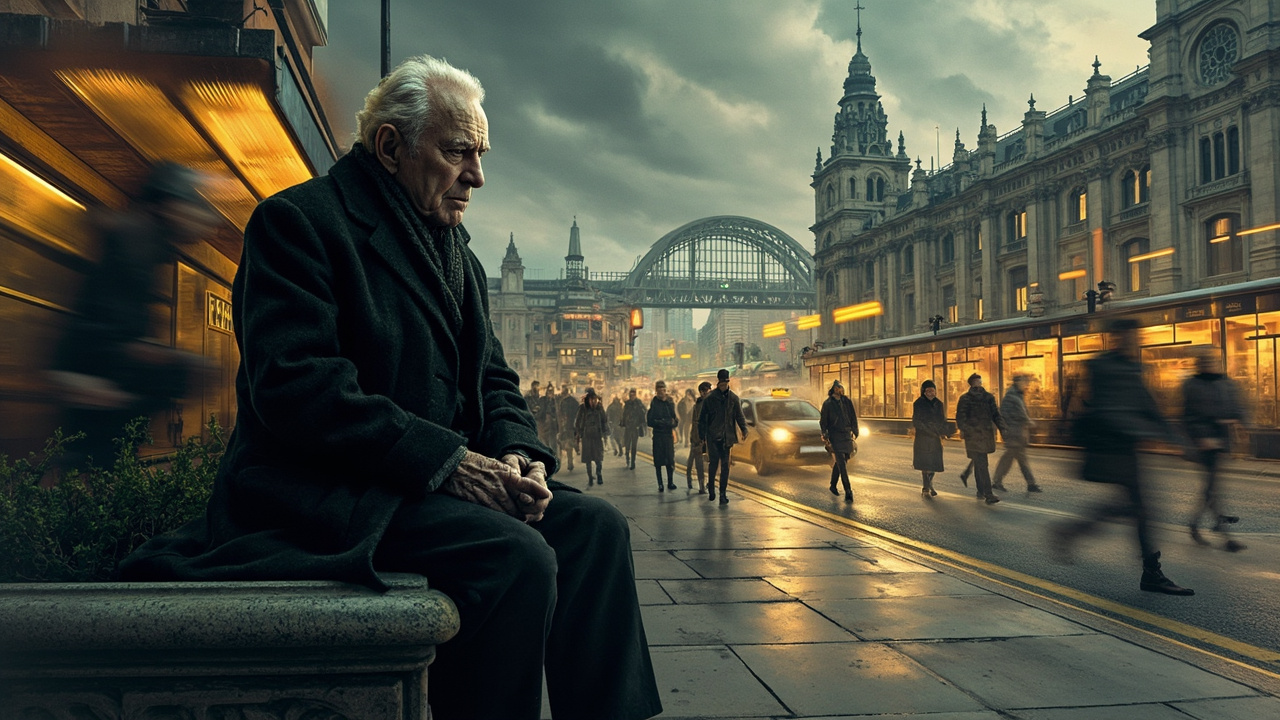
It was one of these figures, the older man who sat near the taxi rank, who caught her attention. He was perhaps seventy, with white hair and a weathered face, and he sat with a certain dignity that set him apart from the others. He never begged. He never called out. He simply sat, his dark coat buttoned to the throat, his eyes following the crowds with an expression that might have been sorrow or might have been simply the blankness of someone who had long since stopped expecting anything from the world.
Margaret noticed him because he reminded her, somehow, of the men in her files. The unnamed. The unremembered.
The file arrived on a Tuesday in November. Subject 147-C: an unidentified male discovered at King's Cross Station, November 1973. The body had been found on Platform 8, unconscious, and the man had died in hospital two days later without regaining consciousness. No identification. No missing persons reports that matched. The file contained a photograph taken at the mortuary: a young man, perhaps thirty, with dark hair and a thin face, wearing a hospital gown. He looked peaceful, as the dead often do in photographs. He looked like someone who had simply fallen asleep.
Margaret read the physical description: approximately five feet nine inches, dark hair going grey at the temples, a scar on the left forearm. The personal effects listed a coat—a dark wool coat with brass buttons. A coat with brass buttons.
Margaret stared at the photograph for a long moment.
She went to King's Cross the next morning. He was there. He was always there. The brass buttons on his coat caught the grey morning light.
She approached him slowly, heart pounding, and sat on the cold pavement beside him. He looked at her with the wariness of someone accustomed to disappointment.
"I'm sorry to disturb you," she said. "May I ask your name?"
He studied her for a moment, perhaps assessing whether she was a journalist, a researcher, a madwoman. "Why?" he asked. "You going to put it in the paper? Write my story?"
"Actually," Margaret said, "I'm a writer. I work with the British Archive. I'm trying to find out about someone—a man who was found dead here in 1973. No name. No family. I thought perhaps..." She stopped, suddenly uncertain. "I thought perhaps you might remember something. Or perhaps..."
She pulled out the file, opened it to the photograph. The man's eyes widened. She watched his face as he looked at the image of himself, forty years younger, dead on a mortuary table. She watched him see his own death.
The silence stretched between them. A train thundered past on its way to Edinburgh or Inverness. The commuters flowed around them, indifferent, their lives moving forward into futures while two strangers sat on cold pavement and contemplated the terrible weight of the past.
"That was me," he said finally. "Or it was, once."
Margaret didn't know what to say. She had spent months inventing lives for the dead, and here was one of her subjects, alive, sitting beside her.
"How?" she asked. "How are you here?"
He laughed, a short, bitter sound. "I woke up. Three days after they brought me in, I woke up. Nobody knew who I was. I'd been beaten—didn't remember that—but I recovered. They discharged me. I was nobody. I had no family, no address, no documentation. I fell through the cracks." He paused. "I've been falling ever since."
"But you must have had a life before," Margaret said. "A name. A history."
He shook his head slowly. "It was all mixed up. I knew things—I knew how to read, how to write, how to do sums. But my name, my family, where I'd lived—gone. Like it had been erased. The doctors said it was the head injury. Retrograde amnesia, they called it. I couldn't remember backwards, only forwards. And there was no backwards to go back to."
Margaret thought of the obituary she had already drafted, the false life she had constructed. Thomas Whitmore, the war veteran. It was a good story, a coherent story. It bore no resemblance to the man sitting beside her.
"I need to tell you something," she said. "I've already written your obituary. I didn't know you were alive. I didn't know you were sitting here every morning. I'm sorry."
He nodded slowly. "What did you say? About me?"
Margaret hesitated. "I said you were a war veteran. That you were probably unhappy. That you walked into the river because you had nowhere else to go."
He was quiet for a long time. Then he said, "That sounds about right, actually. It sounds about right."
They sat together as the morning light strengthened, as the commuters rushed past, as the city churned on around them. Margaret thought about the power of stories, how they could bring the dead back to life, how they could give dignity to the nameless. She thought about how she had invented a man out of fragments and brass buttons, a man who had never existed, while the real man sat beside her, alive, invisible, unnamed.
"Can I write another one?" she asked. "A real one? Your story, as you remember it?"
He looked at her, and something shifted in his face—not hope, exactly, but perhaps its distant cousin. "Why? Who's going to read it? Who's going to care?"
"I will," Margaret said. "I'll care. I'll make sure it's preserved somewhere. You'll be remembered, even if—" She stopped herself. Even if you disappear. Even if you die. Even if the city swallows you up and spits out another set of bones for the Archive to file away.
He was silent for a long moment. Then he said, "I don't remember much. Just fragments. I had a wife, once. I worked for a company that made engines. I liked to read poetry." He paused. "I had a book of Yeats in my pocket when they found me. I remember that. I remember holding onto it."
Margaret felt tears prick her eyes. The Yeats. She had kept the Yeats in her fictionalised version, had made it the central image of Thomas Whitmore's sad end. But this man had actually held the book, had actually read the verses, had actually been someone who loved poetry before he became no one.
"Please," she said. "Let me try. Let me at least try to get it right."
He looked at her for a long moment. Then, slowly, he nodded.
She interviewed him over the following weeks. He sat in the same spot every morning, and she came to him with her notebook, her questions, her growing sense of obligation. She learned what she could: his name was Albert, though he wasn't certain; he had been born in Manchester in 1942; he had married a woman named June who had left him in 1970; he had worked for a company that made diesel engines until he was made redundant; he had wandered to London because he had nowhere else to go; he had been beaten by men he didn't know on a November night in 1973; he had woken up in a hospital bed with no memory of how he had arrived there.
The story was fragmentary, full of gaps and uncertainties. It was nothing like the neat narratives Margaret usually constructed. It was messy and sad and full of loose ends, the way real life always is.
But it was his.
She wrote the obituary in December. She titled it "Albert (c. 1942–1973; survived)", and she filled it with everything he had told her, and everything she had inferred, and everything she still didn't know. She wrote about his childhood in Manchester, his marriage to June, his years of work, his displacement, his death, his inexplicable survival. She wrote about the book of Yeats that he had carried in his pocket, though she didn't know if it was true or something he had reconstructed later, a story to fill the void. She wrote about the brass buttons on his father's coat, how he had worn it so long it had become his own.
When she showed it to him, he read it in silence. She watched his face as he took in the words, the careful construction of a life he barely remembered living. She watched him see himself reflected back, transformed into something that could be preserved, archived, remembered.
"Is it true?" he asked when he finished.
"I don't know," Margaret said. "It's as true as I could make it. It's as true as anyone can make a life, in the end."
He nodded slowly. He folded the pages carefully and put them inside his coat, next to his heart.
"Thank you," he said.
Margaret went back to the British Library. She filed the obituary with the Archive, along with an addendum explaining that the subject had been located, that he was alive, that the file was now incomplete. She wasn't sure what would happen to it. She wasn't sure anything would happen to it. The machine of bureaucracy ground on, indifferent to the small miracle of a man surviving his own death.
But she knew that somewhere, in a folder marked 147-C, there was a record of Albert's life. Not the life she had invented, but the life he had told her, fragmentary and uncertain and real.
She passed him every morning on her way to the library. She stopped to say hello. Sometimes she sat with him for a few minutes, if she had time, if the weather wasn't too cold. She learned more fragments: his favourite poem was "The Lake Isle of Innisfree"; he had once wanted to be a teacher; he still remembered the smell of the sea from a holiday he had taken as a child.
She never asked him if he was happy. The question seemed obscene, given everything. But she thought, sometimes, that he looked less lost than he had before. Less invisible.
"You see me now," he said one morning. "You actually see me."
Margaret nodded. "I see you," she said. "I'll always see you."
It was the best obituary she could write. It wasn't for the dead. It was for the living, for the ones who sat on cold pavements and waited for someone to notice them. It was a promise that their lives mattered, even if no one remembered them, even if their stories were lost, even if they were just names in files, just fragments of memory, just brass buttons on an old coat.
She kept writing obituaries for the unnamed dead. She kept inventing lives for people who had never existed. But now, when she walked through King's Cross, she saw the faces of the living too. She saw the ones who had fallen through the cracks, who had been erased, who were waiting to be remembered.
And sometimes, if she had time, if the weather wasn't too cold, she sat down beside them and asked their names.