Vocabulaire essentiel
| Mot | العربية | Deutsch | Français | Русский |
|---|---|---|---|---|
| عتبة الباب | Schwelle | seuil | порог | |
| آلية | Mechanismus | mécanisme | механизм | |
| دوار | Schwindel | vertige | головокружение | |
| دولاب القفل | Schlossfalle | barillet | сувальда | |
| ممر | Durchgang | passage | проход | |
| النفاذية | Durchlässigkeit | perméabilité | проницаемость | |
| خرافة | Aberglaube | superstition | суеверие | |
| أصل | Herkunft | provenance | происхождение |
L'histoire
Dr. Eleanor Blackwood had spent two decades cataloguing the overlooked mechanics of entry and exit — hinges, latches, tumblers, and the peculiar human compulsion to mark thresholds with ritual and superstition. Her monograph on Scottish baronial door hardware had earned her a modest reputation and a perpetually damp office at the University of Edinburgh. So when a property developer clearing a Leith warehouse telephoned to say he'd found a lock unlike anything in her books, she drove there on a November afternoon with the particular thrill of the specialist who has stopped expecting surprises.
The warehouse had been a chandler's, according to the land records — old enough to predate the Napoleonic wars, old enough to have accumulated the kind of layered neglect that transforms practical spaces into atmospheric ones. She pushed through a door that groaned like a living thing and found herself in a long, low room where dust hung motionless in the grey light falling through cracked skylights. The developer, a brisk man named MacPherson who clearly resented the interruption, led her to the far corner where a door of unexpected solidity stood set into the original stonework.
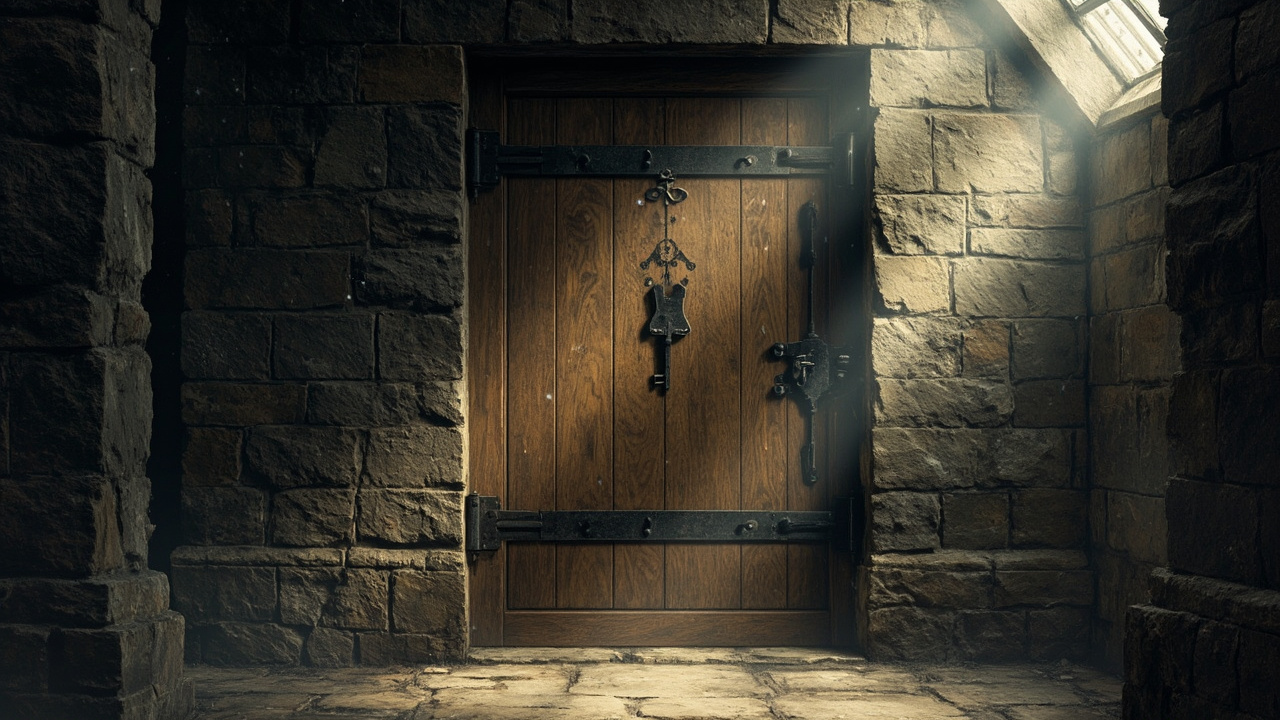
It was the lock that arrested her. She saw it immediately and felt the peculiar vertigo of encountering something she could not place. It was not the Victorian brass cylinder she might have expected, nor the medieval ironwork of the city's older closes. The mechanism was cast in a dark metal she could not identify — not bronze, not steel, not any alloy she recognised — and its surface bore no manufacturer's mark, no maker's stamp, no decorative motif whatsoever. It was simply a lock: functional, severe, and profoundly strange in its anonymity.
"Never seen anything like it," MacPherson said, unnecessarily.
Eleanor crouched beside the door and examined the lock with the focused attention she normally reserved for the Yale patents of 1784 or the magnificent ironwork of Stirling Castle. The keyhole was conventional enough — a standard lever-lock configuration, designed for a flat-bit key of moderate complexity. She reached for her notebook, then stopped. On the doorframe, almost invisible against the weathered wood, someone had scratched a small symbol: a key within a key, the smaller one turned at right angles to the larger.
She photographed it. She measured it. She noted the door's dimensions and the provenance of the building and the developer-photographed lock. And then, because she was a thorough woman and because something in the lock's simplicity appealed to her professional instincts, she produced a small brass key from her pocket — a dummy key she carried for demonstrations, the kind used in museum reconstructions — and slid it into the keyhole.
It turned. The mechanism engaged with a sound like a held breath released. The door swung inward without resistance, revealing a small interior room that smelled of tallow and old paper and something else — something that struck her as being not a smell at all but a quality of the air itself, a density, as though the room had been sealed for a very long time against the ordinary permeability of the world.
She stepped inside. The room was empty except for a wooden table against the far wall. On the table lay a single key, dark metal matching the lock, and beside it a folded piece of paper. She unfolded it. The handwriting was her own.
The message was brief. You will find this letter on your return. The lock opens only for those who have already opened it. Do not attempt to understand this. Simply note that you will return, and that on your return, you will not remember writing this. — E.B.
Eleanor read the words twice, then three times, and felt the cold sensation in her chest that she understood, in her more rational moments, to be fear. She put the key in her pocket. She pocketed the letter. She walked back through the door, which closed behind her with a finality that felt deliberate, and she locked it — the mechanism turning easily, as though welcoming her grip — and she left the warehouse, drove back to the university, and sat in her office until the streetlights came on, turning the letter over in her hands.
She did not go back the next day. Nor the day after. She told herself it was because she was busy, because the monograph was overdue, because the letter was clearly some kind of hoax or delusion — planted, perhaps, by a colleague who had read her earlier work on anomalous architectural features and decided to amuse himself at her expense. She almost believed this. But she kept the key on her desk, and every morning when she arrived, she found herself studying it as though the dark metal might offer some explanation that her own handwriting had withheld.
On the fifth day, she went back.
MacPherson had finished his work. The warehouse was sealed, the windows boarded. Eleanor let herself through a side entrance she had noted on her first visit and navigated the dim interior by torchlight until she stood once more before the door. The lock gleamed faintly, as though recently oiled. She took the key from her pocket, fitted it to the keyhole, and turned it. The mechanism engaged. The door opened.
The room was empty. No table. No letter. No key on a wooden surface. The room was bare, unremarkable, and entirely ordinary — and yet standing in it, Eleanor felt the specific quality of absence that belongs to a place from which something has been recently removed. She crossed to the far wall and pressed her palm flat against the stone. It was warm.
She stood there for a long time, her hand against the stone, and understood, in the way that one understands a theorem whose proof one cannot quite reconstruct, that the letter had not been a hoax. That the lock was not a curiosity. That the door did not merely open a room but opened, in some sense she could not yet articulate, a condition — a loop, a fold in the sequence of cause and effect in which entry and return were not sequential but simultaneous. She had opened the door because she would open the door. The key in her pocket was the key that would be left on the table by the woman who had already found it. She was standing in a room that existed because she had already left it.
She locked the door from the inside, carefully, and turned the key in its hole, and walked back through the warehouse and out into the Edinburgh evening, where the rain was falling with the particular horizontal persistence that makes the city feel, even to its natives, like a place that has sealed itself off from the world by design. She kept the key. She published nothing. But sometimes, late in the evening, when the rain ran down the windows of her office and the old buildings of the university settled in their stone beds with the sounds of long-held breath, she would open her desk drawer and look at the dark metal key and think about doors that open only for those who have already opened them — and she would wonder whether every door, in the end, is that door. Whether every threshold we cross has already been crossed. Whether the hand that reaches for a latch is always, already, the hand that set it down.