Vocabulaire essentiel
| Mot | العربية | Deutsch | Français | Русский |
|---|---|---|---|---|
| تراث | Erbe | patrimoine | наследие | |
| صانع سقوف القصب | Dachdecker | couvreur en chaume | мастер по камышовым крышам | |
| صانع ساعات | Uhrmacher | horloger | часовщик | |
| صانع براميل | Böttcher | tonnelier | бондарь | |
| شذوذ | Anomalie | anomalie | аномалия | |
| منظار الكاميرا | Sucher | viseur | видоискатель | |
| تكليف | Auftrag | commande | заказ | |
| منعزل | einsam | solitaire | уединённый | |
| منهجية | Methodik | méthodologie | методология | |
| إرث | Vererbung | héritage | наследование |
L'histoire
Elena Marsh had built her reputation on an unflinching eye for what was disappearing. The last coal miner in Yorkshire, the last hand-drawn sign painter in Cornwall, the last woman who could recall the precise methodology of bell-founding in Loughborough—these were her subjects, and her photographs had been exhibited in galleries from Edinburgh to Bristol.
When the National Heritage Trust commissioned her to document a series of vanishing trades across Britain, she welcomed the project as an extension of her life's work. She would travel from the Scottish Borders to the tip of Cornwall, from the Welsh valleys to the East Anglian fenlands, capturing what remained of skills that had once defined communities and were now reduced to solitary practitioners, their knowledge destined to perish with them.
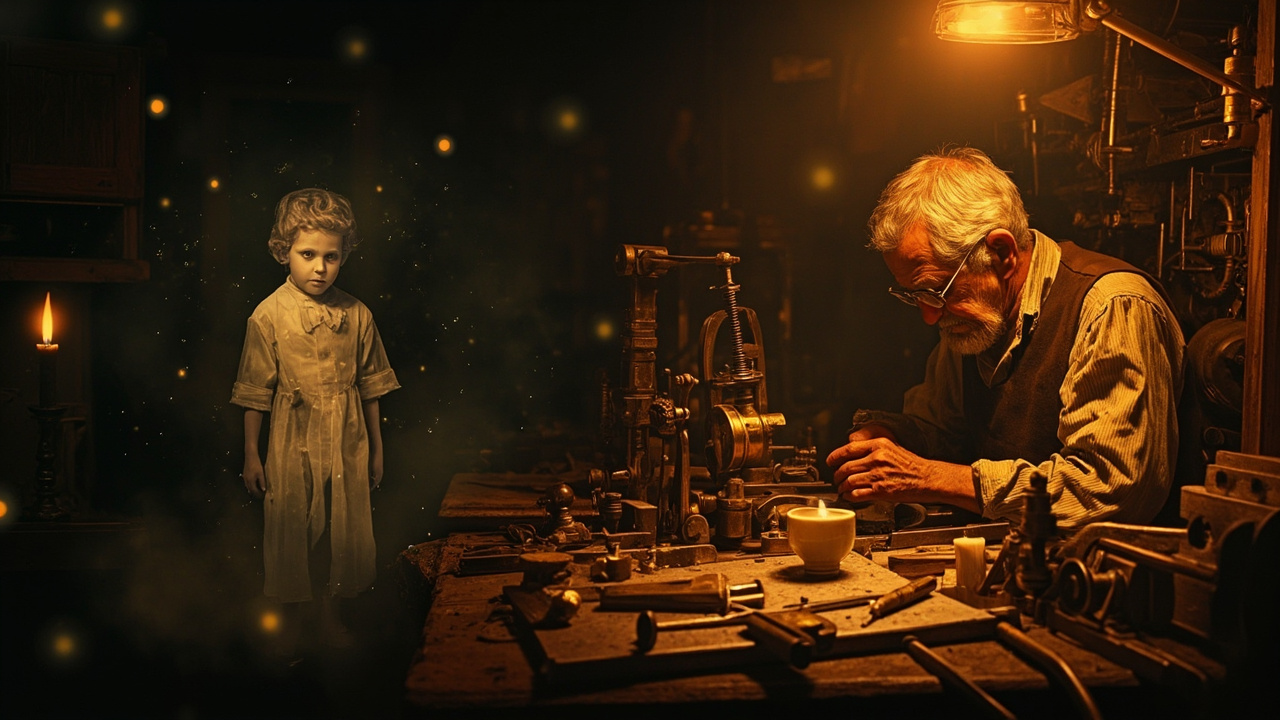
The first anomaly occurred during her third assignment: a portrait of the last remaining clockmaker in Stratford-upon-Avon, a man named Arthur Pembury whose hands still possessed the steadiness of youth despite his seventy-two years. Elena had set up her large-format camera in his cramped workshop, positioning Pembury before a workbench strewn with gears and springs, when she noticed something odd through the viewfinder. In the corner of the room, barely visible in the dim light, stood a figure she had not previously observed—a young boy in Victorian dress, perhaps twelve years of age, watching the clockmaker work with an expression of profound concentration.
She photographed anyway. The shutter clicked, the exposure recorded. When she later developed the plate, the boy was there, sharper than the surrounding clutter, rendered with a clarity that seemed almost deliberate. Yet when she showed the image to Pembury, he could offer no explanation. He had been alone in the workshop, he insisted. Had been alone for forty years, ever since his wife passed.
Elena dismissed it as some fault in the lens, a trick of light and chemistry. She continued with the commission.
The following week, she photographed a thatcher on the Isle of Wight, a man named Declan O'Brien who worked exclusively with water reed and long straw, employing techniques unchanged since the medieval period. Through her viewfinder, she saw only O'Brien and his materials, the golden heap of reeds stacked against a grey sky. But when the plate developed, there was a second figure beside him—a woman, this time, considerably older, wearing a straw hat and carrying the same implements O'Brien used, her face weathered into a map of wrinkles and her posture bearing the unmistakable weight of advanced age.
O'Brien studied the photograph with genuine bewilderment. He had not seen anyone when Elena arrived, he said. No one had been to the site that morning. The path had been undisturbed. Elena felt a cold sensation in her stomach, though she said nothing, and they finished the session in a气氛 of increasing unease.
She did not photograph for three days afterwards. She sat in her accommodation, developing fluid cooling beside her, unwilling to confront what the images might reveal. But the commission demanded completion, and she had never failed to deliver a contracted assignment.
She photographed a rope-maker in Whitby, a hand-press printer in Bath, a cooper in Chester. In each image, there appeared a figure she had not seen through the viewfinder: an older man beside the rope-maker, a woman in Victorian dress beside the printer, a bent and weathered craftsman beside the cooper. Always older, always dressed in period clothing, always observing the contemporary practitioner with what Elena could only describe as a quality of inheritance.
It was the printer who first offered a clue. His name was Geoffrey Shaw, and he had operated the last letterpress in Bath until his retirement the previous year. When Elena showed him her photograph, Shaw studied it for a long moment, his brow furrowed, before asking if she would like to see something.
He led her to a back room where glass-fronted cabinets displayed antique printing equipment alongside historical photographs of the shop through different eras. Shaw retrieved a sepia portrait from a drawer—ostensibly the same elderly man who appeared in Elena's photograph, though the image was faded and worn, its corners softened by decades of handling.
"Thomas Whitmore," Shaw said, reading from the pencil inscription on the mount. "Worked this press from 1847 until his death in 1923. Apprenticed here at fourteen. Never married. Lived above the shop his entire adult life."
Elena examined the portrait. The resemblance to her ghostly figure was unmistakable.
"The previous owner told me once," Shaw continued, "that old Whitmore never truly left. Said he felt him in the presses, guiding the type into place. Nonsense, obviously. But your photograph..." He trailed off, unable to complete the sentence.
That night, Elena could not sleep. She lay in the darkness, turning over the evidence in her mind: the consistent appearance of figures she had not seen, their period clothing, their advanced ages, their intimate connection to whatever trade she was documenting. She began to research each subject, tracing the biographies of their predecessors, the craftspeople who had practiced these trades before the current generation. In every case, she found names, dates, histories—lives that had been lived in these very spaces, hands that had performed these same movements, knowledge passed from master to apprentice across centuries.
The answer, when it came to her, was simple and terrible: she was photographing the dead. Her camera, for reasons she could not explain, was capturing not merely the present but also its echoes, the residue of all who had practiced these trades in these places. The trades themselves were vanishing, and perhaps something else was vanishing too—the accumulated presence of those who had kept them alive.
She completed the commission. Her final subject was a glass-blower in Stourbridge, the last practitioner of a technique he called 'full cameo' that required seventeen separate stages of acid-etching and wheel-engraving. When she developed this plate, she saw not one ghost but three: three generations of glass-blowers, each watching the next, the knowledge flowing from one pair of hands to another across what must have been two hundred years.
Elena exhibited the complete series under the title "What Remains." The critics were uniformly enthusiastic, praising the psychological depth of the portraits, the subtle sense of lineage and inheritance. Only Elena knew that she had photographed something the critics could not see, something that defied rational explanation: the persistence of craft, the way knowledge reverberates through time, the dead watching the living practice what they once knew.
She never discovered why her camera alone captured these figures, or what mechanism allowed the dead to appear alongside the living. But she understood, finally, what the commission had asked her to document. It was not merely trades that were vanishing. It was witnessing itself—the chain of attention that connected each generation to the next, the way we learn by watching others who learned by watching others still. The trades would end, yes. But in the moment of their ending, something else endured: the gaze of all who had come before, still fixed upon the work, still remembering.
She continued her work after that, photographing vanishing trades wherever they remained to be found. And sometimes, reviewing her images, she noticed that a new figure had appeared in the background—a figure she had not seen during the session, dressed in contemporary clothing, her own face slightly aged, watching with an expression she gradually came to recognise as recognition. The dead, she realised, were waiting. And she would join them in time, standing in rooms she would never enter, watching and remembering what she had been privileged to witness.
Until then, she photographed. It was all she could do. And perhaps, in the end, it was enough.