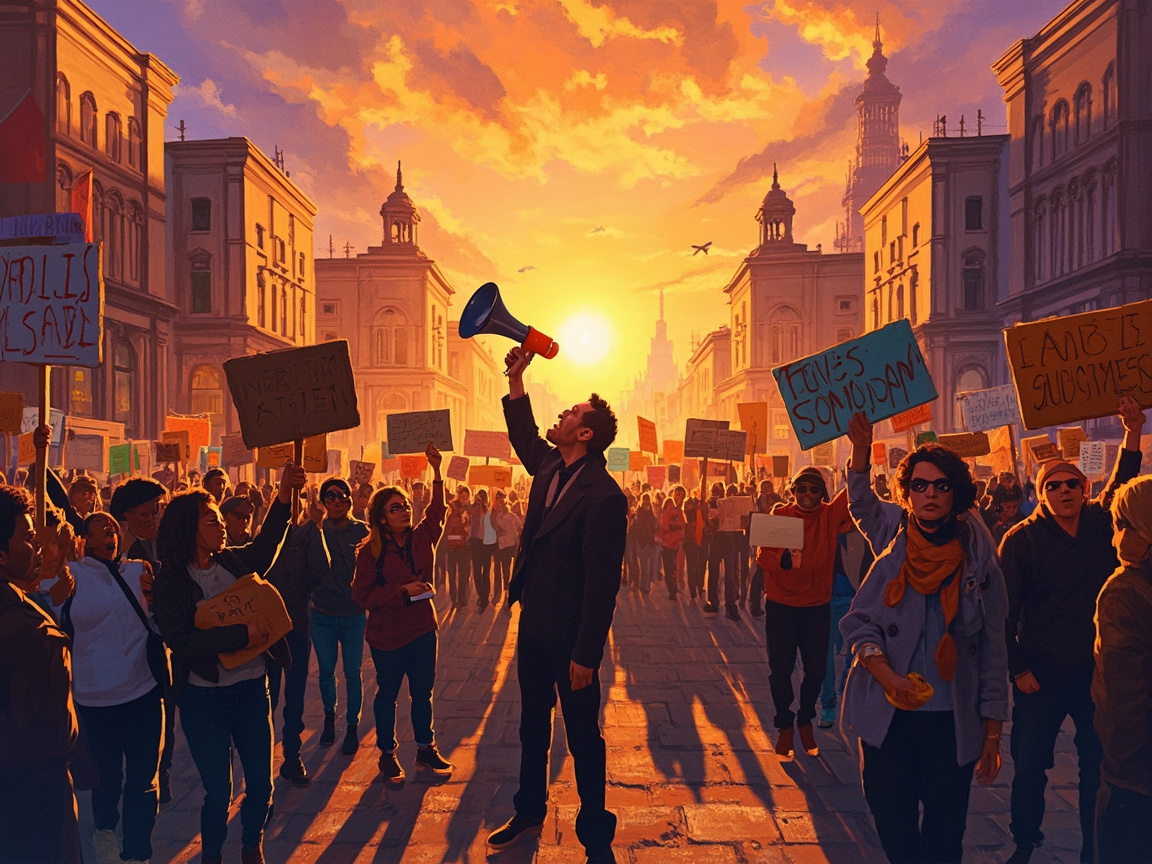
The Rhetoric of Protest
From chants and slogans to manifestos and polemics — the persuasive language of social movements.
From Whispers to Roars: The Power of the Slogan
A well-crafted slogan can condense an entire political philosophy into five or six words, giving a movement an instantly recognisable identity. Before a crowd ever takes shape, organisers prepare a short, melodic chant that the loudest voices can teach to others in minutes. A more ambitious document, the manifesto, lays out principles, grievances and demands in formal prose, often drafted by a handful of thinkers in rented rooms. Whether shouted in the street or printed on a banner, the words function as a clarion call, cutting through the noise of daily life. Their real power lies in repetition: a phrase that begins as one speaker's argument becomes, by the end of the march, a collective rallying cry.
Call to Arms: Martial Metaphors in Civic Life
Protest vocabulary leans heavily on the language of conflict, even when the cause itself is peaceful. A leaflet inviting supporters to a march often reads like a call to arms, urging readers to abandon their armchairs and take to the streets. Hand-painted placards become the visual artillery of a demonstration, each cardboard phrase aimed squarely at public opinion. Organisers hand a megaphone to whoever can project furthest, treating the throat like a weapon. The military register is not accidental: it suggests urgency, solidarity and the seriousness of the cause, framing civic engagement as a campaign that can be won or lost.

Voices in the Square: Vocabulary of Public Dissent
A successful movement is almost always a grassroots one, meaning it draws its energy and its leaders from ordinary people rather than from party headquarters. The streets fill with activists who, only months earlier, had no political profile at all, alongside seasoned dissidents whose long-standing opposition lends the gathering credibility. When thousands converge in a single public space, the event is no longer an isolated complaint but a demonstration — visible, televised, and impossible for authorities to ignore. Participants rarely say simply that they "support" a cause; they say it stands for something larger, a vocabulary that signals moral commitment rather than casual preference.
Persuasion and Polemic: The Rhetoric of the Cause
Behind every chant lies a careful exercise in rhetoric, the art of moving an audience through choice of words, rhythm and argument. Critics, however, may dismiss that same language as a polemic — a one-sided attack designed to inflame rather than to persuade. Movement leaders tend to insist they are simply speaking to the zeitgeist, the spirit of the moment, and articulating what people already feel but cannot yet name. They arrive at meetings with a written platform, a list of demands that translates moral urgency into concrete policy. The tension between polemic and platform, between anger and proposal, is what separates a transient outburst from a movement that endures.
Quiz
-
1According to the article, what is the main function of a slogan?
The article states that a slogan 'can condense an entire political philosophy into five or six words.'
-
2Which area of life does the article say protest vocabulary borrows from most heavily?
Section 2 explains that protest language 'leans heavily on the language of conflict.'
-
3When the article calls a movement "grassroots", what does it imply?
The article defines grassroots as drawing 'its energy and its leaders from ordinary people rather than from party headquarters.'
-
4According to the final paragraph, what separates a transient outburst from a movement that endures?
The final sentence says 'The tension between polemic and platform, between anger and proposal, is what separates a transient outburst from a movement that endures.'
-
5How does the article define the term "zeitgeist"?
The article describes zeitgeist as 'the spirit of the moment' — the defining mood of a period.