Must Know Vocabulary
| Word | العربية | Deutsch | Español | Français | Italiano |
|---|---|---|---|---|---|
| مؤامرة | Verschwörung | conspiración | complot | cospirazione | |
| حياكة | Stricken | tejer | tricot | lavoro a maglia | |
| غرزة | Masche | punto | maille | punto | |
| مقاومة | Widerstand | resistencia | résistance | resistenza | |
| شفرة | Code | código | code | codice | |
| قوات | Truppe | tropa | troupe | truppa | |
| طرد | Paket | paquete | colis | pacco | |
| يضلل | irreführen | engañar | induire en erreur | fuorviare | |
| متعمد | absichtlich | deliberado | délibéré | deliberato | |
| يواجه | konfrontieren | confrontar | affronter | affrontare |
The Story
The Knitting Circle
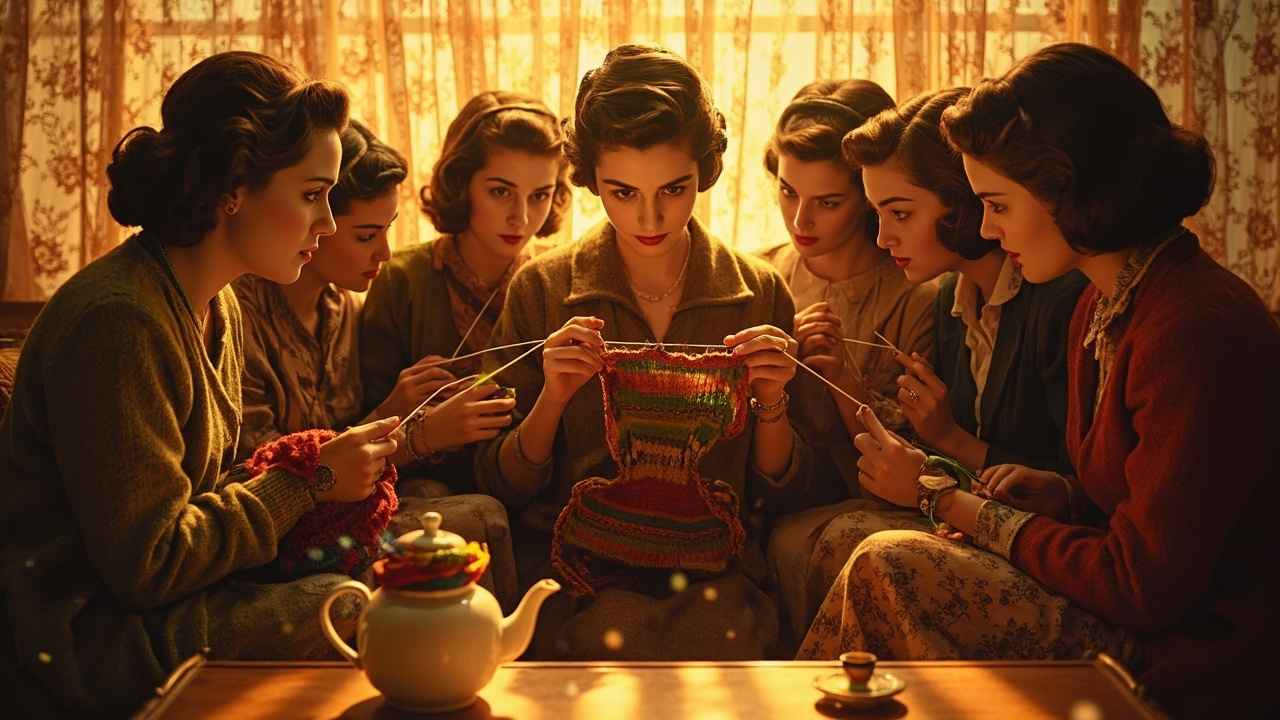
In the autumn of 1942, the women of Little Beckwith met every Tuesday in the back room of Mrs. Hartley’s teashop. The war had taken most of the village men, so the knitting circle was more important than ever. They made socks for soldiers, mittens for children, and—most importantly—tea cosies for the Women’s Institute sales. No one paid much attention to the cosies. They were just colourful, woolly things that kept the teapot warm.
That changed the day young Peggy Thompson joined the circle. Peggy had come from London to stay with her aunt after her parents were killed in the Blitz. She was quiet, with sharp eyes and a habit of biting her lip when she was thinking. The other women liked her, but they didn’t know what to make of her questions.
“Why do we always use the same pattern?” Peggy asked one Tuesday, holding up a half-finished cosy. “This one’s been in the village for years.”
Mrs. Hartley chuckled. “Tradition, dear. The ladies of Little Beckwith have been knitting that same design since before the Great War.”
Peggy frowned. “But look—” She pointed to the stitches. “These little bumps here. They’re not mistakes. They’re… different.”
The Hidden Stitches
The room fell silent. The women leaned in, their needles still. Peggy was right. The cosies had tiny, deliberate variations—extra stitches here, a dropped stitch there. They weren’t random at all.
“It’s a code,” Peggy whispered. “I’ve seen something like this before. In London, the resistance used patterns to send messages.”
Mrs. Hartley’s face went pale. “You don’t think…?”
Peggy nodded. “Someone’s been using our tea cosies to pass information. And if we’ve noticed, the wrong people might notice too.”
That night, Peggy and Mrs. Hartley stayed late in the teashop. They spread out every cosy they could find, comparing the stitches. By midnight, they had cracked the pattern. The cosies weren’t just keeping tea warm—they were carrying details of troop movements, supply routes, even the dates of secret missions.
The Spy in the Village
The next morning, Peggy and Mrs. Hartley went straight to the vicar. He was the only man left in Little Beckwith who could be trusted. After hearing their story, he stroked his chin and said, “There’s only one person who’s been here long enough to know the pattern. And she’s been acting strangely lately.”
The women’s hearts sank. It was Miss Whitmore, the sweet old lady who ran the post office. She had been sending parcels of tea cosies to “needy families” for years—parcels that always seemed to end up in the hands of German officers.
That afternoon, Peggy confronted Miss Whitmore in the post office. The old woman didn’t deny it. “I had to,” she said, her hands trembling. “My son is a prisoner of war. They promised to keep him safe if I helped.”
Peggy’s anger melted. She understood the impossible choices of war. But the cosies had to stop.
A New Pattern
That Tuesday, the knitting circle met as usual. But this time, they weren’t just making tea cosies. They were making a plan. Together, they designed a new pattern—one that looked the same but carried false information. They sent it out into the world, hoping it would mislead the enemy.
Miss Whitmore was sent away quietly, to live with a cousin in Scotland. The vicar made sure her son was treated fairly. And Peggy? She stayed in Little Beckwith long after the war ended. She never told anyone what really happened to the tea cosies. But sometimes, when the knitting circle met, she’d smile to herself and run her fingers over the stitches—stitches that had helped win the war.