Must Know Vocabulary
| Word | العربية | Deutsch | Español | Français | Italiano |
|---|---|---|---|---|---|
| حمامة | Taube | paloma | pigeon | piccione | |
| محب الحمام | Liebhaber | aficionado | éleveur amateur | allevatore | |
| حظيرة | Taubenhaus | palomar | poulailler | colombaia | |
| منزل متصل | Reihenhaus | terraza | terrasse | terrazza | |
| متألق | schillernd | iridiscente | iridescent | iridescente | |
| غريزة العودة للبيت | Heimfindevermögen | instinto de retorno | instinct de retour | istinto di ritorno | |
| متجعد | verwittert | averiado | duréci par les intempéries | consunto | |
| إقرار | Anerkennung | reconocimiento | reconnaissance | riconoscimento |
The Story
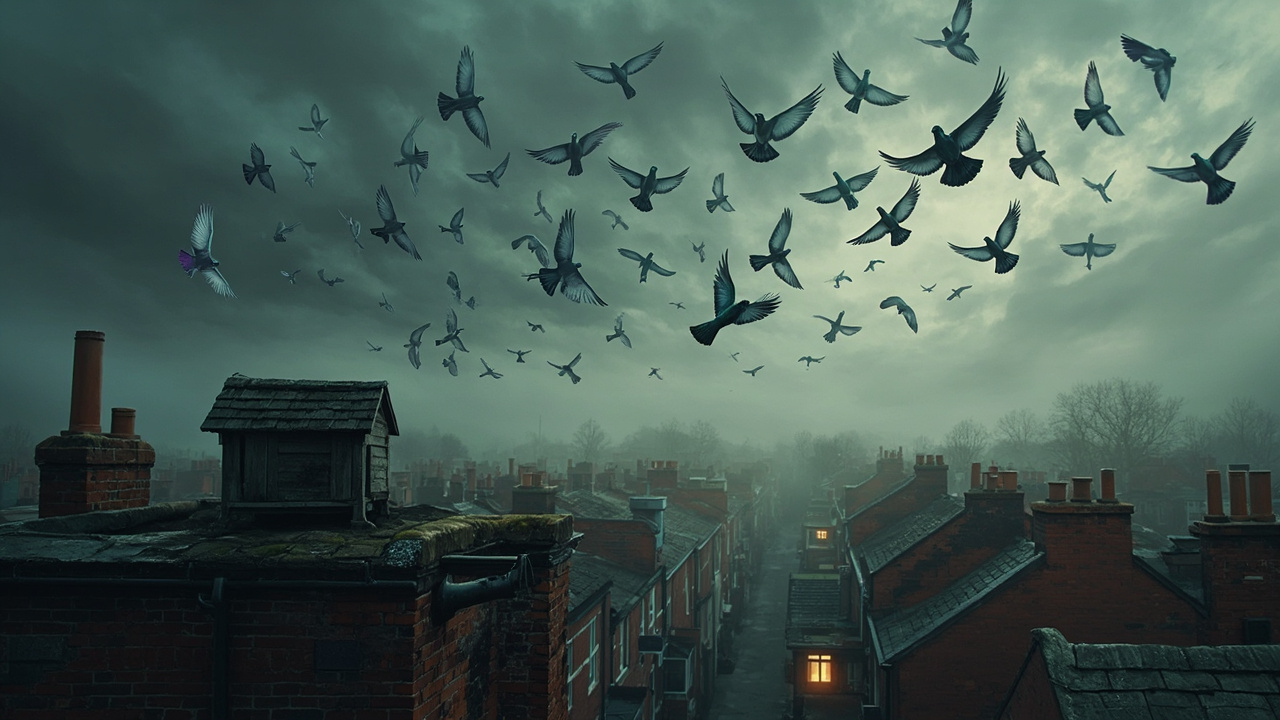
The first time Marcus noticed the birds, they were circling above the back-to-back terraces like feathered satellites. He stood at his bedroom window in Everton, watching them wheel and dive against Liverpool's grey October sky. They moved with such precision, such apparent joy, that he felt something loosen in his chest—a brief release from the weight of being sixteen and entirely alone in a house where his father worked night shifts and spoke to him mainly through silence.
The birds belonged to Mr. Coyle, who lived three doors down in a narrow house with a coal bunker and a coop on the roof that Marcus could see from his window. The old man was out there every morning and evening, rain or shine, tending to his birds with the careful attention of a man who had nothing else to fuss over. His face was weathered like old leather, and he wore the same patched cardigan year after year.
Marcus had never spoken to him properly. Their paths rarely crossed, and when they did, Mr. Coyle simply nodded—a small, private acknowledgment that seemed to say: I see you there, standing at your window. I know what it is to watch from a distance.
It was the pigeons that finally gave Marcus a reason to knock on the door.
"Beautiful birds," he said when Mr. Coyle answered, feeling foolish for stating the obvious. "I've been watching them fly. They're extraordinary."
The old man's eyes lit up. He invited Marcus in, showed him the coop, introduced him to his favourites—a blue chequer cock named Winston, a red hen called Dorothy. He spoke about racing routes, about the birds' homing instinct, about the trust required to send a pigeon fifty miles away and have it return.
"They find their way back to what they love," Mr. Coyle said, stroking Winston's iridescent neck. "That's what makes them remarkable."
Over the following weeks, Marcus became a regular visitor. He learned to clean the coop, to check the birds for signs of illness, to train the young ones. Mr. Coyle taught him patiently, and in the silences between instructions, Marcus sensed a vast well of unspoken sadness.
"Who do they race to?" Marcus asked one evening.
Mr. Coyle was quiet for a long moment. Then he crossed to the window and pointed across the rooftops to a distant window where a single light burned.
"That one. Third street over. Do you see it?"
Marcus could just make it out—a yellow glow in a third-floor window, half-hidden by chimney pots.
"That's where my Elsie lives," the old man said softly. "My daughter. We haven't spoken properly in twenty-three years. Not since her mother passed and I said things I shouldn't have. But I can still see her light from here, every evening. And she can see mine."
Marcus didn't understand. "But the birds—"
"I send one across every Sunday," Mr. Coyle continued. "With a note tied to its leg. Just a few words—how the birds are, what the weather's like, whether I've managed to make a decent cup of tea. And she sends one back. Her window opens, the bird lands on her sill, and she takes the message. Sometimes she waves. I wave back."
He turned to Marcus with eyes that glistened in the dim light of the coop.
"You think a father stops watching over his child just because they don't speak? I see her every night. I've watched her grow from a girl into a woman, watched her marry, watched her children be born. Those birds carry more love than you could possibly imagine, lad. They're the only bridge I have left."
Marcus thought of his own silent house, his father's back turned each morning as he left for work. He thought of all the things that went unsaid between people who shared the same walls.
"Will you teach me?" he asked. "To send messages that matter?"
Mr. Coyle smiled—a real smile, the first Marcus had ever seen from him.
"That's what the birds are for, son. That's what they've always been for."
That winter, Marcus began writing letters to his father—not the kind you post, but the kind you fold small and tie with thread. Each Sunday, when Winston flew out across the rooftops with his message, Marcus sent one too. And slowly, impossibly, his father's responses began to arrive—not on pigeon paper, but in words spoken aloud across the kitchen table, finally, after years of silence.