Must Know Vocabulary
| Word | العربية | Deutsch | Français | Русский |
|---|---|---|---|---|
| خيّاطة | Näherin | couturière | швея | |
| ميكروفيس | Mikrofiche | microfiche | микрофиша | |
| هرب للزواج سرياً | durchbrennen | s'enfuir pour se marier | сбежать накануне свадьбы | |
| نصب تذكاري | Gedenkstätte | mémorial | мемориал | |
| جسم الفستان العلوي | Oberteil des Kleides | corsage | лиф | |
| منارة | Leuchtturm | phare | маяк | |
| كوخ | Hütte | chaumière | хижина | |
| تطريز | Stickerei | broderie | вышивка | |
| ميناء | Hafen | port | гавань | |
| اختفى | verschwinden | disparaître | исчезнуть |
The Story
Clara had always believed that clothes carried memories. Every stain told a story, every repaired hem spoke of careful hands. But she had never expected to find a mystery hanging among the rail of 1960s shifts and hand-knitted cardigans.
The shop was called Remnants, a cramped treasure trove wedged between a fish-and-chip shop and a secondhand book dealer on the seafront of Pelham Bay. The elderly owner, Margaret, had hired Clara for the summer to help sort through a donation that had arrived from a house clearance in the nearby cliffs. Among the dusty boxes of costume jewellery and fur coats that smelled of mothballs, Clara discovered the wedding dress.
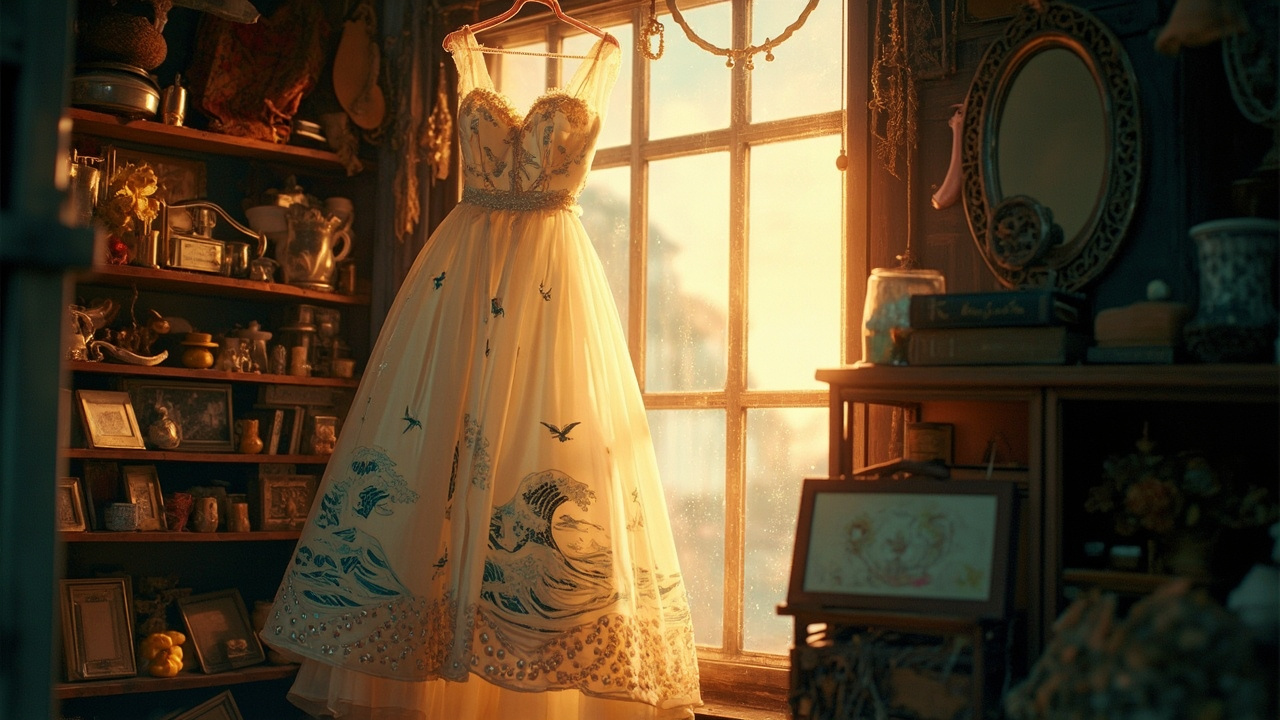
It was exquisite. Ivory silk with a sweetheart neckline, entirely hand-stitched with seed pearls arranged in patterns of waves and seabirds. The craftsmanship was extraordinary, the work of someone who had clearly trained for years. Yet the most remarkable feature was hidden inside the bodice, where someone had embroidered a tiny lighthouse surrounded by roses.
Margaret could not tell her much. The dress had come from a cottage in the lighthouse keeper's quarters that had stood empty for decades. The woman who had lived there, a certain Miss Eleanor Hartwell, had been a local artist and amateur seamstress who had simply vanished one summer in the 1950s. Nobody knew where she had gone. There had been no body, no note, no explanation. The mystery had faded from local memory like morning mist.
Clara became obsessed. She spent her evenings in the public library, reading through old newspaper archives on microfiche, tracing the fragments of Eleanor's life. She learned that Eleanor had been engaged to a local fisherman named Henry Whitmore, whose family had strongly opposed the match. She discovered that Eleanor's paintings, once highly regarded, had all vanished along with her. And she found a single wedding announcement dated June 1954, for a ceremony that had never taken place.
The breakthrough came when Clara met Catherine Whitmore, Henry's daughter, now an elderly woman living in a bungalow near the harbour. Catherine's eyes filled with tears when she saw the photograph of the dress.
"My father kept her photograph until the day he died," Catherine whispered. "He told me they had planned to elope. That Eleanor made her own wedding dress because she wanted to carry something of the sea with her. But the night before they were due to leave, she disappeared."
Catherine gave Clara Eleanor's final letters, which had been hidden in a tea tin for seventy years. The handwriting grew more desperate with each page. Eleanor had realised that Henry's family would never accept her, and she believed the only way to protect him was to disappear completely, to let him believe she had simply abandoned him rather than suffered the family's cruelty forever.
The final letter was the most heartbreaking. Eleanor wrote that she had made a terrible decision, one that would break Henry's heart but save his future. She would vanish without a trace, and he would eventually move on. She asked him to forget her, to live the life his family wanted. "I would rather be forgotten," she wrote, "than be the reason you lose everything."
Clara understood then that the wedding dress was never meant to be worn. It was a memorial, a promise, a grief made beautiful. Eleanor had stitched her heartbreak into every seam, knowing she would never walk down any aisle. The lighthouse on the bodice was a farewell, the sea birds a prayer for release.
That evening, Clara walked along the cliff path until she reached the old lighthouse cottage. The door was unlocked, as if someone had been waiting. Inside, in a room overlooking the grey expanse of ocean, she found it: a canvas covered with a white sheet. She lifted the cloth and gasped.
The painting showed a woman in a wedding dress standing on a cliff edge, the sea crashing below. Her face was turned away, but her hands were raised in a gesture of release, as if she were letting something precious fall into the waves. And in the corner, barely visible, was a signature: E.H., 1954.
Eleanor had not vanished. She had simply chosen to become invisible, to pour herself entirely into her art and leave the world behind. The wedding dress and the painting were the twin halves of the same story, a life frozen at the moment of decision.
Clara returned the dress to the shop and placed it in the window, where it caught the morning light. She wrote a small card to accompany it, telling the truth for the first time. "Made by Eleanor Hartwell, 1954. A labour of love never completed. A story never told. Now finally remembered."